


Refrigeration industry is divided into air-cooled and water-cooled chillers. Compressor types include screw chillers and scroll chillers. In terms of temperature control, there are low-temperature industrial chillers and ambient temperature chillers. The temperature of ambient chillers is generally controlled between 0℃ and 35℃. Low-temperature chillers typically maintain temperatures between 0℃ and -100℃.
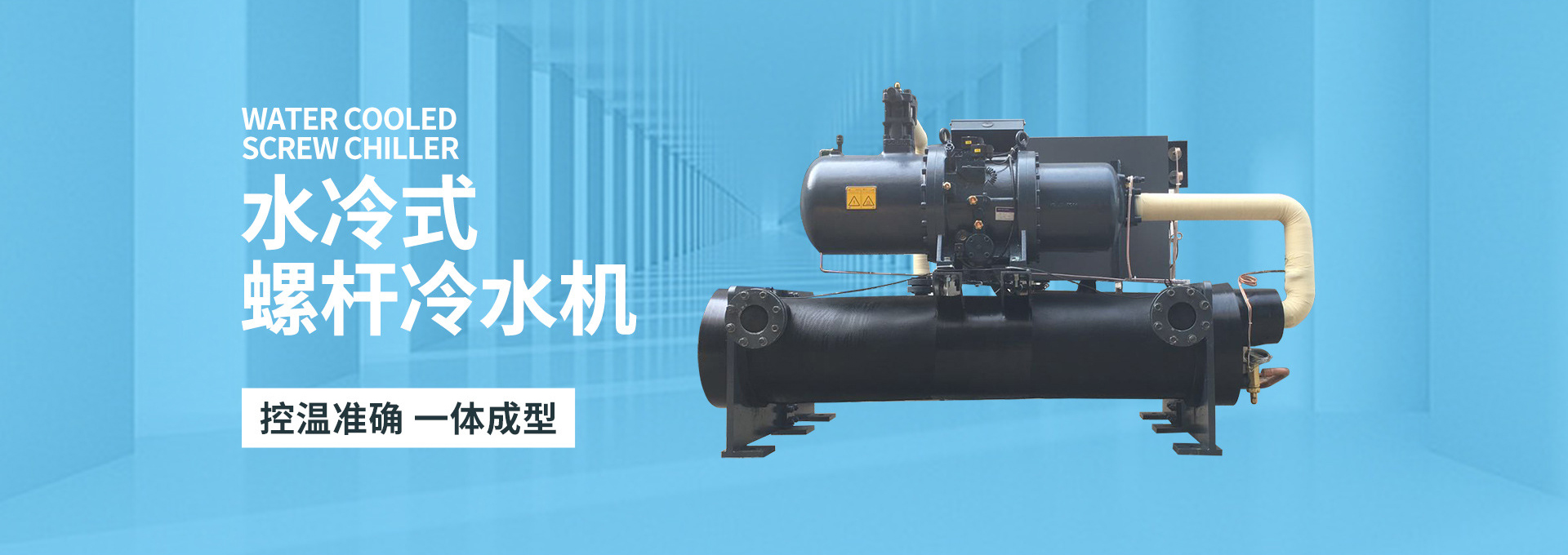
Water-cooled chillers
Chiller units, also known as chillers, refrigeration systems, and cooling equipment, are widely used across various industries, resulting in varied requirements. Their operation principle involves a multifunctional machine that removes liquid vapor through a refrigeration cycle that compresses or absorbs heat.
The refrigerator is composed of four main parts: the compressor, evaporator, condenser, and expansion valve, thereby achieving both refrigeration and heating effects.
Refrigeration units, commonly known as chillers, cold water chillers, ice water chillers, and various other types, are widely used across industries, leading to a multitude of names. As the chiller unit industry continues to evolve, an increasing number of people are turning their attention to this sector. Any choice becomes increasingly significant for humanity. In terms of product structure, we introduce competitive offerings such as "High Energy Efficiency Ratio Water-Cooled Screw Units," "Water Source Heat Pump Units," "Screw Heat Recovery Units," "High-Efficiency Heat Pump Units," and "Water Source Heat Pump Units." These are essentially multi-functional machines that remove liquid vapor through refrigeration cycles involving compression or heat absorption.
Air-cooled Water Chiller
The steam compression refrigeration unit consists of four main components: the steam compression refrigeration cycle, compressor, evaporator, condenser, and some measuring devices, to achieve different refrigerants. Absorption refrigeration units use water as the refrigerant, relying on the interaction between water and lithium bromide solution to achieve strong refrigeration effects. Refrigeration machines are commonly used in air conditioning units and industrial cooling. In air conditioning systems, chilled water is typically distributed to the heat exchangers or coils of air conditioning units or other types of terminal equipment to cool the respective spaces, and then the cooled water is redistributed back to the condenser for cooling. In industrial applications, chilled water or other liquid cooling pumps are used through process or laboratory equipment. Industrial chilled water machines are used to control the cooling of products, machinery, and plants in various industries. Depending on the type of refrigeration, chilled water units can be categorized as water-cooled and air-cooled. Technically, the energy efficiency ratio of water-cooled chilled water units is 300 to 500 kcal/h higher than that of air-cooled units; in terms of installation, water-cooled systems can only be used when integrated with cooling towers, while air-cooled systems can be moved without additional assistance.
