

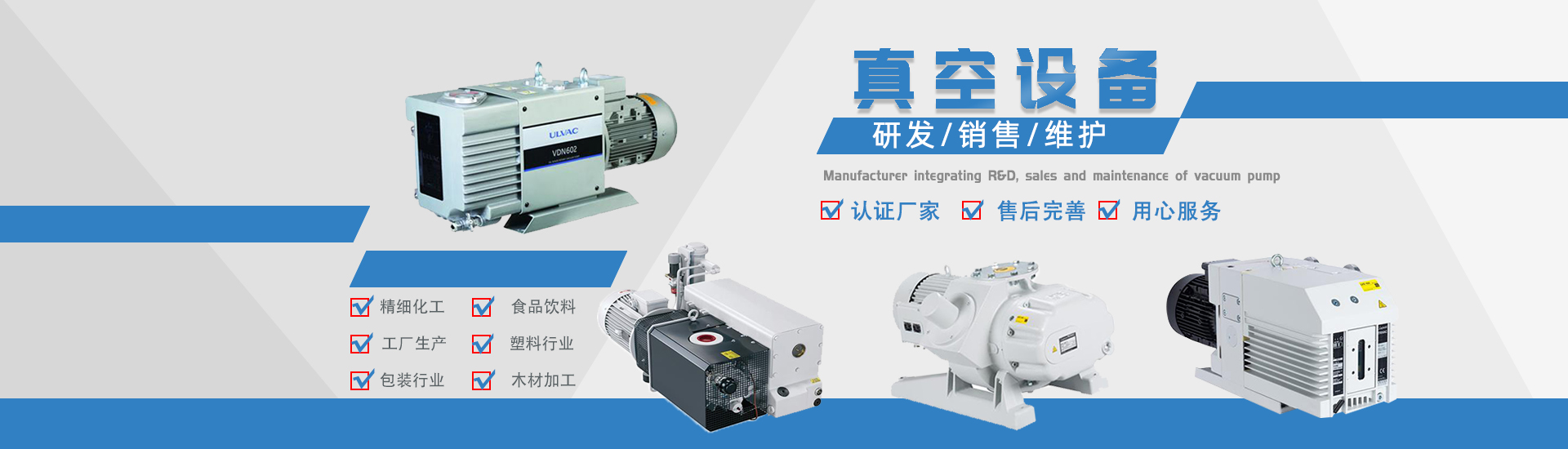


The Aifake Vacuum Pump refers to equipment or devices that use mechanical, physical, chemical, or physical-chemical methods to evacuate air from a container to achieve a vacuum state. In layman's terms, it is a device that improves, generates, and maintains a vacuum in a closed space through various methods. With the development of vacuum applications, its pumping speed ranges from a few tenths of a liter per second to tens or even hundreds of thousands of liters per second.
Next up, our editor will introduce the mechanical selection of iFAS vacuum pumps.
1. Does the oscillation during operation affect the process and the environment? If the process does not allow it, select a pump without oscillation or adopt anti-oscillation measures.
2. Understand the composition of the gas being extracted, including whether it contains condensable vapor, particles of dust, and whether it is corrosive. When selecting, knowledge of the gas composition is necessary to choose the appropriate pump for the extracted gas. If the gas contains vapor, particles, or corrosive substances, it should be considered to install auxiliary equipment such as condensers and dust collectors on the pump's inlet piping.
Under its working pressure, it should be capable of exhausting all the gas generated during the process of the vacuum equipment.
4. Proper Combination: Due to the selective evacuation of this product, it may not be sufficient to meet the evacuation requirements with a single pump. In such cases, a combination of several pumps is necessary to complement each other and achieve satisfactory evacuation. For instance, a titanium sublimation pump has a high evacuation rate for hydrogen but cannot evacuate helium. In contrast, a triode sputter ion pump (or a diode asymmetric cathode sputter ion pump) has a certain evacuation rate for argon. When combined, these two types of pumps can achieve a better vacuum level in the vacuum equipment. Additionally, some products cannot operate under atmospheric pressure and require preliminary vacuum, while others have an outlet pressure below atmospheric pressure, necessitating a primary pump. Therefore, a combination of pumps is essential for these applications.
5. Vacuum Equipment's Requirements for Oil Contamination. If the equipment strictly requires oil-free operation, various oil-free pumps should be selected, such as: water ring pumps, molecular sieve adsorption pumps, sputter ion pumps, and low-temperature pumps, etc. If the requirement is not strict, oil pumps can be chosen along with some oil-contamination prevention methods, such as adding cold traps, baffles, and oil traps, which can also meet the requirement for clean vacuum.
