



Phoenix Net, China Net, and China Accounting Net among mainstream media outlets widely report: Fang Tian Xu Ze Fu: Establishing a Mold Enterprise Operation System Centered on Financial Management
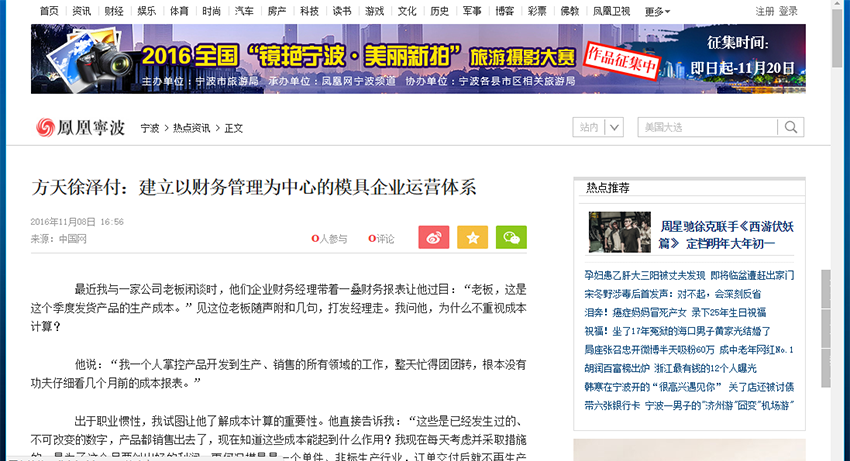
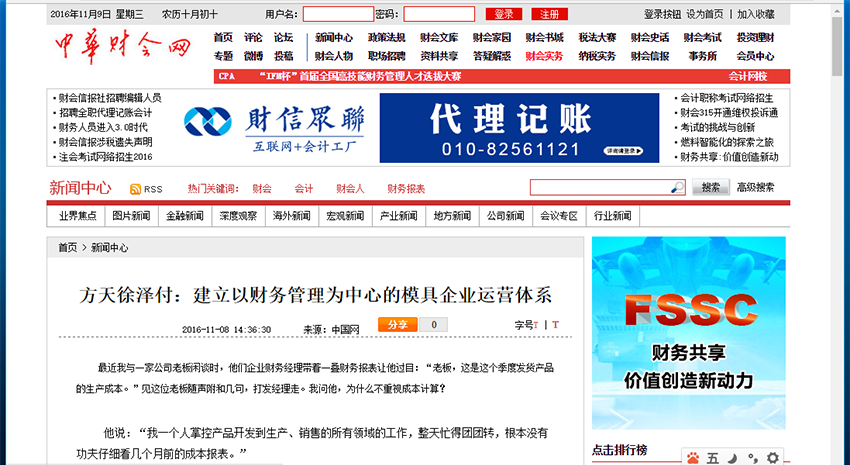
What did General Manager of Fangtian Software, Mr. Xu Zefu, have to say?
While chatting with a company owner, their financial manager brought a stack of financial statements for him to review: "Boss, these are the production costs of the products shipped this quarter." Seeing the boss nod in agreement a few times, he sent the manager away. I asked him why he didn't pay attention to cost calculations?
He said, "I manage all aspects of product development, production, and sales all by myself, and I'm so busy that I'm constantly swamped. I don't have the time to meticulously review the cost reports from a few months ago."
Out of professional habit, I tried to explain the importance of cost calculation to him. He told me directly, "These are past, unchangeable numbers. The products have been sold, so what's the point of knowing these costs now? What I'm considering and taking action on every day is to achieve good profits this month. Moreover, mold-making is a one-off, non-standard production industry, and production stops after the order is delivered. These cost data are not very valuable for new product orders either."
Is it that most people understand finance as follows: "Accountants record transactions based on the aggregated numbers from various units, prepare financial statements, and report the financial status and business performance of the company to relevant parties within the enterprise?"
Recalling a recent management summit I attended, where I exchanged ideas with software peers about development management systems. They shared several viewpoints: "Financial work is the responsibility of the accounting department, meant for submitting financial reports to tax authorities." "It's a post-event statistic that doesn't provide much value to the company." "If we were to integrate the financial system with the mold logistics production system like Fangtian Software, it would make the system more complex." "We only focus on mold production management systems and can simply transfer the required data to the financial systems of Ufida or Kingdee."...
Certainly, we may be the company that has developed an integrated management system for mold enterprises in the mold informationization field up to now. With a development direction based on "logistics production" and "financial management as the core," we have indeed encountered numerous integration challenges and substantial R&D investments during the development process. However, why do we stubbornly believe that resolving the production difficulties of mold enterprises necessitates improving the level of enterprise financial management? This is by no means an exaggeration.
There is a significant misunderstanding or one-sided understanding among many business owners about the role of corporate accounting. Corporate accounting is divided into "financial accounting" and "management accounting." What we usually consider as "finance" only falls under the scope of "financial accounting."
The Difference Between Financial Accounting and Management Accounting
One, Different Service Targets
The focus of financial accounting lies in recording books of accounts based on daily business records, regularly preparing relevant financial statements, and reporting the company's financial status and operating results to external groups and individuals with economic interests. Its primary goal is to serve external stakeholders, and financial accounting is also known as "external accounting."
Management accounting, as an internal management system of corporate accounting, primarily focuses on serving the internal management of enterprises. Unrestricted and unbound by the "Generally Accepted Accounting Principles" of financial accounting, it analyzes and studies specific issues encountered in enterprise management and operation, providing the necessary information and data for predictive decision-making and control assessment to all levels of internal management personnel. Management accounting is also referred to as "internal accounting."
The basic functions differ.
The role of financial accounting is to provide accounting information services to the external stakeholders of the enterprise. The methods and procedures are fixed, employing unified financial accounting systems and standards, executing a fixed accounting cycle process. It primarily serves shareholders, creditors, and debtors, fulfilling the function of reflecting and reporting on the business performance and financial condition, which is categorized as "reporting-type accounting."
Management accounting methods are flexible and diverse, with no fixed procedures to follow. Companies can design the process of management accounting based on their own specific circumstances, obtaining data from the perspective of business management, setting work objectives for responsible entities, and controlling the behavior of such entities. Management accounting focuses more on the management process. It considers the psychological and behavioral impact of results on various internal personnel, works towards achieving business objectives, and provides guidance for the company. It primarily fulfills the functions of forecasting, decision-making, planning, control, and assessment, categorizing it as "operational accounting."
III. Varying Timeliness of Information
The primary function of financial accounting is to reflect the past, as evidenced by its emphasis on the principle of objectivity and adherence to the historical cost principle. It can only reflect actual economic activities that have already occurred in the past. Therefore, financial accounting essentially falls under the category of "sunk costs."
Management accounting information spans the three tenses of past, present, and future, serving not only to analyze the past but also to utilize financial accounting data for forecasting and planning the future, while also controlling the present. Management accounting prioritizes future-oriented functions, analyzing the past to determine the company's current business status, thereby better guiding future decisions. Therefore, management accounting is essentially a "living account."
IV. Different Principles Followed
Financial accounting work must strictly adhere to the "Enterprise Accounting Standards" and the unified accounting system of the industry to ensure the consistency of financial information reports over time and comparability in space. When providing information to the public, these principles and requirements must include systematicity, continuity, comprehensiveness, authenticity, accuracy, and legality, which can be regarded as the implementation of "national law."
Management accountants are not fully restricted and strictly bound by the "Enterprise Accounting Standards" and the unified accounting system of the industry. They can flexibly apply modern management theories such as predictive science, cybernetics, information theory, and decision-making principles as guidance in their work. When providing quantitative information to internal management departments, they do not insist on precise calculations or information without legal efficacy. Most often, their information载体 is internal reports without a unified format, fixed reporting dates, and not publicly disclosed. Additionally, management accounting information sometimes employs methods different from financial accounting to record, analyze, and predict the operating conditions of the enterprise, which can be interpreted as the "house rules" of the company.
V. Different Staff Requirements
The finance and accounting department requires specialized accounting professionals with a solid foundation in accounting knowledge, strong operational skills, and meticulous work ethic to handle the task of "bookkeeping."
The methods of management accounting are flexible and diverse, lacking a fixed work procedure to follow. The system is lacking in unity and standardization, requiring consideration of numerous factors and involving complex content. This necessitates that personnel engaged in this field must possess a broad knowledge base, extensive industry experience, and decisive adaptability. They should also have strong analytical and problem-solving skills. Such talent undertakes the role of "auditing."
"Financial accounting and management accounting are two fundamental financial functions of a mature management system."
"Can a system without a financial module truly be called an ERP? A standalone MES system, while enhancing local management within a company, also creates information silos."
If a business management system lacks a financial module, or if data generated from a production management system is exported to another financial management software, it can only be considered as providing bookkeeping for financial accounting, not a full-process operation analysis and control for management accounting. Then, is it feasible to separately implement the functions of management accounting? No, it is not! Many of the data required for management accounting come from the financial accounting system, which is a deep processing and reuse of financial accounting information, and thus, it is affected by the quality of financial accounting work.
"I believe the challenges and difficulties in developing an enterprise management system for mold software company are: to create a financial system that combines both financial accounting and management accounting functions, and to achieve seamless integration with the logistics and production systems."
At the management summit, the moderator asked me to sum up my remarks: "Management accounting is the current data, financial accounting is the past data. Although they have many differences, they are interdependent, mutually constrained, and complementary to each other. Their goal is the same: to serve the management and business objectives of enterprises, together forming an organic whole of the modern enterprise accounting system."
The core of a company's business operations is the movement of capital, with the purpose of business operations being to achieve capital appreciation. Every aspect of a company's production and management, as well as each link in the chain, relies on financial reflection and regulation, and cannot be separated from the management of operational capital. Therefore, the quality of financial work directly impacts the company's operational profitability. As modern enterprises advance in the process of deepening management model development, they need to establish a comprehensive management system and operational mechanism centered around finance.
The financial supervision of a company, along with real-time cost accounting, serves as the nerve center of internal management. Its core position in corporate management is a practical necessity. In light of this, authors emphasize that business owners must prioritize financial management efforts. The financial management of a company should commence with management accounting, implement budget control, and ensure that each order's costs are manageable and profits are anticipated. Similarly, financial personnel with expertise in both areas are more likely to be trusted and valued by the company.
In summary, we enhance the modern enterprise management operation mechanism centered around financial management, emphasizing the comprehensive control and management of the pre-event, event, and post-event processes. This ensures that financial management is integrated throughout the entire production and operation of the enterprise. By implementing a modern enterprise management system centered around financial management, we boost the company's competitiveness, enhance its ability to withstand market risks, expand profitability, and maximize wealth. This is also the original intention behind our commitment to integrating financial, logistics, and production into a comprehensive management system over the past 20 years in the mold enterprise informationization field.
Copyright Notice: Your sharing is our motivation to maintain originality. For redistribution, please note: This article was first published on the "Mold Master" WeChat official account.
