
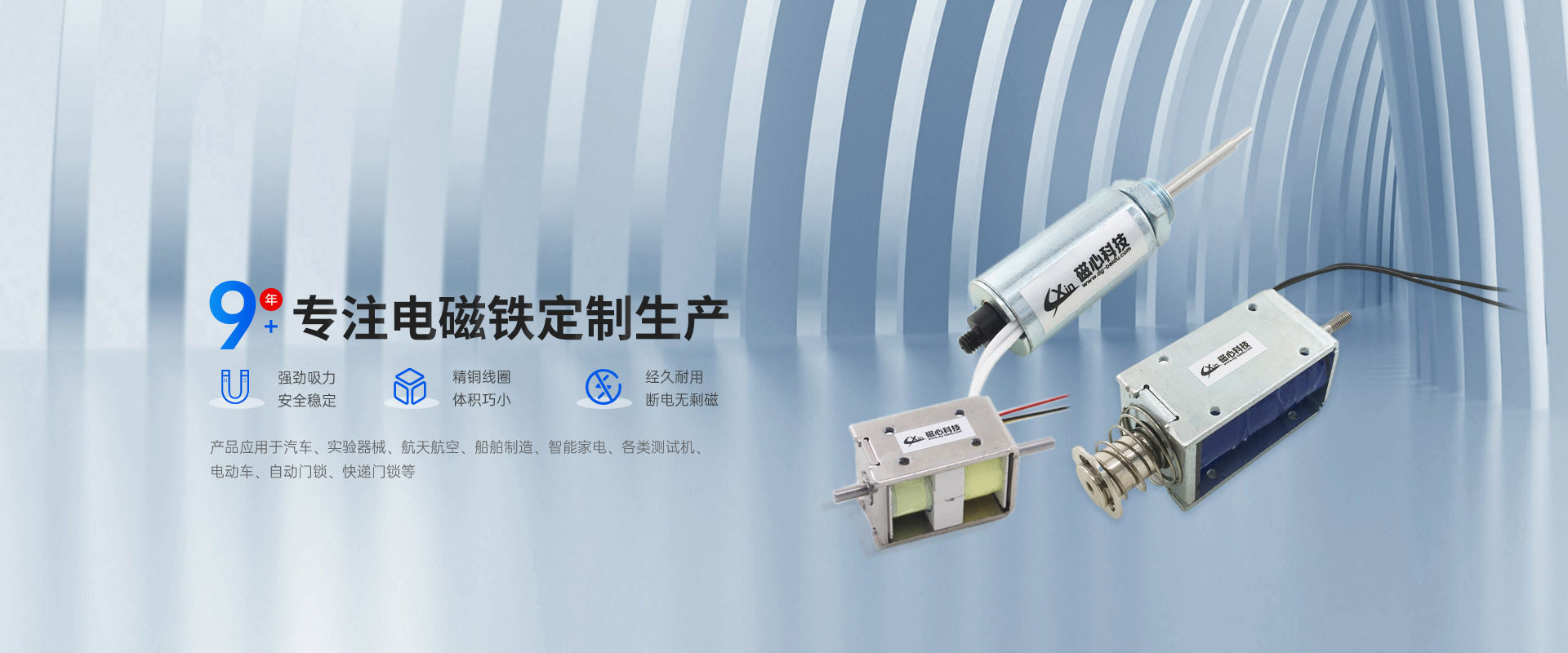



Linear electromagnets move loads toward the core when powered, in this sense, electromagnets are a pulling device. However, if a plunger is installed on the slide rod section and extends through a hole deep into the core, it will move away from the core as it is drawn in, pushing the external load a specified distance. Therefore, electromagnets can provide force and tension.
Magnetic Field Direction Determination: According to Ampère's right-hand rule, the direction of the magnetic field generated by the current loop can be determined using the right-hand rule. The method involves bending the four fingers outside the thumb towards the palm to represent the direction of the current; the direction in which the thumb points is the north pole of the magnetic field.
Electromagnet Terminology
Power: The thrust or pull, as well as the attractive force, generated by the coil of an electromagnet when an electric current passes through it.
2. Trip Distance: The distance from the starting point to the stopping position of the zip line.
3. Retention Force: The pulling or pushing force at the end of the slide rod's travel.
4. Work Cycle: The ratio of the sum of on-time and off-time to the total on-time.
5. Continuous Power Supply: 100 operating cycles
6. Interval Work Cycle: Work cycles less than 100 have a long allowable power-on time to prevent excessive temperature.
7. Retained Magnetism: The magnetic force remaining in an electromagnet after it is de-energized.
8. Coil Operating Temperature: The high operating temperature of the coil should not adversely affect the material's structure and function. This temperature is the sum of the ambient temperature and the coil's temperature rise, typically around 130 degrees Celsius.
9. Turns per ampere: the product of current and the number of turns in the coil.
10 Response Time: The time it takes for the slider to engage after being powered on.
