



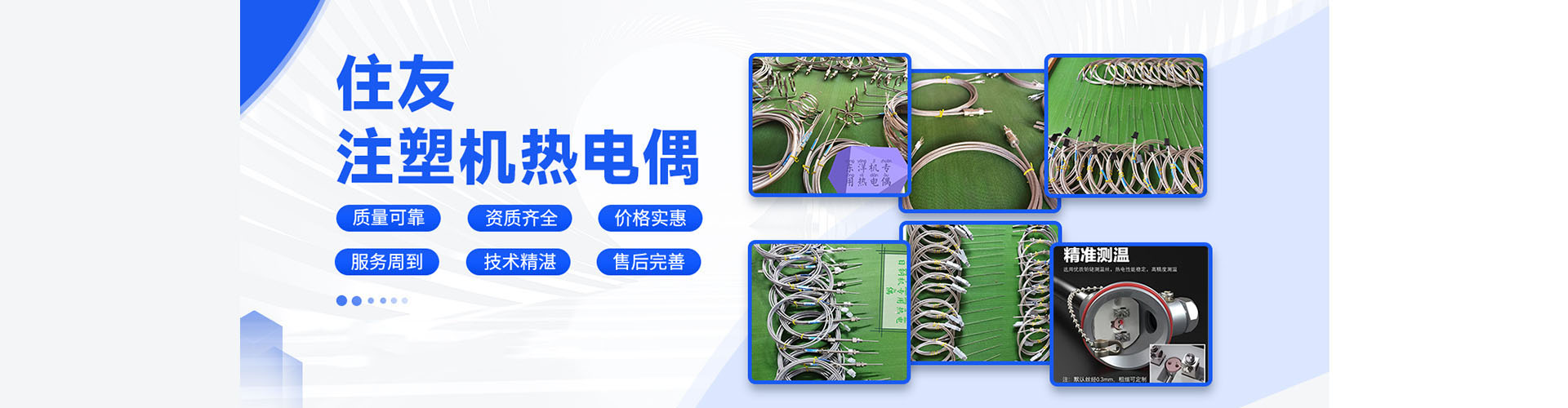


The thermocouple temperature sensing line for hot runner systems is a crucial temperature sensor wire that plays a key role in hot runner systems. It is mainly used to monitor the temperature within hot runner molds, ensuring that molten plastic maintains a constant temperature during flow, thereby enhancing the quality and performance of injection molded products. Below is a detailed analysis of the thermocouple temperature sensing line for hot runner systems:
I. Definition and Composition
Definition: A thermal conductive thermocouple sensor line is a temperature sensor wire that operates based on the principle of the thermoelectric effect. It measures the temperature within the hot runner mold and converts the temperature signal into an electrical signal, thereby achieving temperature control.
Composed of wires made from two different materials, these materials form a circuit at the contact ends (referred to as the "hot end"). When there is a temperature difference between the hot end and the contact end of the measured temperature environment (known as the "cold end"), a thermoelectric potential is generated in the circuit, i.e., the thermoelectric effect. This thermoelectric effect is proportional to the temperature difference, so the temperature can be inferred by measuring the thermoelectric potential.
Section II: Working Principle
Thermoelectric Effect: The working principle of the thermocouple temperature sensing line in hot runner systems is based on the thermoelectric effect. This effect occurs when two different conductive materials form a closed loop and there is a temperature gradient between the two ends, generating an electromotive force within the loop, which is known as the thermoelectric potential.
Signal Conversion: By measuring the thermoelectric potential in the circuit, it can be converted into an electrical signal. After being processed through an amplification circuit, the signal is displayed using LEDs or pointers, thereby enabling real-time temperature monitoring.
III. Types and Features
Type: There are various types of thermocouple temperature sensing lines for hot runner systems, with the common ones being standard J and K types. The J-type thermocouple is made of iron-copper nickel (Constantan), with a general temperature range of -40℃ to 750℃; the K-type thermocouple is made of nickel-chromium-nickel silicon, with a temperature range up to -40℃ to 1200℃.
Features:
Accuracy: Capable of accurately measuring temperature in both high and low-temperature environments.
Stability: Operates effectively in intense electromagnetic fields and radiation environments, and is resistant to pressure and vibration.
Practicality: Simple structure, easy to install and maintain, and relatively low cost.
IV. Applications and Importance
Application: Specialized thermocouple temperature sensing lines for hot runner systems are widely used in the injection molding process, monitoring mold temperatures to ensure constant temperature of molten plastic during flow.
Importance: In the injection molding process, unstable temperatures can lead to plastic flow issues, affecting product quality and performance. The thermal channel thermocouple temperature sensing line monitors mold temperatures in real-time and feeds back temperature signals to the control system, adjusting the heater temperature to achieve consistent temperature control and enhance molding quality.
