

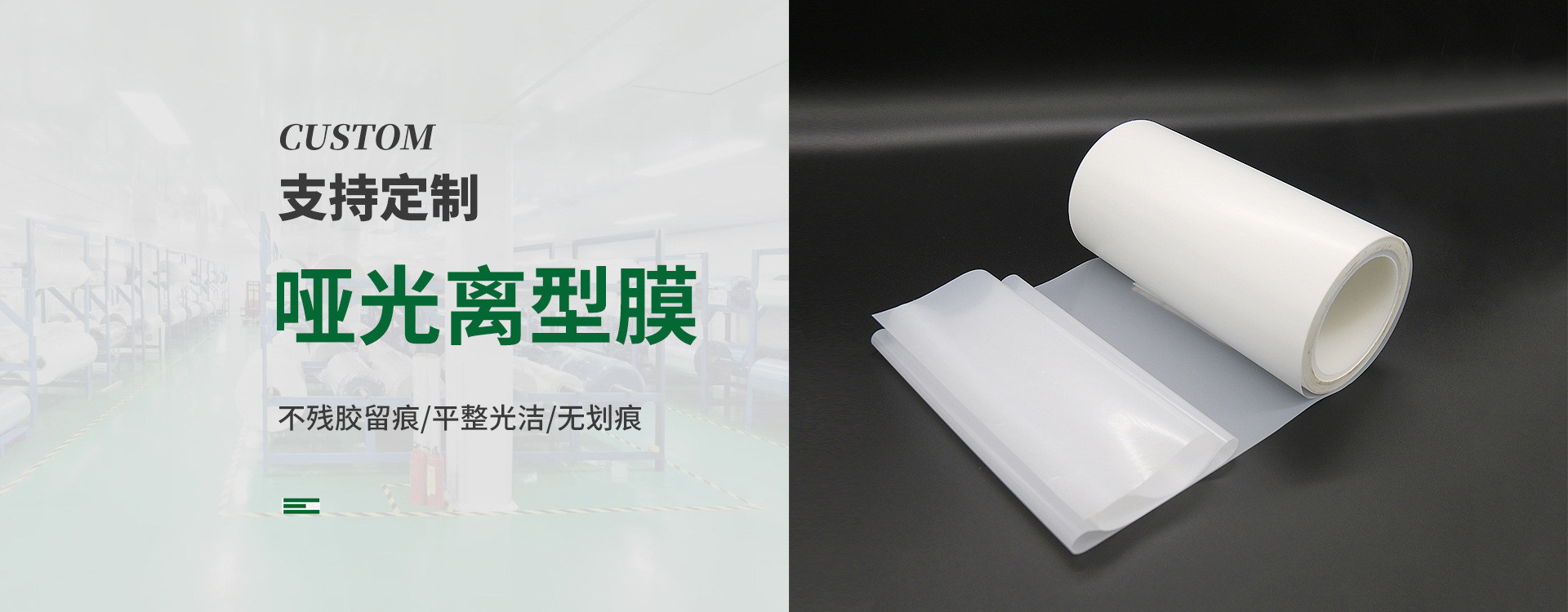


Separation film refers to a type of film with different appearances. Under limited conditions, separation film has no adhesiveness or only slight adhesiveness when in contact with specific materials. Typically, to enhance the release force of plastic films, they are treated with plasma, fluorinated, or coated with silicon release agents on the surface of film materials such as PET, PE, PP, OPP, and so on.
Our organic pressure-sensitive adhesives exhibit exceptionally light and stable peel forces. According to the varying requirements for peel force of different isolation films, the adhesiveness of the isolated goods differs, and the peel force is correspondingly adjusted to achieve an extremely light and stable peel force during stripping.
PET release film is a commonly used material for thermal transfer printing, with the base material being PET, also known as silicone oil film. Standard thickness ranges from 12um to 100um. The cold and hot tear resistance, as well as the matte adhesion and bonding properties, can be categorized into cold and hot tear resistance and matte surface.
Why does the release film lose silicone oil? Generally, there are several explanations:
Overheating when using the release film
Improper storage.
3. Inconsistent coating.
Separation film is a commonly used material in thermal transfer printing, with the base material being PET. It is also known as silicone oil film due to its silicone coating. The standard thickness ranges from 25um to 150um. The cold and hot tear resistance, as well as the glossy and matte surfaces, can be treated for anti-static and anti-scratch properties. The product boasts excellent adhesion and sealing characteristics.
