
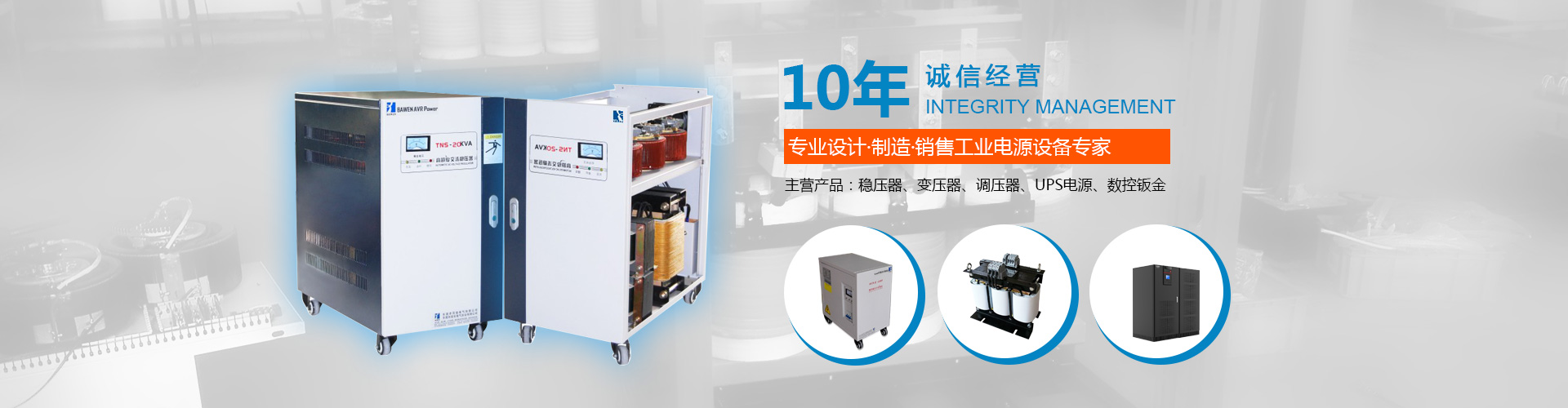



In fact, since the invention of the light bulb by Edison, marking the dawn of the era of enlightenment for humanity, the application and use of voltage energy have gradually become an indispensable type of energy in everyday life. As the times have progressed and technology continues to innovate, the consumption of energy from homes to cities, from cities to societies, and even to the world, has evolved from moderate usage to excessive consumption and waste. Therefore, to effectively control the use of voltage energy, individuals have invented voltage regulators that can accurately control the input and output values of energy, reducing over-consumption and waste. So, what are the characteristic advantages of a high-performance voltage regulator device?
If we were to categorize voltage regulators, we could distinguish between autotransformer and compensating types. The autotransformer type features specifications that are entirely opposite to those of compensating voltage regulators, regardless of capacity or output voltage. In terms of non-compensating voltage regulators, the single-phase capacity generally ranges from 0.5 kVA to 3 kVA, while the three-phase capacity is limited to less than 9 kVA.
Compared to the single-phase capacity (5 kilovolt-amps and above) and three-phase capacity (15 kilovolt-amps and above) of compensating voltage regulators, the voltage capacity of autotransformer-based voltage stabilizers is significantly smaller. Consequently, autotransformer stabilizers, also known as non-compensating voltage regulators, are typically used in residential settings with lower energy consumption. Additionally, the operating system of compensating voltage regulators includes a compensating transformer, which is absent in autotransformer stabilizers, and does not suffer from issues with 110-volt output.
The characteristic advantages of voltage stabilization equipment lie in its ability to control the input and output values of voltage energy in residential or production areas. It reduces issues of excessive energy consumption and waste while ensuring the safe use of household appliances and machinery by consumers and production personnel.
