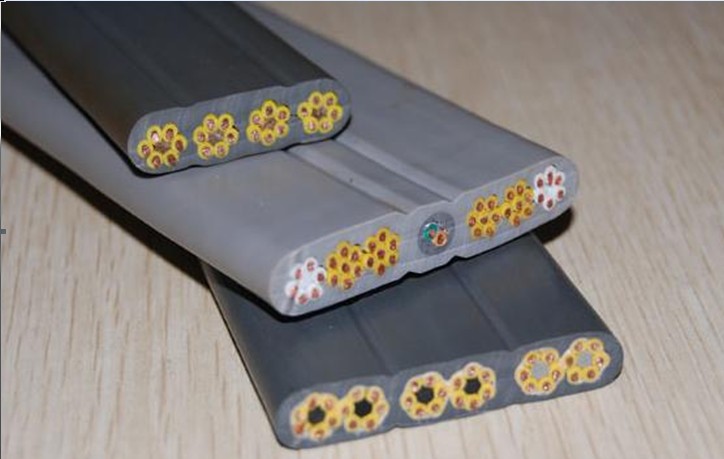

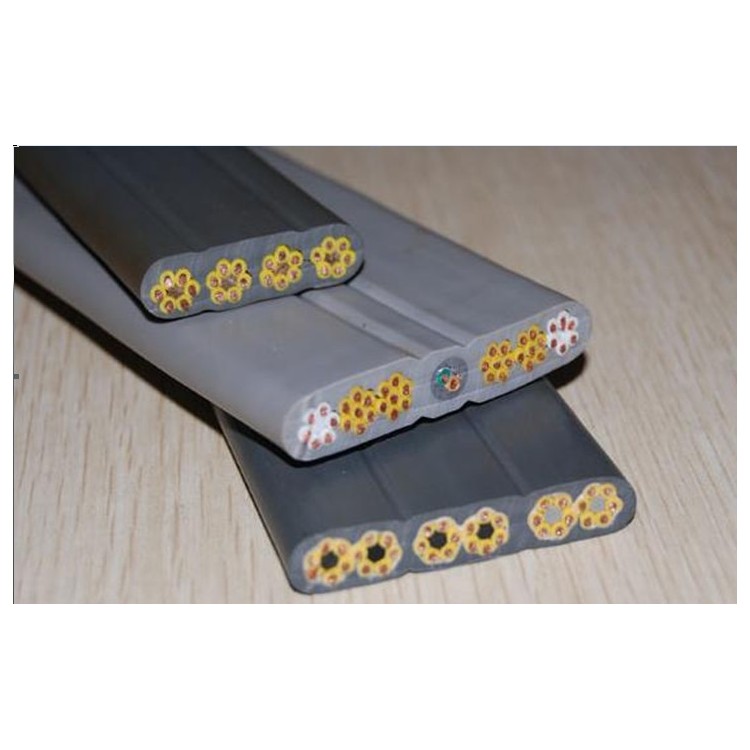
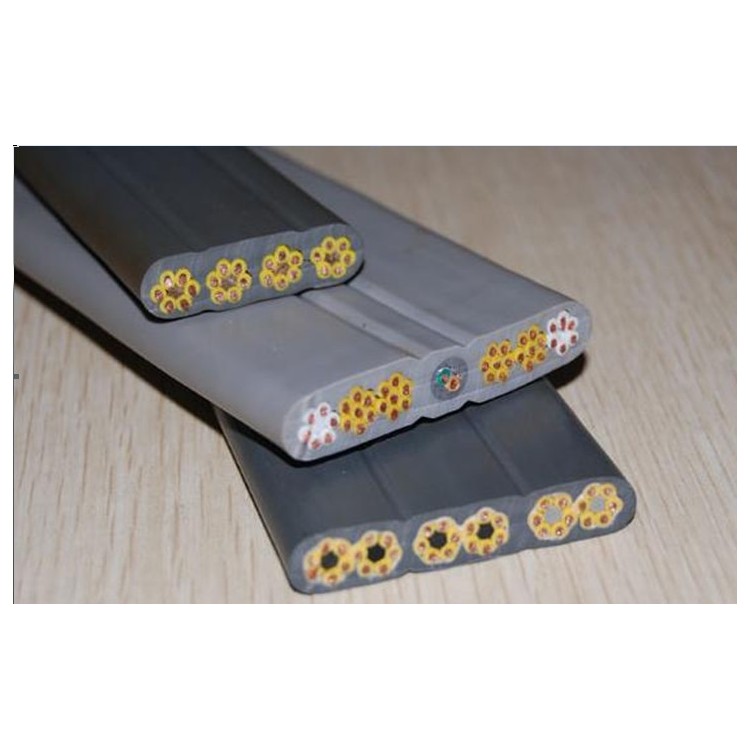
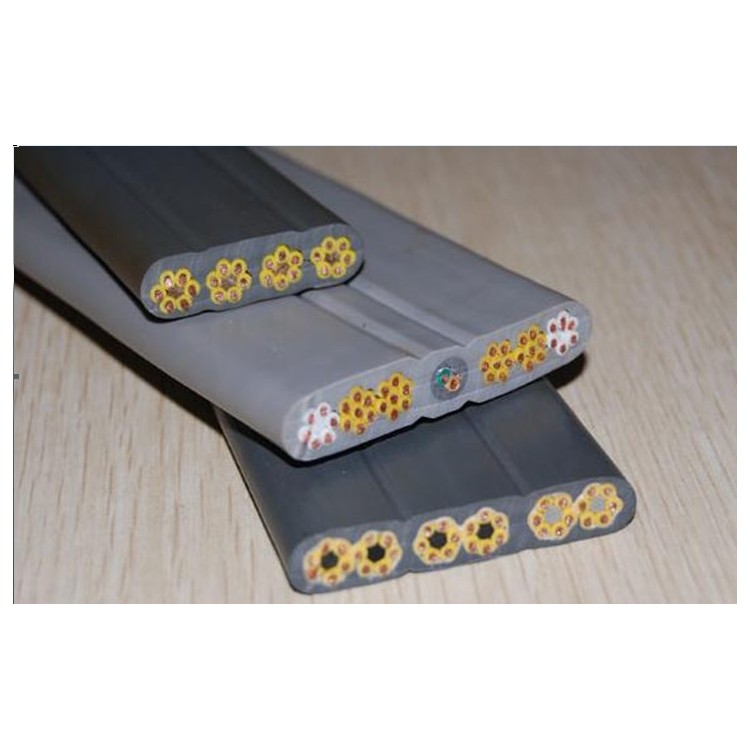
Nitrile cold-resistant flat cables feature cold resistance, softness, wear resistance, and oil resistance, suitable for power transmission lines and control, lighting, and communication lines for mobile electrical equipment such as trolleys and conveyors with special requirements for cold resistance and oil resistance at AC rated voltages of 0.6/1KV and below. This product is widely used in industries such as metallurgy, power, shipping, and ports. The conducting cores are designed with a soft structure to ensure excellent flexibility of the cable.
Detailed Information on Nitrile Flat Cables
I. Overview:
Nitrile flat cables feature cold resistance, flexibility, wear resistance, and oil resistance, suitable for power transmission lines and control, lighting, and communication lines for mobile electrical equipment such as trolleys, conveyors, and transmission machinery with special requirements for cold resistance and oil resistance at alternating rated voltages of 0.6/1KV and below. This product has been widely used in industries such as metallurgy, power, shipping, and ports. The conducting cores are made with a soft structure to ensure good flexibility of the cable.
Insulation and protective layer materials use polyethylene, enhancing the cable's softness and its resistance to corrosion and cold.
Color-coded insulated wire cores for easy laying and installation.
Available for customer requirements, additional wire ropes or other load-bearing elements can be added to both sides of the cable core (YVFB-G model).
II. Features:
Especially soft, highly resistant to bending, smooth in movement, without twists.
Indoor and outdoor, adaptable to temperature, resistant to acids, alkalis, oils, and salts.
Material selection is stringent, craftsmanship exquisite, performance reliable, and lifespan long-lasting.
Section 3: Specifications and Models:
| Model | Name | Rated Voltage | Primary Applications | Tensile strength less than N |
| YFFB | Nitrile Chloroprene Insulation and SheathFlat Soft Cable | 450/750V | Primarily used for cranes, conveyors, medium to small excavators, and loading/unloading machines. | 2000/100m |
| YFFB-F | Nitrile Chloroprene Insulated and Sheathed Composite Flat Flexible Cable | 450/750V | Mobile machinery primarily used for large and medium-sized field operations, such as cranes, excavators, and material handling machines. | |
| YEFPB | Butyl rubber insulated nitrile polyvinyl chloride insulated and sheathed shielded flat flexible cable | 3.6/6KV | ||
| YFFB-L | Nitrile Chloroprene Insulated and Sheathed Conductors with Tensile (Steel Wire Reinforced) Flat Flexible Cable | 300/500V | Primarily used for elevators and other moving machinery in low-rise buildings.Control Cable | |
| YFFB-JL | Nitrile Chloroprene Insulated and Sheathed Twisted Conductor (Steel Reinforced, Flexible) Flat Cable | 300/500V | Control cables primarily used for high-rise building elevators | |
| YFFB-FJL | Nitrile Chloroprene insulated and sheathed stranded cables with steel wire reinforcement for traction, control, and communication (flat, flexible, mobile) | 300/500V | Primarily used for elevator control cables |
| Code | Code Description |
| Y | Mobile |
| VF (Flat type uses "FF") | Nitrile Cable Series |
| L | Cheng La (with steel wire) |
| B | Flat CableFlat Cable |
| F | Composite |
| P | Copper braided shielding |
| R | Multi-strand braided conductor |
Nitrile Chloroprene Insulated and Sheathed Flat Type Flexible Cables
YVFB (Standard Type)
YVFB-G (Enhanced Type)
YVFBP (Shielded)
YVFB-TH (Rugged Type)
Model | Name |
YVFB | Nitrile insulated and sheathed flat flexible cables |
YVFBP | Nitrile insulated and sheathed copper braid shielded flat flexible cables |
YVFB-G | Nitrile insulated and sheathed steel wire reinforced mobile flat flexible cable |
Model No. | Rated Voltage (V) | Core Count | Nominal Cross Section mm² |
YVFB | 450/750 V | 2-28 | 0.75-6 |
YVFBP | 450/750 V | 2-10 | 2.5-150 |
YVFB-G | 450/750 V | 2-28 | 0.75-150 |
4. Main Product Performance (Compliant with Q/ZB01-2002)
Cable rated working voltage: AC 450/750V and below.
The cable operates in a temperature range of -40℃ to 70℃.
The bend radius of the cable is 10 times smaller than the length of the cable's shorter side.
The maximum DC resistance (Romax) of each cross-section conductor at 20°C is as follows: (Complies with GB/T3956-1997)
Section mm2 | 0.75 | 1 | 1.5 | 2.5 | 4 | 6 | 10 | 16 | 25 | 35 | 50 | 70 | 95 | 120 | 150 | 185 | 240 |
Romax | 26.0 | 19.5 | 13.3 | 7.98 | 4.95 | 3.30 | 1.91 | 1.21 | 0.780 | 0.551 | 0.386 | 0.272 | 0.206 | 0.161 | 0.129 | 0.106 | 0.0801 |
The minimum insulation resistance (Rimin) of the insulated cores at each cross-section at 70°C is as follows: (Complies with GB5023-1997)
Section mm2 | 0.75 | 1 | 1.5 | 2.5 | 4 | 6 | 10 | 16 | 25 | 35 | 50 | 70~95 | 120~185 | 240 |
Romax(MΩ.m) | 11 | 10 | 10 | 9 | 7 | 6 | 5.6 | 4.6 | 4.4 | 3.8 | 3.7 | 3.2 | 2.9 | 2.8 |
The finished cable cores withstand AC 50Hz, 2.5kV test voltage without breakdown for 5 minutes.
Insulation and sheath with lower tensile strength of 10N/mm², lower elongation at break of 150%, no cracks in winding at -40°C low temperature, and lower elongation during stretching at -40°C of 20%.
Flow correction coefficient (Ki) for different environments and temperatures
℃ | 10 | 15 | 20 | 25 | 30 | 35 | 40 |
Ki | 1.41 | 1.35 | 1.29 | 1.22 | 1.15 | 1.08 | 1.00 |
℃ | 45 | 50 | 55 | 60 | 65 | 70 | |
Ki | 0.91 | 0.82 | 0.71 | 0.58 | 0.41 | 0.18 |