
I. Overview:
A vacuum deaerator is a crucial component. Oxygen is the primary corrosive substance in water systems and boilers, and it should be quickly removed from the feedwater; otherwise, it will corrode the boiler's feedwater system and components. The corrosion product, ferric oxide, can enter the boiler, settle or adhere to the boiler tube walls and heating surfaces, forming iron scale that hinders heat transfer. Moreover, corrosion can cause pitting on the inner walls of pipes, increasing the resistance coefficient. Severe pipe corrosion can lead to frequent pipe burst accidents. It is stipulated by the state that steam boilers with an evaporation rate of 2 tons per hour or more and hot water boilers with a water temperature of 95℃ or more must remove oxygen. For many years, many boiler feedwater treatment professionals have been seeking both efficient and economical deaeration methods, and vacuum deaeration is one of them. It is mainly suitable for low-temperature, low-pressure boilers and for deaeration of feedwater in boilers without steam sources.
II. Working Principle
The principle of the rotary vacuum oxygen remover is based on Henry's Law and Dalton's Law. According to Henry's Law, in a closed container, any gas that is present at the water surface has a solubility that is directly proportional to its partial pressure, and this solubility is only related to the partial pressure of the gas itself. Under a certain pressure, as the water temperature increases, the partial pressure of water vapor increases, while the partial pressures of air and oxygen decrease. At 100℃, the partial pressure of oxygen drops to zero, and the dissolved oxygen in the water also reaches zero. When the pressure above the water surface is less than atmospheric pressure, the solubility of oxygen can also reach zero at lower water temperatures. Oxygen molecules in the surface space are expelled or converted into other gases, resulting in a zero partial pressure of oxygen, and oxygen in the water continuously escapes, achieving the oxygen removal effect.
This deoxygenation method is typically carried out at temperatures ranging from 30℃ to 60℃. It allows for deoxygenation at low water surface temperatures (at 60℃ or room temperature), making it suitable for thermal boilers and steam boilers with large load fluctuations and poor thermal deoxygenation performance. Vacuum deoxygenation can achieve satisfactory deoxygenation results in these cases. Compared to thermal deoxygenation technology, it requires much lower heating conditions, reduces the steam consumption in the boiler room, and can be installed at a lower level. However, this lower placement demands a certain height difference and places higher management requirements on critical equipment such as jet pumps and pressure pumps compared to thermal deoxygenation.
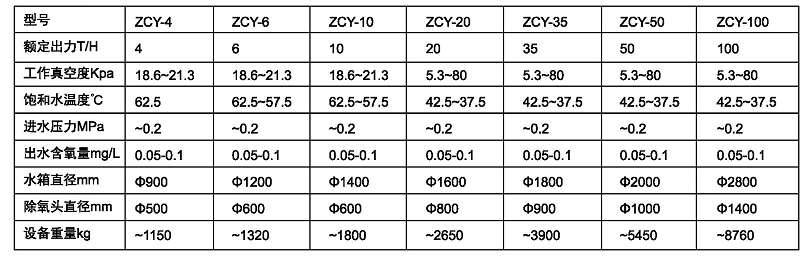
Model and Specifications:
Model Representation Method
ZCY—50T/H
| |-----Flow Rate: 50 T/H
Vacuum Oxygen Remover
Section 3: Equipment Composition
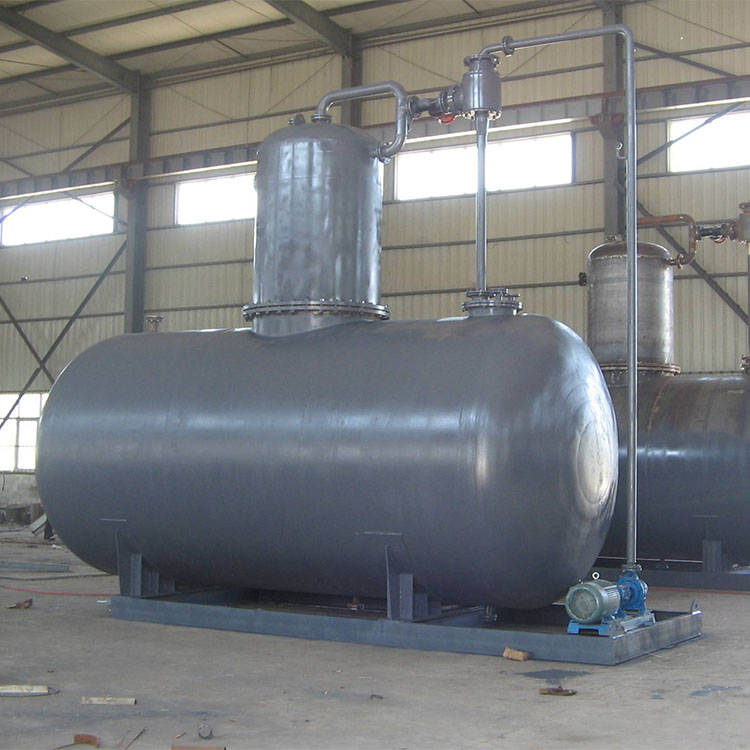
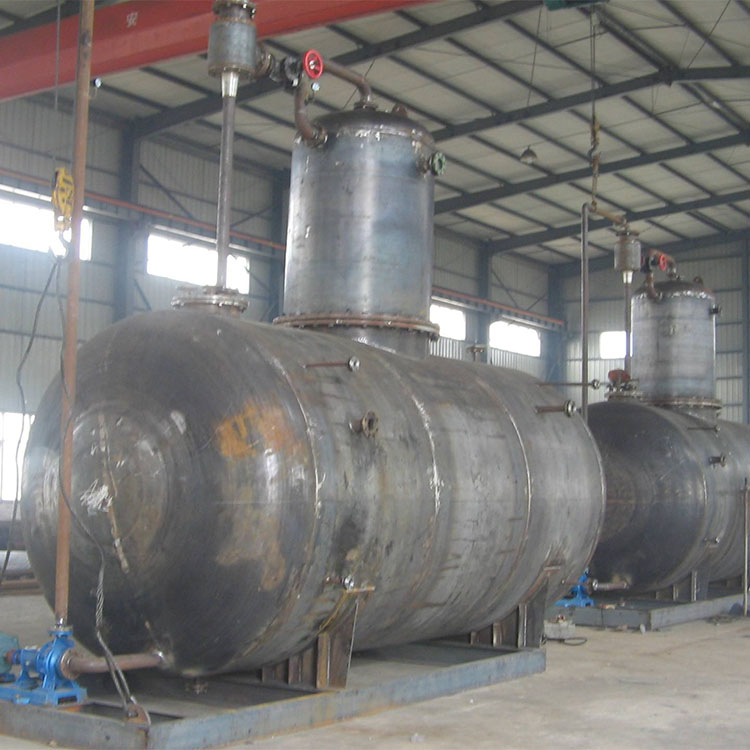
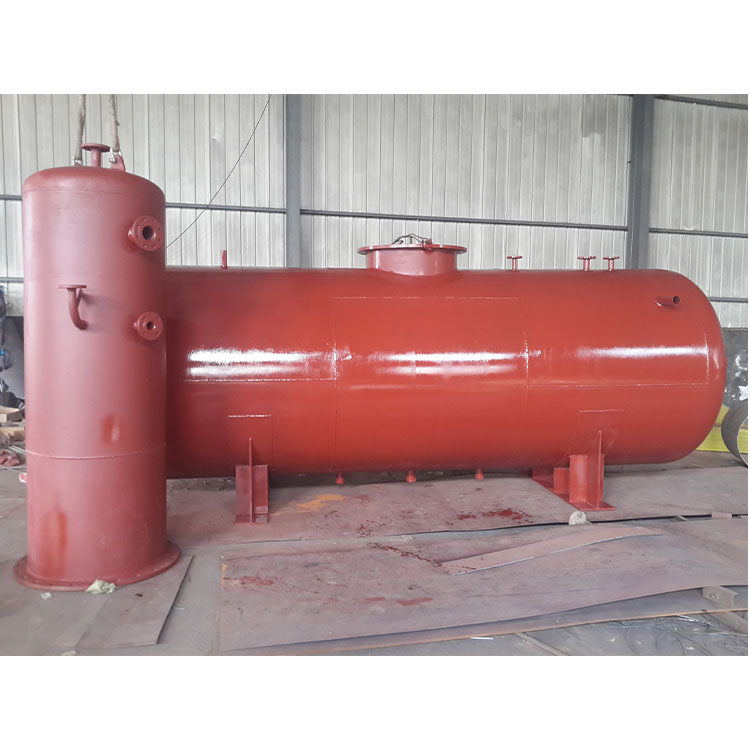
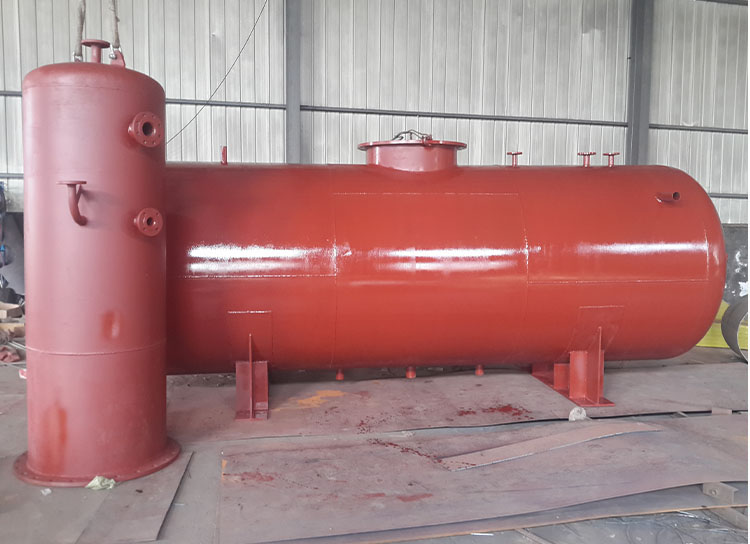
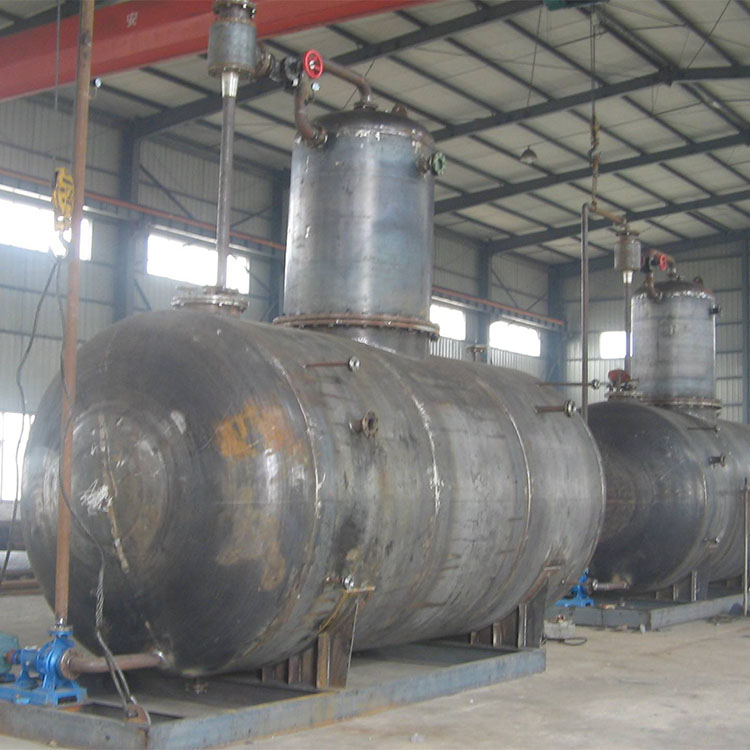
The Rotating Membrane Vacuum Deoxygenator is primarily composed of the deoxygenator (including the deoxygenation head and deoxygenation tank), an efficient rotating membrane unit, a water jet vacuum pump unit, and a feed pump unit.
The vacuum oxygen removal unit is equipped with an efficient rotating film device, converting natural film formation to strong rotating film, increasing the rotation speed of the liquid film, forming a small skirt by the liquid rotating along the inner wall of the rotating film, enhancing dispersion and mass transfer functions; while maintaining the gas (vapor) channel. It integrates the three independent heat transfer and mass transfer methods into one, primarily highlighting the principle of increasing vacuum to lower the boiling point, all within a single component. Due to its high oxygen removal efficiency and the unique function of lowering the boiling point with increased vacuum, it has broken through the technical performance of low-temperature, low-pressure oxygen removal.
During operation of the rotary film vacuum oxygen remover, the deoxygenation water tank is under a negative pressure state. When installed at a high position, the distance between the water outlet of the tank and the inlet of the boiler feed pump should not be less than 10 meters; when installed at a low position, the outlet of the tank is connected to the water lift pump unit, allowing the negatively pressured water to be pressurized before entering the boiler feed pump.
The water jet vacuum pump unit is equipped with a long-throat ejector, which features a compact design structure and low power consumption. It also boasts high suction efficiency, doubling the suction capacity compared to the older models under the same conditions. It operates at low noise with no vibration, and the installation and layout are simpler.
The role of the feed water pump unit is to increase the vacuum water pressure via the feed water pump and then supply it to the boiler when the deaerator is installed at a low position.
Section 4: Specifications and Models