

One: Subdrain Plate Slope Construction Method
Ensure a smooth cement or clean earth surface.
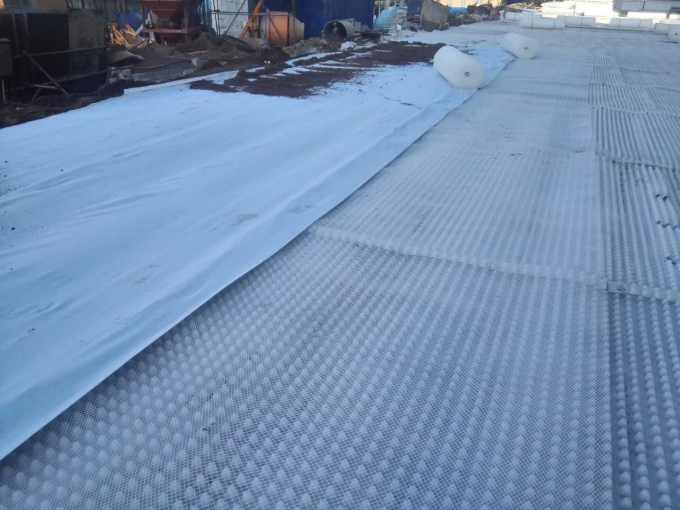
To lay out the garage drainage panels flat, standard manufacturers offer garage plastic drainage panels in widths of 2 meters, with the widest option reaching 3 meters. Lengths are available in 8, 10, and 15 specifications. Note that the drainage panels should be sealed, and the laying direction should be consistent. Refer to the longitudinal and horizontal laying methods based on the drainage slope for installation. The joints must be overlapped in the direction of the drainage slope; reverse overlap is not permitted.
2. Soil Filling Method
During backfilling, non-woven fabric is initially laid, while simultaneously using backfill soil to compact and stabilize. Subsequently, backfill soil can be placed directly over the fabric. The thickness of the first layer of backfill soil should be greater than 600mm, followed by layered backfilling, with each layer being 600mm thick. Finally, leave a layer of 300-500mm thick for manually mixed planting soil, to be naturally filled in.
Secondly, the technological requirements for the water storage and drainage board.
Drainage: The large gap space on the raised platform offers superior drainage capacity compared to traditional gravel and ceramic beads.
2. Water Retention: Capable of intercepting a certain amount of rainwater, which not only conserves resources but also meets the growth needs of plants.
3. Stress-Resistant: Special process, thickened top boss for enhanced compressive strength.
4. Space Efficiency: The product features an extremely thin thickness, significantly saving space in construction.
5. Root Barrier: Heat-fused welding prevents plant roots from penetrating the drainage board, effectively protecting the waterproofing layer.
6. Corrosion Resistance: Acids, alkalis, and salts in natural and general industrial environments cannot react with HDPE materials to achieve corrosion resistance.
7. Durability: Made with high-performance HDPE, the product boasts enduring stability in performance, with a lifespan exceeding a century.
8. Versatile: The material itself is an excellent waterproofing material.
9. Drainage board material: Significantly lighter than traditional cobblestones and陶粒, it not only achieves drainage functions but also meets the safety requirements of construction.
10. Rational Design: Capable of providing waterproofing, drainage, water storage, breathability, insulation, heat preservation, vibration reduction, and soundproofing functions.
Insulation and Heat Retention: Lightweight and excellent roof insulation properties.
12. Environmental Enhancement: Provides ample water and oxygen for plant growth.
The above content details the construction methods and process requirements for water-retaining and drainage boards on slopes. Only when these standards are met after production can a water-retaining and drainage board be considered high-quality, and only then can it fulfill its role during use.