
Magnetic Flocculation Sedimentation Technology - Revolutionary Coagulation and Clarification Process Technology
Introduction to Magnetic Coagulation Sedimentation Technology
The Magnetic Coagulation Sedimentation technology involves simultaneously adding magnetic powder with a specific gravity of 4.8-5.1 to the traditional coagulation sedimentation process, which binds with pollutants to form a single entity. This enhances the coagulation and flocculation effects, resulting in denser and stronger flocs for faster sedimentation. The sedimentation rate of magnetic flocs can exceed 40 m/h. The magnetic powder is then recycled and reused through high-shear machines and magnetic seed catchers (magnetic separators).
The entire process has a short停留 time, making the likelihood of a reverse dissolution process for most pollutants, including TP, extremely low. Additionally, the magnetic powder and flocculants added to the system exhibit excellent adsorption properties for bacteria, viruses, oil, and various fine particles. As a result, the removal efficiency of these pollutants is superior to that of traditional processes, with particularly significant phosphorus removal effects. Moreover, due to its high-speed sedimentation performance, it boasts numerous advantages over traditional methods, such as faster speed, higher efficiency, smaller land occupation, and lower investment. Magnetic coagulation sedimentation technology is a revolutionary new technique.
Magnetic coagulation sedimentation technology originated in the United States. Previously, its application in water treatment projects was limited due to the unresolved issue of magnetic powder recovery. Now, this technological challenge has been successfully overcome, with a magnetic powder recovery rate exceeding 99%. Consequently, the technical and economic advantages of the magnetic coagulation sedimentation process are fully demonstrated, leading to its increasingly widespread use both domestically and internationally. Currently, China is progressively implementing this technology in various engineering applications such as urban wastewater treatment, recycled water use, river black and odorous water treatment, high-phosphorus wastewater treatment, paper mill wastewater treatment, and oilfield wastewater treatment, all yielding favorable results.
Section II: Magnetic Concrete Sedimentation Process
Treated wastewater first enters the 1st stage mixing pond of the treatment facility, where it is simultaneously dosed with coagulant PAC. After thorough mixing, it proceeds to the 2nd stage mixing pond, where it combines with recovered magnetic powder and recycled sludge to form flocs. It then moves on to the 3rd stage mixing pond, where it reacts with the flocculant PAM added there, producing larger floc particles. These particles settle rapidly in the sedimentation pond, and the clarified water exits to either the next treatment process or is discharged directly in compliance with standards.
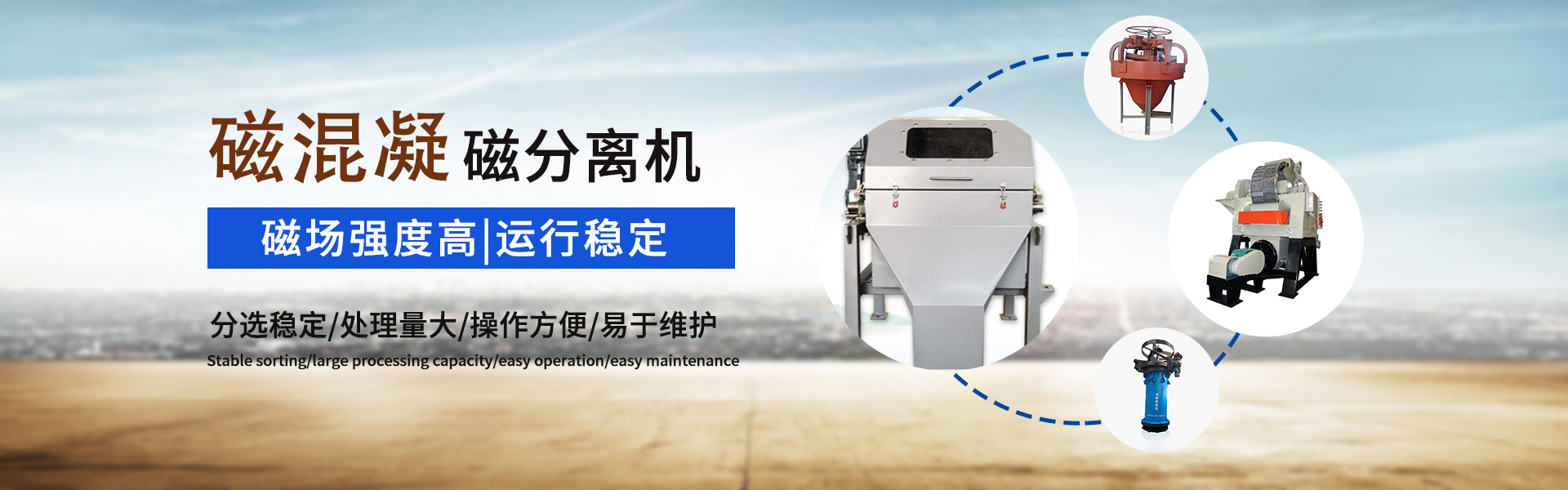
Sludge settled in the sedimentation pond is partially recycled to the second-stage mixing tank for further reaction via污泥回流泵. The other portion undergoes sludge stripping in a high-shear machine and then enters a magnetic separator for magnetic powder recovery. The recovered magnetic powder is reintroduced into the second-stage mixing tank for continued reaction. The remaining sludge is then transferred to the subsequent sludge treatment system. Pre-mixed PAC and PAM solutions are pumped to their respective dosing points. PAC is added to the first-stage mixing tank, while PAM is added to the third-stage mixing tank.
Section III: Application Fields
Wastewater Sector: Removal of SS (Suspended Solids) and Total Phosphorus; Elimination of Particulate and Some Colloidal COD
Wastewater treatment plant upgrading, including: advanced phosphorus and suspended solids removal; river black and臭water treatment; heavy metal wastewater treatment; oily wastewater treatment.
Water Treatment Field: Phosphorus and Algae Removal, Softening
Section 4: Process Features
The settlement rate is fast, reaching an impressive 40m/h high settlement speed.
2. High surface load, up to 20 m³/㎡h ~ 40 m³/㎡h.
3. Short stay time, from water in to water out can be as low as 20 minutes.
4. Effectively reduces land area requirements; sedimentation pond land area can be reduced to as low as 1/20 of conventional technology.
5. Phosphorus removal results in effluent TP levels as low as 0.05 mg/L.
6. High transparency with turbidity < 1 NTU.
7. High SS removal rate, effluent < 2 mg/L.
8. Magnetic particle recycling utilization, with a recovery rate over 98%, and low operation costs.
9. Effective optimizer dosage optimization reduces operating costs, potentially saving up to 15% in additional dosages.
The system is compact (also available as a portable processing unit) and can be controlled automatically, with simple operation.
