


Lotus Root Cultivation Technique:
1. Selecting High-Quality Varieties
Selecting superior lotus root varieties is crucial for enhancing both yield and quality. When choosing varieties, one should consider local climate conditions and market demand. Generally, early-maturing varieties have shorter growth cycles and are suitable for planting in summer; late-maturing varieties have longer growth cycles and are ideal for planting in autumn. Additionally, it's important to select varieties that are disease-resistant, high-yielding, and of good quality.
2. Site Selection and Pond Construction
Lotus root requires ample water and fertile soil, thus it is advisable to choose water-rich, easily drained, and fertile paddy fields or ponds for cultivation. After selecting the site, construct the lotus pond as needed, with a depth of 0.8-1.2 meters and a width of 5-8 meters, adjusting the length according to实际情况. When constructing the pond, ensure the bottom is compacted and lay a layer of fertile soil 0.2-0.3 meters thick to facilitate the growth of lotus roots.
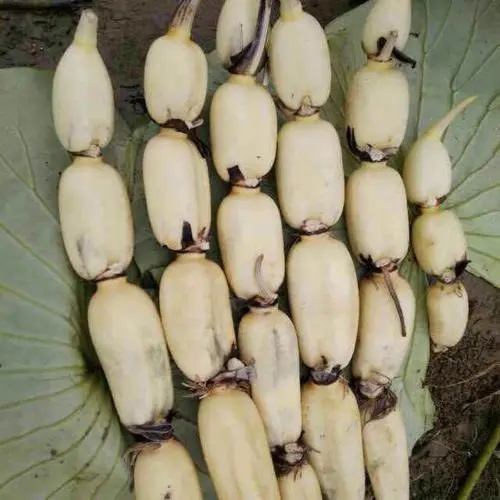
3. Proper Fertilization
Lotus root requires ample nutrients for growth, thus timely fertilization is essential during its growth period. Generally, during the early and middle stages of lotus root growth, nitrogen and phosphorus fertilizers are primarily used to promote growth and development; in the later stages, potassium fertilizers are applied to enhance the quality and yield of lotus root. When fertilizing, adjustments should be made based on growth conditions and soil fertility, with an average application of 10-15 kilograms of urea, 20-30 kilograms of calcium superphosphate, and 10-15 kilograms of potassium sulfate per mu. When applying fertilizers, it is important to spread them evenly around the root area of the lotus root to avoid burning the root system.
4. Scientific Water Management
Lotus root requires ample moisture for growth. During irrigation, adjustments should be made based on weather conditions and soil moisture. During the early and middle stages of lotus root growth, maintain water depth at about 3-5 cm; in the latter stages of growth and during winter, keep the water depth at approximately 10-15 cm.
5. Pest and Disease Control
Lotus root is susceptible to various pests and diseases during its growth, thus timely control is essential. In pest and disease management, adhere to the principle of "prevention first, comprehensive control." On one hand, strengthen field management to enhance the disease resistance of lotus root; on the other hand, conduct regular chemical control to prevent the occurrence and spread of pests and diseases. Common pests and diseases affecting lotus root include rot disease, aphids, and looper moths, which can be controlled with appropriate chemicals. When using chemicals, pay attention to selecting low-toxicity, low-residue agents to ensure the quality and safety of lotus root.
