
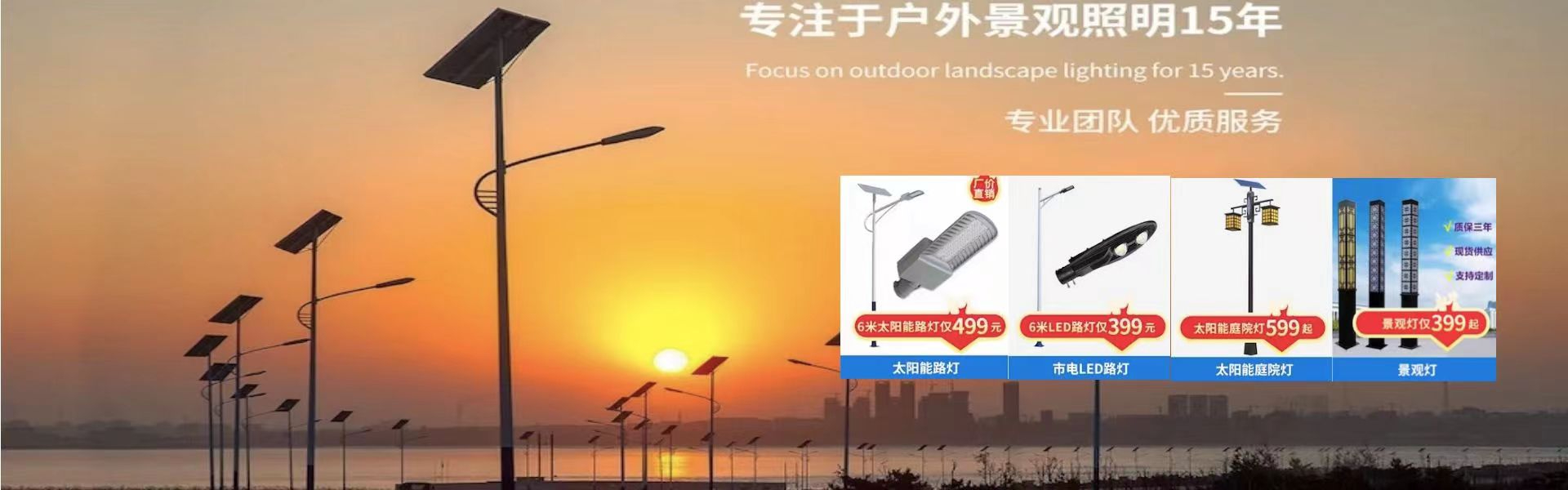

Is the solar-powered street lamp truly more practical than the traditional one? This has long been a topic of debate, with arguments for both. Currently, the solar-powered street lamp is all the rage in the market, and many organizations eager to install street lamps are quick to choose the solar-powered option. But are there really substantial differences in their usage?
Firstly, let's understand the cost implications between the two.
For a 6-meter lamp post, a standard 6-meter street light setup with a 20W LED fixture, including the pre-buried parts, costs approximately 700 yuan (medium quality).
A set of 6-meter solar street lights, equipped with a 20W LED lamp, an 80Ah battery, an 80Wp solar panel, a pre-buried component, and a controller, costs approximately $1,900 (medium configuration, medium quality).
It's clear to see that solar street lamp prices are 1.7 times that of traditional street lamps. Let's put the price aside for a moment and compare their respective lifespans.
The lifespan of standard streetlights is determined by the LED lighting, as the components of standard streetlights are merely the pole and the lamp head. Even the poorest quality pole can last for 15 years without issue. The theoretical lifespan of LED lighting is 100,000 hours, and even if it only lasts for 50,000 hours in practice, it is still safe within a 15-year period.
The lifespan of solar streetlights is not solely determined by the LED bulbs but rather the batteries. Many battery manufacturers offer a warranty of 3 years, with an extended lifespan of 5 years. This means that after 5 years of use since installation, the battery's performance will significantly decrease or completely fail. The cost to replace a battery, including labor, is at least around $500.
Here, you should have a general understanding. We list these figures merely to clarify some essential knowledge; please do not follow blindly. As a solar street lamp manufacturer, we hope that more and more people use solar street lamps. However, whether out of sympathy or for the social good, it is necessary to make these issues clear to everyone.
For personal recommendations, if the installation and wiring are not too challenging, opt for standard LED streetlights, which can be a one-time solution. In areas like mountainous regions or places where trenching and wiring are not feasible, solar-powered streetlights are undoubtedly the preferred lighting option.
