


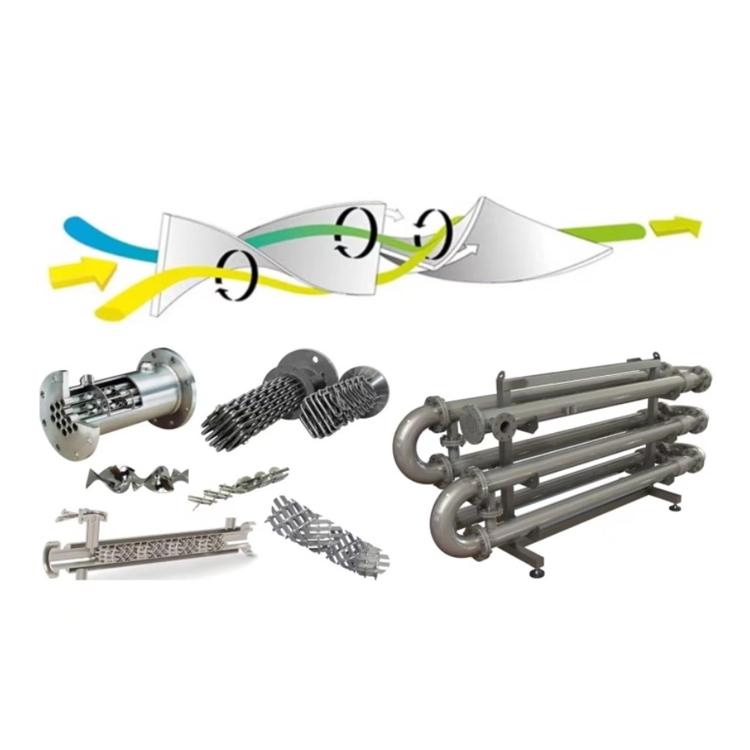
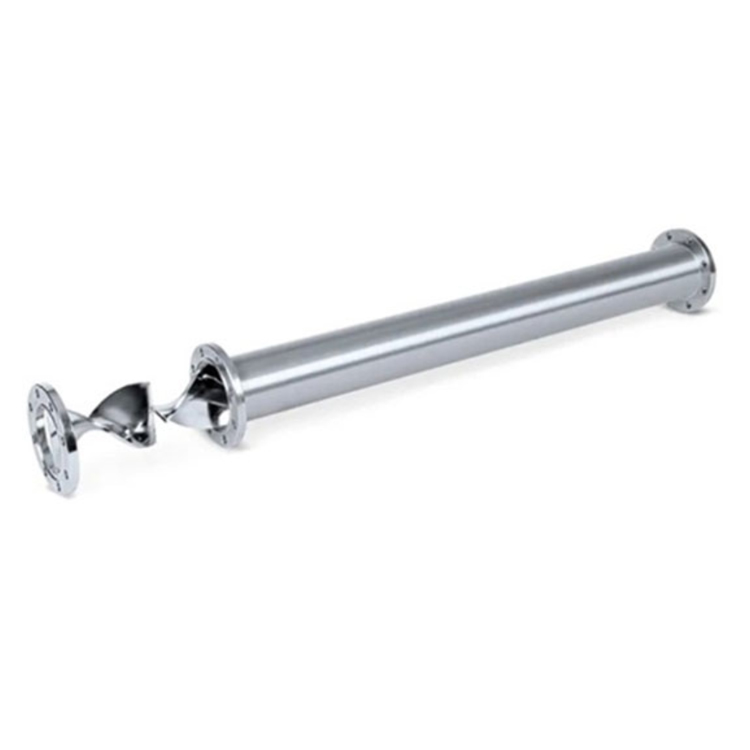

Static mixers are stationary devices installed inside pipes with appropriate shapes and lengths, which achieve excellent mixing, reaction, and dispersion effects as fluids flow through them. Fluid flow is achieved through the use of pumps. In addition to being widely used in the oil refining and chemical industries, they are also extensively employed in food processing, mining, plastic extrusion, environmental protection, and other sectors. Static mixers are high-efficiency pipeline mixing devices without moving parts, and compared to traditional mixing equipment such as agitators, colloid mills, and homogenizers, they offer advantages such as simple process (pipeline connections), compact structure (similar to part of the pipeline), low energy consumption (minimal pressure loss), maintenance-free (no moving parts), clean and hygienic (air-tight during operation), high production capacity (can run continuously), good mixing performance, and low investment. They can replace traditional equipment in processes involving liquid-liquid, liquid-gas, liquid-solid, gas-gas mixing, emulsification, neutralization, absorption, extraction, reactions, and enhanced heat transfer.

The working principle of a static mixer: As two or more streams of fluid flow through the mixing unit components inside the tube, they undergo multiple cuts, shears, rotations, and recombination, achieving thorough mixing between the fluids. The fluid mixing mechanism of static mixers differs significantly between laminar and turbulent flow. In laminar flow, the static mixer relies on the fluid paths to divide and shift the fluid, and then recombine it. Mixing is achieved through the regular, repeated action of these "cut, shift, recombine" elements. In turbulent flow, in addition to the aforementioned three elements, intense vortices are generated in the direction of the flow cross-section, resulting in a strong shearing force on the fluid. This further divides the finer parts of the fluid, leading to an additional mixing process.
