
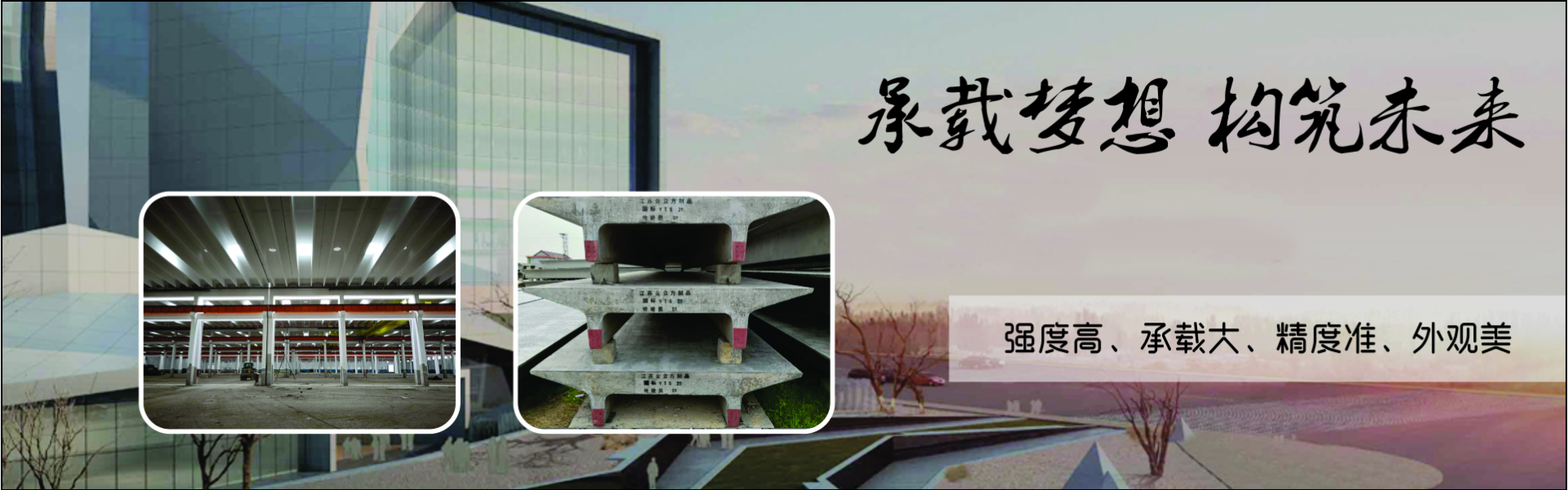

The double-T beam is a reinforced concrete precast load-bearing structural member that combines beams and slabs. The double-T beam has a wide slab surface and narrow, tall ribs. The panel can bear loads both horizontally and vertically, with a larger pressure interface. The neutral axis enters or approaches the panel. The main steel reinforcement in the middle of the double-T beam has a high tensile strength. Through the above structural design, the double-T beam exhibits strong tensile and compressive bearing capacity.
Dual-T Board Applications and Development History
The double-T slab exhibits clear layers of force transmission with a simple and straightforward geometric structure. Utilizing double-T slabs allows for the production of load-bearing structural elements with large spans and extensive coverage areas, offering excellent value for money. Compared to other precast panels, the double-T slab demonstrates superior cost-effectiveness. Since the 1950s, this type of material has been widely developed globally.
China began using this type of floorboard for constructing factory rooftops and buildings as early as 1958. In the 1960s, the double-T slab gained widespread adoption in the United States, transitioning from a specialized structural element to a common one. It was extensively used in single-story buildings, multi-story buildings, factories, and large-span public function buildings, among others. Following suit, countries like Romania, Poland, Japan, the United Kingdom, Finland, the Federal Republic of Germany, and Canada also expanded the use of double-T slabs. Germany even developed a complete set of specialized equipment for the double-T slab.
Benefits of Using Double T-Panel as a Wall Material
The double-T slab is not only suitable for horizontal installation on various surfaces of buildings, such as roofs, walls, floors, and ceilings, but it can also be embedded in strip-shaped foundation structures to form walls. In this case, the ribs of the double-T slab can serve as wall columns, and by covering them with insulation and panels, a protective layer is formed. However, if double-T slabs are used in one part of the building, they should also be used in corresponding areas. The same rib spacing and panel width facilitate their integration and mutual support. Buildings extensively using double-T slabs can reduce the number and types of construction formwork, lighten the building's weight, shorten the construction period, and offer both economic and technical benefits.
What are the benefits of using double T deck for roofing collaboration?
Utilizing double-T panels for roofing collaboration can reduce the amount of beams and columns needed in the building, making the structure simpler and easier to install. The speed of hoisting and placement is also significantly increased, thus reducing engineering costs from two aspects. Compared to large-span beams, double-T panel and steel structural roofs are more resistant to corrosion, have a longer lifespan, and offer strong load-bearing capacity. They are suitable for humid environments, high-fire requirement areas, and factories with high levels of acid, alkali, salt corrosion.
Double-T decks in large-scale construction applications
In large-scale construction applications, double-T panels also possess significant advantages. Due to their individual lengths that can extend up to dozens of meters and their strong load-bearing capacity, the use of double-T panels in large buildings can effectively reduce joints and assembly, enhancing the overall integrity of the structure. Moreover, the structure of double-T panels is both rational and lightweight, all of which contribute to their application advantages in the construction of large public buildings.
Now, civil construction is trending towards intensive and large-area development, which has greatly expanded the application opportunities for double-T panels in both civil and public buildings. Today, the construction of large restaurants, convention centers, conference centers, and factories has already adopted double-T panels as a standard structural element.
