

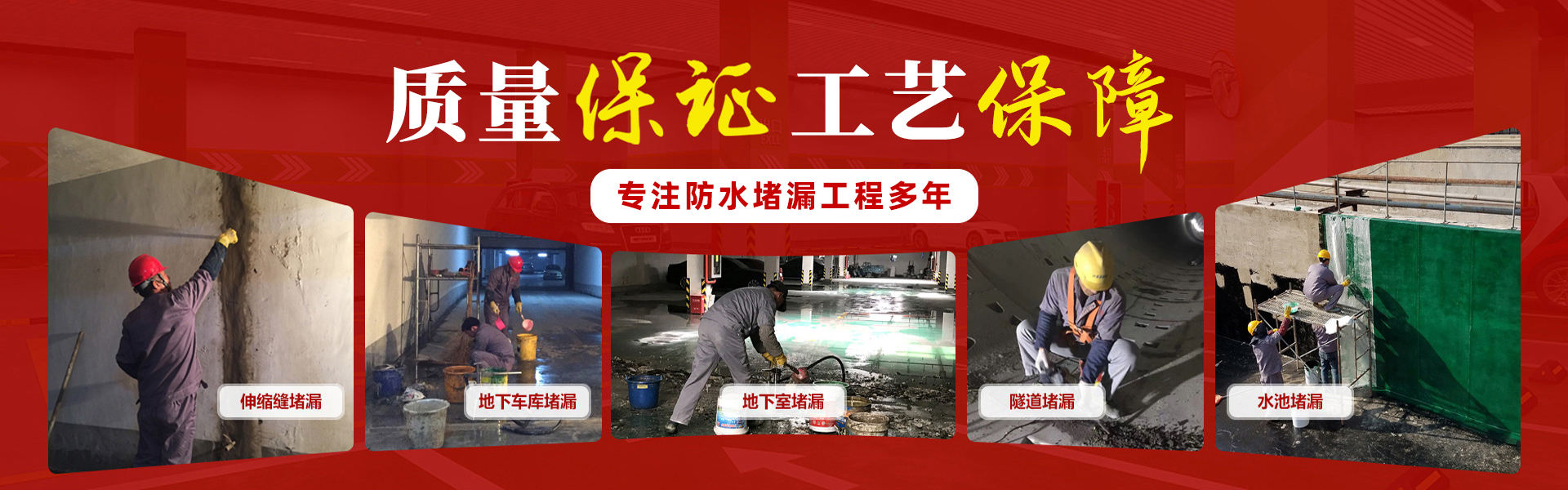


Basement expansion joints are construction joints designed to prevent uneven settlement of buildings, but in actual civil engineering projects, leakage may occur due to various reasons. How should basement expansion joint leakage be addressed? Based on our 20 years of construction experience, our company has compiled a basement expansion joint leakage sealing construction plan, which combines grouting with the filling of flexible materials to resolve the issue of leakage in expansion joints.
Basement Crack Sealing Solution
The company has adopted a treatment method that involves first grouting to stop leakage, followed by flexible protection using high polymer sealing materials, and finally rigid protection. While addressing leakage, the deformation joints are ensured to maintain their伸缩 deformation function.
1. Streamline the grassroots level:
Remove the existing material and impurities from the expansion joint to the specified depth (usually 7-10 cm), and rinse clean with water.
2. Fixed grouting channels and grouting pipes:
Mixed with a quick-setting leak sealer (available in liquid or powder form), 32.5-grade or higher ordinary silicate cement is used to secure the grouting channel—PE foam strips. During the fixation of the PE foam strips, a grouting pipe is buried approximately every 50 cm. The grouting pipes are made of 10-13mm pressure-resistant rubber hoses, which serve both as water supply pipes and grouting pipes.
3. Grouting Leak Sealing
Begin by injecting high polymer grouting material—Grouting Leak Stopper from the bottom, controlling the grouting pressure between 0.3~0.5MPa. Stop the grouting when the adjacent hole starts to leak, close the valve, and then inject from the other hole. Proceed sequentially. After all the grouting is completed, inspect for any leaks. If there are still leaks in certain areas, supplement the grouting from the nearest hole until no leakage remains.
4. Cut off grouting pipes: After 24 hours of grouting, cut all grouting pipes upon confirmation of no leakage, and dry the interface with a blowtorch.
5. Surface Cleaning: Use a wire brush to remove impurities and the surface debris generated during the torch baking process. Recommended Reading: Expansion Joint Leak Sealing
6. Construction Flexible Material: Apply a 50~60mm thick PG321 two-component polysulfide sealant within the seam, followed by a 300mm wide, 20mm thick two-component polysulfide sealant as the outer layer. After the polysulfide sealant has cured, use a compressive sealant as the final semi-rigid protective layer.
Summary: This concludes our comprehensive coverage by Dinglong Tai Sealing Company's editor on "Basement Deformation Joint Sealing Construction Plan [Basement Deformation Joint Sealing]. For more information on building waterproofing and sealing, please follow our website for a continuous stream of high-quality content.
