

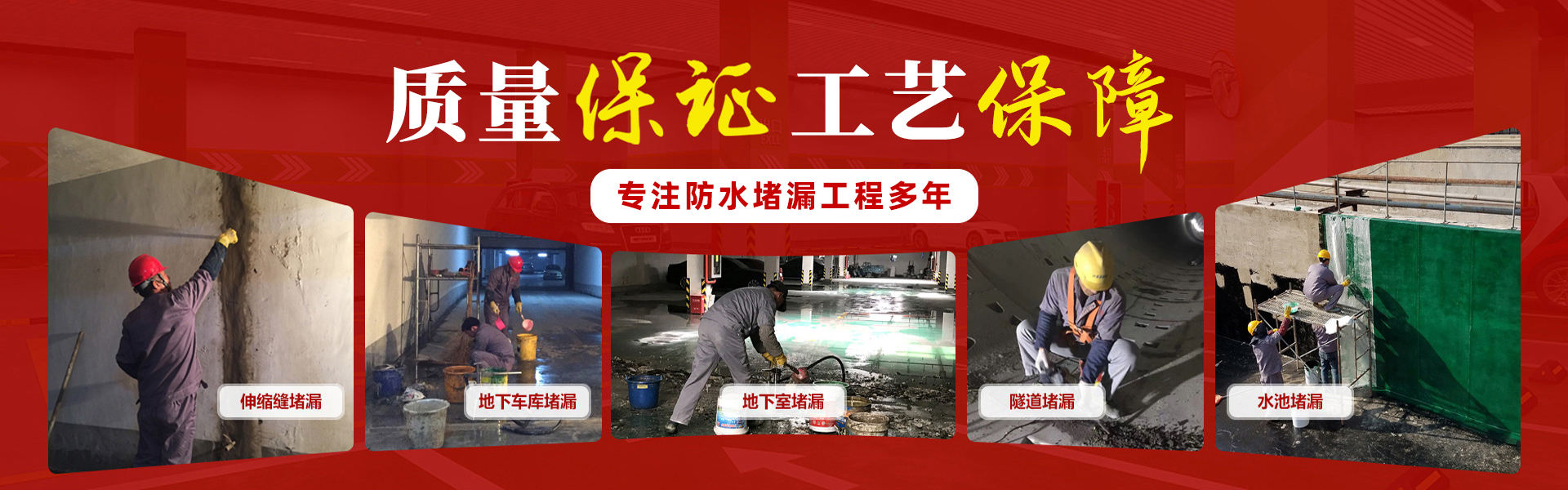


Leakproofing basements can be quite complex, whether it's water seeping through holes, cracks in expansion joints, or widespread leakage. It's essential to first stop the rapid flow before addressing the slow渗s, and to implement leakproofing measures step by step. Next, we'll introduce four common methods for basement leakproofing.
1. Leak repair and plug for holes
Leakage through holes can be directly plugged. Generally, under low water pressure and small holes, holes can be chiseled to form concave shapes with a diameter × depth of 2×4, 3×6, or 4×8 cm, centered around the leak point. Note that the hole walls should not be chiseled into a V-shape with a larger outside and smaller inside, and should be as vertical as possible to the base surface. Clean the concave shape with water thoroughly.
Next, apply the proportionally mixed and heated M131 waterstop rapid-setting agent with force into the depression, then press it firmly around to ensure a tight seal, allowing the agent to bond closely with the hole's walls. After observing for a period to confirm no leakage, proceed to seal the next leak point.
Occasionally, during the drilling process, water flows uncontrollably. In such cases, relying solely on quick-setting agents is insufficient to stop the flow. First, a wedge must be carved, then coated with emulsified asphalt or waterproofing paint for waterproofing treatment. After that, the wedge is hammered into the hole to block the strong current, and finally, the surrounding holes are sealed tightly using the aforementioned method.
2. Leak and crack repair堵漏
Cracks and leaks are addressed using direct plugging methods. First, a groove is carved along the crack direction, creating a slot with a width × depth of 2×4, 3×6 (era). The groove must be perpendicular to the base surface and cleaned thoroughly.
Next, twist the pre-mixed rapid-setting waterstop into strips suitable for the groove size. Once heated, quickly force them into the groove, and compress them tightly inside and on both sides to ensure a tight bond between the waterstop and the base. For longer cracks, segment the filling. After repairing, observe for a period, and only fill other cracks once no leaks are detected.
3. Repairing and filling concrete honeycomb surface
Localized leakage due to poor concrete construction, which manifests as honeycomb-like surface, should be addressed by first thoroughly cleaning the leaky area. Remove the subgrade with a depth of 3~4cm, and ensure the excavation area is 3~5cm larger than the honeycomb perimeter. Recommended reading: Langfang Basement Expansion Joint Sealing Company
After cleaning with water, apply two coats of M179, followed by leveling and compacting with fine stone concrete one grade stronger than the original or waterproof mortar mixed with M142. After sealing leaks in holes, cracks, and honeycomb surfaces using this method, do not rush to apply the waterproof mortar. Instead, observe for a few days.
Water under pressure may still seep through weak points after the blockage. If new leakage points emerge, the same method must be used to repair and block them. Continue this process of sealing, observing, and sealing again, until no more leakage occurs.
4. Large-Surface Waterproof Mortar
Once all leak points are sealed, to prevent water pressure from seeping in again, waterproof mortar should be applied with a thickness of no less than 2cm, spread in 2 to 3 layers. The construction sequence is typically to start with the walls before the floor, and the exterior walls before the partition walls.
When operating, the junction should be layered and staggered to leave a joint. Each layer of waterproof mortar should be spread to form a sealed whole, and the shadow angle at the junction of the ground and wall should be rounded.
