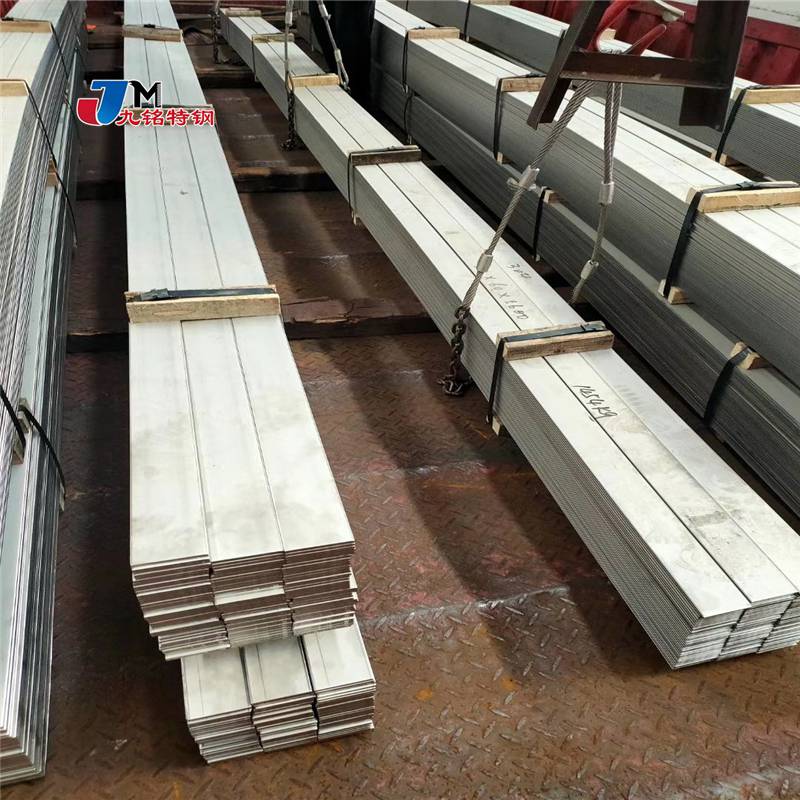
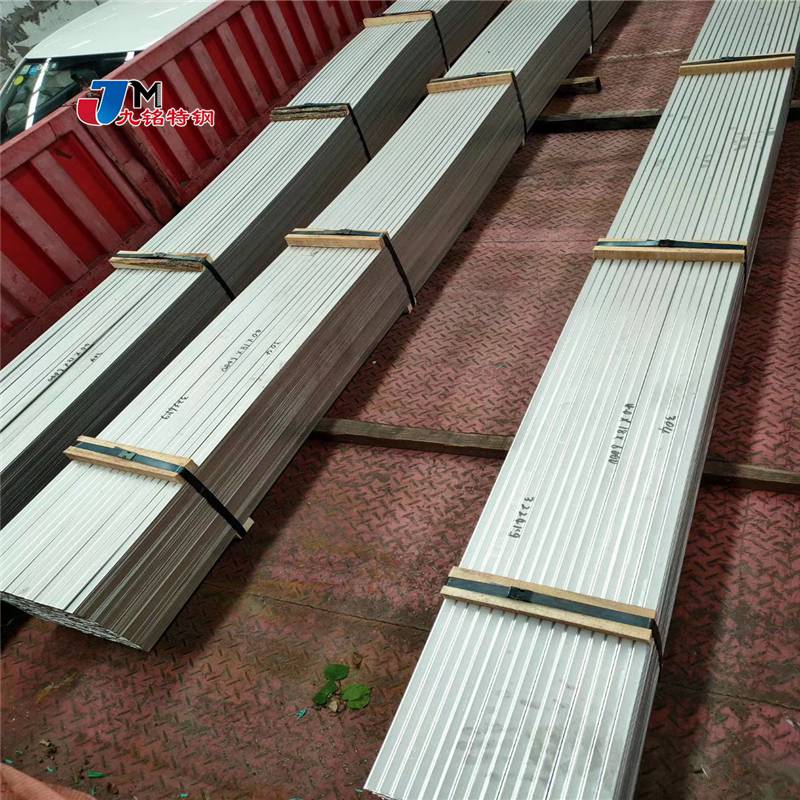
2205 stainless steel flat steel can be assembled into various different load-bearing components according to different structural requirements, and can also serve as connectors between components. It is widely used in various architectural and engineering structures, such as beams, bridges, transmission towers, lifting and transporting machinery, ships, industrial furnaces, reaction towers, container racks, and warehouse shelves, etc.
2205 dual-phase stainless steel has twice the yield strength of regular austenitic stainless steel, a feature that allows designers to reduce weight in product design, making this alloy more cost-effective than 316, 317L. This alloy is particularly suitable for temperatures ranging from -50°F to +600°F. Applications outside this temperature range can also consider this alloy, but there are some limitations, especially when used in welding structures. Stainless steel flats
Stainless Steel Flat Bar
Stainless steel flats are used in construction projects for bridges, frames, fences, transmission ships, vehicles, and more. The raw material for producing stainless steel flats is low-carbon square billets, and the finished products are delivered in hot-rolled, cold-rolled, or hot-rolled and cold-rolled conditions. During transactions, the contract and other documents should include complete dimensions of the edge width and thickness of the stainless steel flats, as well as main processing details such as annealing and solution treatment.
Types and specifications
Primarily divided into equilateral and non-equilateral types, the equilateral category can be further categorized by the specifications of square steel, which are indicated by the dimensions of the side length and thickness. The domestic specifications range from 3mm x 20m to 150mm.
Orders for imports and exports are generally based on the specifications required in use, with the steel grade corresponding to the carbon structural steel grade. In other words, there are no specific element and property series besides the specification number.
The delivery length of stainless steel flat steel is available in fixed lengths and multiples of fixed lengths. The range of fixed length options for domestic products varies from 3-9m to 4-12m, while the length options for Japanese-made products range from 6-15m.
Import/Export

Our imports and exports are of a certain volume, mainly sourced from Japan and Western Europe. Export destinations primarily include Hong Kong and Macau, Southeast Asia, Latin America, and the Arab region. The main exporting production enterprises are steel mills (rolling mills) in Jiangsu, Liaoning, Hebei, Beijing, Shanghai, Tianjin, and other provinces and cities.
Aesthetic quality
The surface quality of stainless steel flats is specified in the standards, generally requiring no harmful defects for use, such as lamination, scaling, cracks, etc.
The allowable range for geometric shape deviation is also specified in the standard, generally including such items as curvature, edge width, edge thickness, vertex angle, theoretical weight, etc., with a significant twist being specified.
Inspection Editor
Chemical Composition
(1) Composition Index: The chemical composition of the stainless steel flat steel belongs to the general structural rolled steel series, with the main inspection indices being C, Mn, P, and S. The content varies according to the grade, with an approximate range of C<0.08%, Mn: 2.0, P<0.035%, S<0.03%.
(2) Testing Methods: When testing the aforementioned chemical composition, commonly used standard testing methods include GB223, JISG1211-1215, BS1837, BS Manual 19, GOST22536, etc.
Specification Standards
GB/T2101-89 (General Provisions for Acceptance, Packaging, Marking, and Quality Certificate of Section Steel); GB9787-88/GB9788-88 (Hot-Rolled Steel Dimensions, Shape, Weight, and Allowable Deviations); JISG3192-94 (Shape, Dimensions, Weight, and Permitted Tolerances of Hot-Rolled Section Steel); DIN17100-80 (Quality Standard for Common Structural Steel); GOST535-88 (Technical Conditions for Common Carbon Steel Sections).
In accordance with the aforementioned standards, goods should be delivered in bundles with the number of捆绑 layers and bundle length conforming to the regulations. Generally, goods are delivered unpacked, so both transportation and storage should be mindful of moisture protection.
Mechanical Properties
(1) Inspection Method:
① Tensile Test Methods. Common standard testing methods include GB/T228-87, JISZ2201, JISZ2241, ASTM A370, GOST 1497, BS18, DIN 50145, etc.
② Method for bend testing. Common standard testing methods include GB/T232-88, JISZ2204, JISZ2248, ASTME290, ГОСТ14019, DIN50111, etc.
(2) Performance Criteria: The main inspection items for evaluating performance are tensile tests and bending tests. The criteria include yield point, tensile strength, elongation, and bending qualification, among others.
Weight Calculation
Weight per meter (kg) = 0.00793 x Edge Width (mm) x Edge Thickness (mm)