



 通过中商114认证
Plate Heat Exchangers: Performance Features
High heat exchange rate, with a thermal conductivity coefficient K ranging from 3000 to 8000 W/(m·K), exceeding other heat exchanger types.
Plate heat exchangers boast a high heat transfer coefficient, which dictates their compact and small-size structure. They can accommodate 250 square meters of heat transfer area per cubic meter, significantly outperforming other types of heat exchangers.
The plate heat exchangers also feature flexible assembly and easy disassembly for cleaning. They can adjust the heat exchange area by varying the number of plates to accommodate changes in heat load. Within the same exchanger, for purer fluids, increasing the number of passes can enhance the flow rate between plates, aiming for a high heat transfer coefficient.
Due to the use of two seals between the cold and hot media in plate heat exchangers and the creation of holes between the seals for atmospheric communication, the mixing of the two media can be effectively prevented.
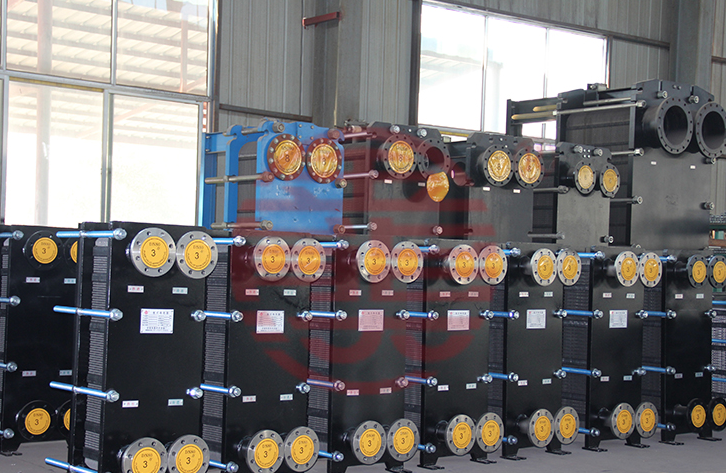
Plate Heat Exchanger Installation Method:
1. The heat exchanger plates are categorized based on installation angle, including large angle, small angle, and mixed angle types. If one plate is oriented upwards, the other plate should be downwards, adhering to the counter-current principle of plate heat exchangers to enhance turbulence in the medium.
2. Push the sealing gasket into the sealing groove along the plate and secure the clips, doing so for each unit. Once the sealing gaskets are hung properly, a double seal is formed on the plate. A single plate is referred to as Plate A, while two plates are Plate B. The principle is that if the double seal of Plate A is on the left, then the double seal of Plate B should be on the right.
3. Clean and wipe the parts. Before bonding the sealing gasket to the groove, clean any remaining adhesive from inside the groove. Apply the synthetic resin adhesive to the inside of the plate, then press in the sealing gasket.
4. During the installation process, it is crucial to inspect the condition of the gasket on the plates for any damage. Ensure that each plate is checked and installed individually. Neglecting the inspection and replacement of the gasket could lead to potential leakage during the pressure testing operation.
Each heat exchanger features over 160 plates. With multiple individuals collaborating, each plate is installed with proper seals, ensuring they are securely in place and there are no leaks.
6. The plates should be alternately rotated 180° for stacking; no misassembly is permitted. The clamping bolts should be tightened until the plate bundle reaches the calculated size.
