

1. Precise adjustment capabilities, meaning the relationship between the applied force and displacement is highly sensitive.
2. Excellent softness performance, meaning a relatively wide range of deformation.
3. Manufacturing is relatively straightforward.
4. The structure is quite compact.
5. High energy rates.
Feature Examples:
Conical helical springs offer excellent buffering capabilities and can withstand higher loads.
Coiled helical springs can store more energy and withstand greater loads, but their manufacturing process is more complex.
The performance of the concave spiral spring is similar to that of the conical spiral spring, and it is commonly used in seats and mattresses, etc.
Spring steel wire cross-sections come in circular and rectangular shapes, with circular being the most commonly used.
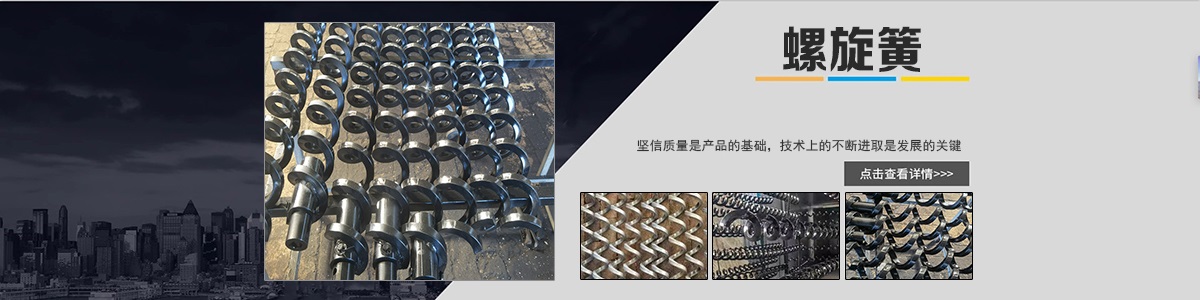
Helical springs, also known as torsion springs, are designed to withstand torsional deformation, with their working parts tightly coiled into a spiral shape. The ends of torsion springs are machined into various shaped torsion arms, rather than hooks. Torsion springs are commonly used in balancing mechanisms within machinery and are widely applied in industrial production, such as in automobiles, machine tools, and electrical equipment.
