

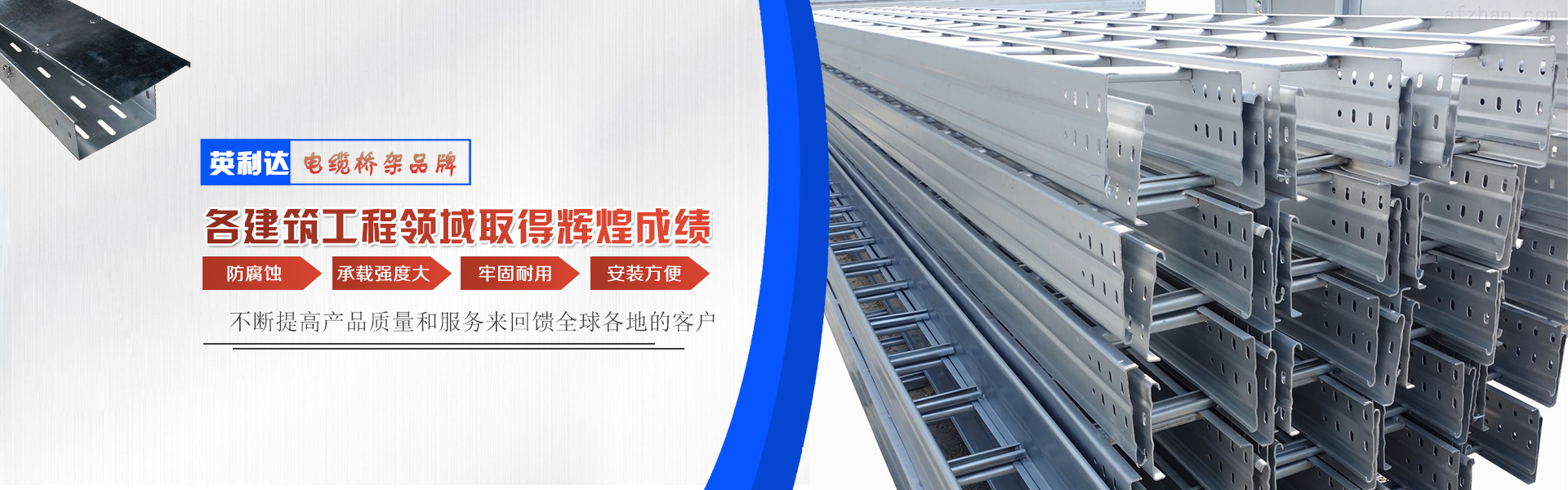


The primary uses of cable trays are in three main aspects: supporting cables; protecting cables; and managing cables.
(1) Support Cables
Cable trays utilize their structural features to attach and support cables to buildings (structures) or to independently support cable passage through tunnels, caves, underground, and aerial environments, primarily serving as cable supports. They act as a framework for cables, allowing them to be laid on cable trays. Since most cables are flexible and cannot be installed independently, the rigid structure of cable trays effectively supports the cables.
(2) Cable Protection
Cables are akin to blood, primarily responsible for transmitting various forms of electrical energy, information transfer, and control. Cable trays act as the vascular walls, isolating cables from the outside world and protecting them by enclosing, supporting, and lifting them.
The large-span cable bridge supports can be used during the laying of power cables, preventing the cables from sagging due to their own weight. They shield the cables from direct exposure to the atmosphere, protecting them from direct damage caused by sunlight, fog, rain, snow, and wind, thereby extending the service life of the cables.
The槽式 cable tray is effective for laying computer cables, communication cables, thermocouple cables, and other high-sensitivity system control cables, offering good shielding against interference for control cables and protection for cables in harsh corrosive environments.
Fire-resistant cable trays can withstand temperatures up to 700°C, allowing cables to remain functional for 30 minutes to 1 hour. They are suitable for use in high-temperature factories or buildings with strict fire safety requirements, as well as fire engineering cable installations.
Glass fiber reinforced cable trays offer high anti-corrosion and moisture resistance. With a sealed structure, they effectively protect cables from direct corrosion and dampness, especially in coastal areas and facilities with severe corrosion.
Cable tray systems with different materials and structural designs offer varied functionalities and cable protection solutions. Selecting the appropriate cable tray tailored to local conditions can meet cable protection needs under various conditions and environments.
(3) Cable Management
By utilizing the management cables of cable trays, the various cables for energy (mainly electricity) engineering and intelligent engineering in construction projects can be scientifically arranged. This approach optimizes the use of building space, ensuring rational structural design, easy construction, space-saving, aesthetically pleasing layouts, and facilitates maintenance and replacement.
News Center Co., Ltd.
