
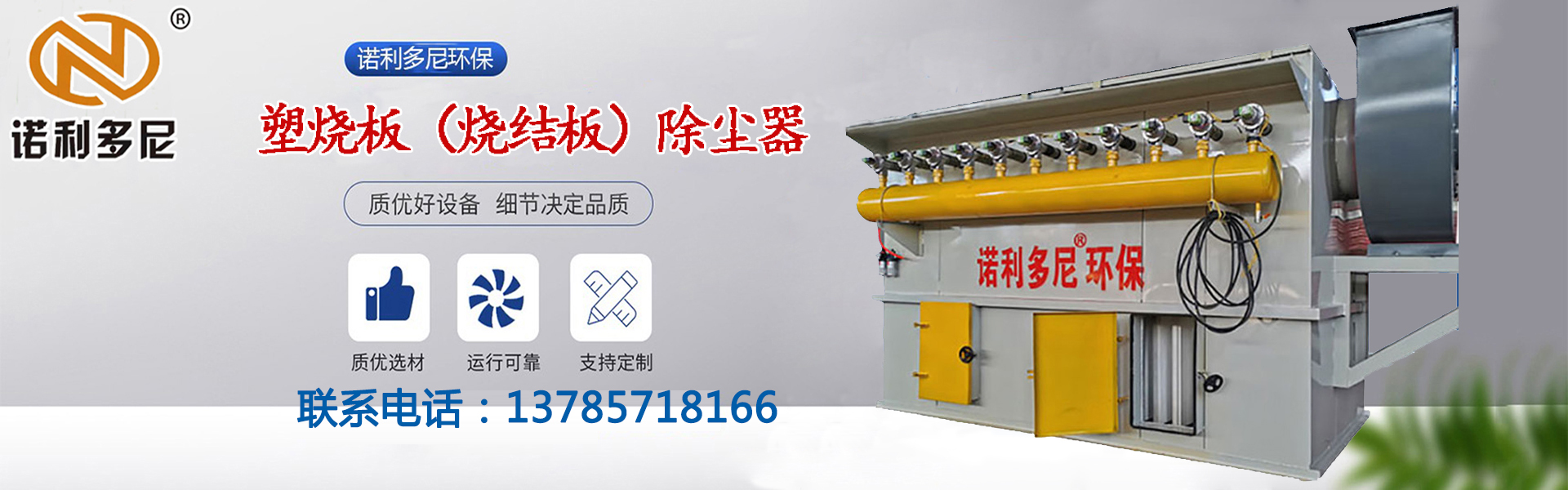


Difference Between a Plastic Fume Collector and a Baghouse Collector:
The external shape of the molded plate features a wave-like pattern reminiscent of an accordion box. If laid out flat, it equates to a threefold increase in surface area. The internal structure of the wave filter is divided into 17 cavities, a design that not only considers the strength of the components but is also crucial for aerodynamics to ensure efficiency during pulse jet back-pulse cleaning. The dust collector assembled with this technology occupies only 1/2 to 1/3 of the space of a bag-type dust collector with the same filtering area. The overall structure is also correspondingly reduced, offering space-saving benefits and creating conditions for user-friendly factory design and reduced total equipment cost.
Design Focus: Dust Removal for Sintered Plate Collector
Due to the wave-shaped sintered plate capturing dust through its PTFE coating, the smooth surface makes it difficult for dust to penetrate or linger. Even if some extremely fine dust particles manage to enter the gaps, they are immediately blown away by the set pulse compressed air flow. Therefore, clogging does not occur in the filter substrate layer, and the pressure loss of the filter element stabilizes and remains constant after a very short period of time. This indicates that the resistance loss of a specific powder under specific temperature conditions is only related to the filter air velocity and does not increase over time. Consequently, the treated air volume of the dust collector does not change with time, ensuring consistent air intake and dust removal efficiency.
Hydrophobic Properties of the Plastic Fume Collector
Due to the completely hydrophobic nature of the material and coating used in the filter plates, when water is sprayed onto them, an interesting phenomenon occurs: the condensed water droplets gather and flow down as a stream. This is not the case with fiber fabric filter bags, which, due to their absorbency, form a water film and adhere dust, causing an overall increase in resistance. This is no longer a concern in plastic fume extractors. This will result in excellent performance for handling smoke dust from condensation and highly hygroscopic dusts such as ammonium phosphate, calcium chloride, soda ash, and mirabilite.
The rigid structure of the sintered plate eliminates the lifespan issue caused by frame wear in fiber fabric filter bags. Another important indication of its long lifespan is the extended period of trouble-free operation of the filter elements, which require minimal maintenance. Its excellent dedusting characteristics maintain a stable resistance, ensuring the sintered plate dust collector operates effectively for an extended period. In fact, without uncontrolled temperature or special gases, the lifespan of the sintered plate dust collector could be quite long. The Tai Plastics sintered plate dust collector, introduced 87 years ago, has not yet required a filter element replacement. Even if a filter element is damaged by an accidental factor, it can be continued to use with special adhesives, without any adverse effects from a minor bonding seam. It possesses inherent rigidity and toughness, does not require any internal frame support, and is far superior in pressure resistance, corrosion resistance, wear resistance, and air impact resistance compared to fabric bags. Consequently, its lifespan is typically over 10 years.
Principle of Dust Removal in Plastic Sintered Plate Collector:
The dust collector utilizes pulse online cleaning without requiring shutdown. During operation, the cleaning control operates based on a combination of time and pressure differential. The control is automatically handled by the PLC system, ensuring the dust collection system remains in optimal running condition. When the dust collector discharges, a comprehensive control method is employed, with a high material level sensor installed in the hopper. An alarm is displayed on the control panel when the dust in the hopper reaches the high material level.
Shaped sinter plates are the main components of shaped sinter dust collectors, performing the tasks of gas-solid and liquid-solid separation within the dust collectors.
