
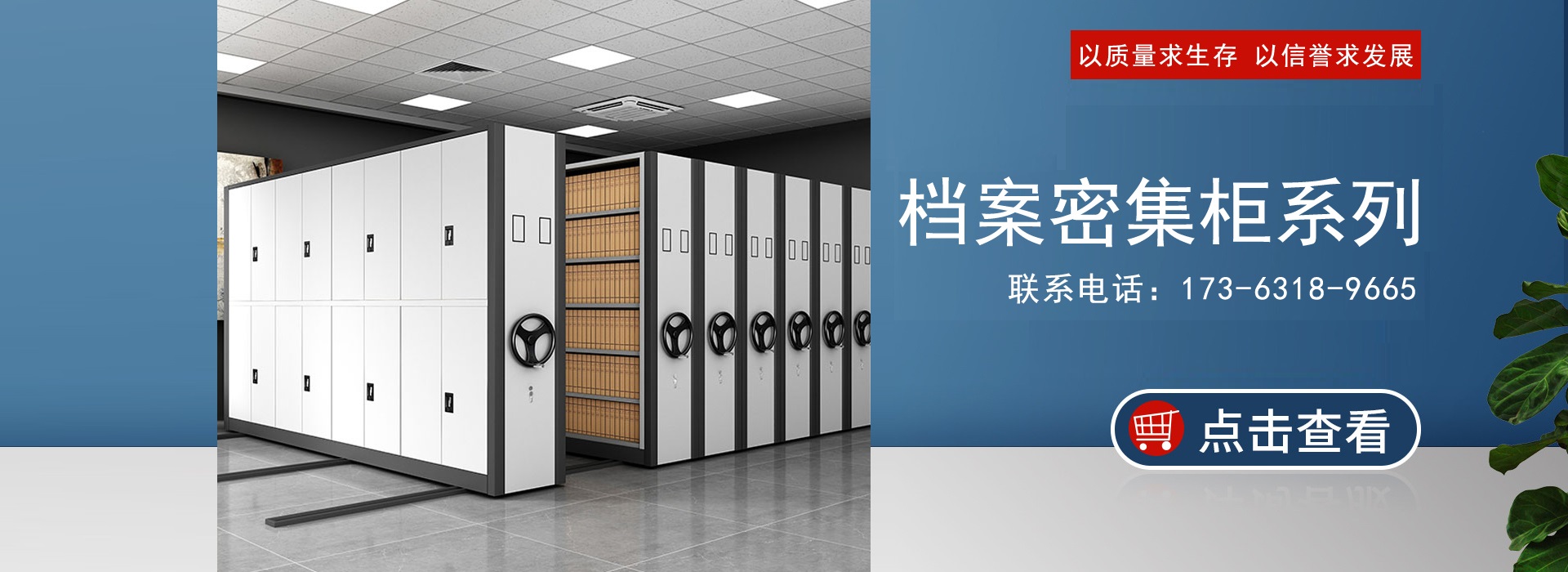


What are the advantages and disadvantages of using compact storage cabinets (mobile shelves) for archiving?
Advantages of Compact Storage Cabinets (Rack Shelves)
1. Optimize land usage
File cabinets, compared to traditional filing cabinets (Product: File Cabinets), offer up to 50% more storage space, enhancing space utilization. They effectively increase storage capacity without expanding the warehouse, making the most of the storage space and saving on investment costs.
2. Enhance inventory and adjustment efficiency
Storing various types of files in filing cabinets not only allows for rational partitioning and categorization but also enables efficient intelligent numbering and storage. This naturally enhances retrieval and storage processes, ensuring a well-organized system that minimizes the risk of file loss. It also improves document handling, avoiding unnecessary complications in daily operations.
3. Flexible Adjustment of Layer Spacing
As the company grows, the variety of documents expands, including not only administrative files but also financial vouchers, engineering drawings, and more. The varying sizes of these documents are accommodated by the adjustable spacing between shelves in filing cabinets, which meets the storage needs of various organizations. Additionally, the cabinets are sturdy, aesthetically pleasing, and well-maintained.
The drawbacks of compact storage cabinets (compact shelves)
1. High-density cabinets have certain requirements for the load-bearing capacity of the storage room floor.
Ground-bearing capacity primarily refers to ensuring that the loading of the cabinets does not exceed the load-bearing standards of the building design when designing floor plans for file cabinets. The uniformly distributed live load on the档案库房 floor should be 5KN/m2, and when using compact storage racks, it should not be less than 12KN/m2. For archives storage rooms that do not meet the load-bearing standards, it is not advisable to install compact storage racks.
2. It is extremely inconvenient to dismantle and transport the compact storage cabinets.
As the volume of archival documents continues to grow, it becomes necessary to expand or construct new storage rooms or archives. But what about the existing compact cabinets? Discarding them is a waste, and disassembling them is not convenient. Moreover, disassembly of the cabinets requires technical expertise and is costly. After disassembly, transporting and reinstalling them in a new storage facility incurs additional expenses. Additionally, the quality of the cabinets reassembled cannot be guaranteed.
3. Poor mobility hinders timely and secure transfer of files.
When encountering sudden events, it is crucial to act with urgency to ensure document safety, as every second counts. Due to poor mobility, temporary crating is required for transportation, which consumes time and is不利于 the rapid and safe transfer of documents.
As the company places increasing emphasis on work efficiency, the advantages of mobile file cabinets over traditional filing cabinets greatly enhance our document management, making it more accurate and systematic. However, it's important not to overlook their drawbacks. To excel in document management, it's crucial to continuously update our management concepts, bravely explore new methods, and capitalize on strengths while mitigating weaknesses to promote the development of the document management industry. The construction of smart archive storage facilities represents a new trend in the future of archive development, and intelligent mobile cabinets are indispensable hardware in these smart archives. By integrating software with document management, they bring convenience to the management process.
