
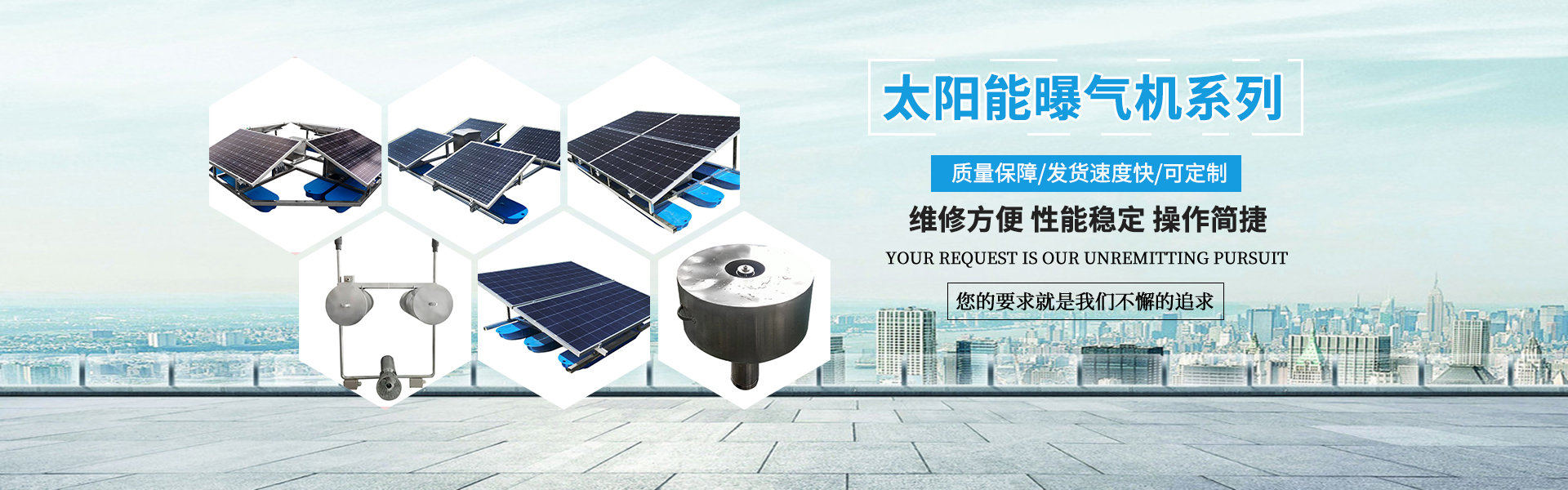


Solar Aeration MachineOperation Steps for Replacing Mechanical Seals and Requirements for Pressure Leak Testing.
OneSolar AeratorSteps for Replacing Mechanical Seals
Remove the main engine from the intake pipe, unscrew the connection bolts between the impeller and the shaft to remove the impeller. Unscrew the bolts connecting the intake chamber to the flange and remove the intake chamber. Unscrew the oil filling bolt on the end cover and drain the mechanical oil from the mechanical seal chamber. Remove the bolts connecting the flange to the end cover, then remove the flange and sequentially disassemble the mechanical seal components.
Mechanical seals are double-end face mechanical seals, including static seals, dynamic seals, springs, and other components. The static and dynamic seals near the impeller end are made of silicon carbide; the static and dynamic seals near the motor end are made of silicon nitride and alumina materials (note: no further notice will be given if there is a change in materials). The installation steps are the opposite of the disassembly steps.
Section Two:Solar AeratorPressure Leak Detection Requirements
1. After replacing the mechanical seal, a pressure leakage test should be conducted on the mechanical seal chamber. The requirement is that each leakage check should last no less than 3 minutes, with a test pressure of 0.2 MPa.
2. At the mechanical seal oil filling hole, screw on a special leak detection connector. Through the connector, inflate the mechanical seal chamber to achieve a gauge pressure of 0.2 MPa. Place the electric motor into a water-filled container (refer to Figure 5) for 3 minutes; the impeller end mechanical seal should not leak. Remove the motor from the container, attach a tube to the motor's leak detection hole via the connector, and place the outlet into the water-filled container (refer to Figure 6). Continue inflating the mechanical seal chamber to a gauge pressure of 0.2 MPa for 3 minutes; the outlet tube should not leak.
3. The double-axis extension special motor is equipped with two sets of mechanical seals. Air pressure leak detection should be carried out separately as referenced.
Section 3Solar AeratorInstallation Instructions
1. Secure the buoy and bracket by connecting and fastening them with M6x25 bolts.
Two: Place a rubber pad block in each groove of the bracket, position the main unit on the bracket grooves, and then securely fasten it with a locating clamp.
The motor's cables are securely fastened to the tray with cable ties.
Four: Two牵引tension cables are installed on the buoy, with the length of the cables determined by the anticipated installation position.
Before placing the assembled machine into the pond, it is necessary to measure the depth of the pond's bottom, adjust the submersion depth of the main unit, ensuring that the distance between the main unit and the pond's bottom is kept above 60 centimeters to prevent the removal of mud from the bottom.
Plug the power cable into the接线board at the pier.
7. Power on and observe the rotation direction of the impeller to ensure it aligns with the direction indicated on the directional sign. If not, for a three-phase motor, simply swap any two of the three single-color cores of the power lines.
During the installation into the pond, secure the device using two, three, or four ropes anchored to the installation pillars within the pond.
9. If the water level is too high or too low upon machine startup, adjust the motor bracket height to alter the water level. A higher main body results in a higher water level, but ensure the impeller is submerged below the water surface.
