
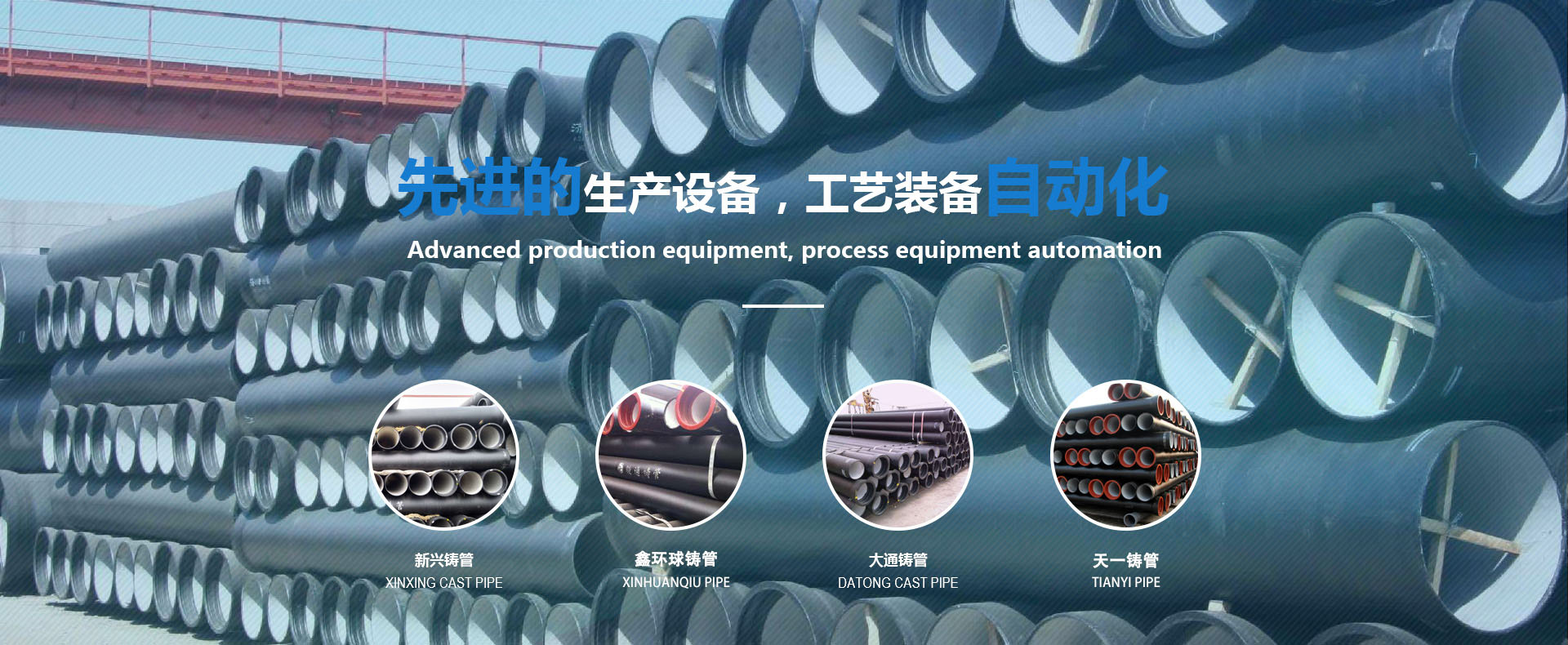


Ductile iron pipes, also known as cast iron pipes and ductile cast iron pipes, are made from pig iron. They can be categorized based on their manufacturing methods into sand casting centrifugal spigot and socket straight pipes, joined cast iron straight pipes, and sand casting iron pipes. They can also be classified by the raw materials used into gray iron pipes, ductile cast iron pipes, and high silicon iron pipes. Cast iron pipes are commonly used in pipeline projects for water supply, drainage, and gas distribution.
1. Water-Cooled Cast Iron Pipe
Cast Iron Sand Core Centrifugal Straight Pipe
The raw material for sand-type centrifugal cast iron pipes is gray cast iron, suitable for conveying water, gas, and other pressure fluids.
(2) Continuous Cast Iron Pipe
Continuously cast iron straight pipes, also known as gray iron cast iron pipes, are suitable for conveying water, gas, and other pressure fluids.
2. Drainage cast iron pipes
Standard drainage cast iron sleeve pipe and fittings. Flexible seismic interface cast iron straight pipes, these cast iron pipes are sealed with rubber rings and securely fastened with bolts, offering excellent flexibility and expandability under internal water pressure. They can accommodate significant axial displacement and lateral deformation, making them suitable for indoor drainage pipes in high-rise buildings, particularly ideal for seismic zones.
Manufacturing Standards for Ductile Iron Pipes
One, stringent requirements for chemical composition, with higher carbon and silicon content in the original iron liquid than gray cast iron, and a decrease in the manganese, phosphorus, and sulfur content in ductile iron.
The molten iron temperature upon casting is higher than gray cast iron, and lower than nodular iron, with a loss of molten iron temperature during the孕育 treatment.
The company has initiated spheroidization treatment, which involves adding a spheroidizing agent to the molten iron.
Four, dealing with nodular cast iron with poor fluidity, the shrinkage is significant, thus requiring a higher pouring temperature and larger scale of the pouring system. More use of risers, chilled iron, and selection of sequential solidification criteria.
Five, Cast iron is an iron-carbon alloy with a carbon content greater than 2%, with the industrial grade typically containing 2.5% to 4% carbon and including elements such as C, Si, Mn, S, and P. It is a product obtained through the smelting of iron ore in a blast furnace. Depending on the shape of carbon present in the cast iron, it can be further divided into pig iron for steelmaking, casting iron, and nodular cast iron, among others. Cast iron features: it is strong, wear-resistant, and has good casting properties, but it is brittle and cannot be forged or rolled.
