



Product Introduction
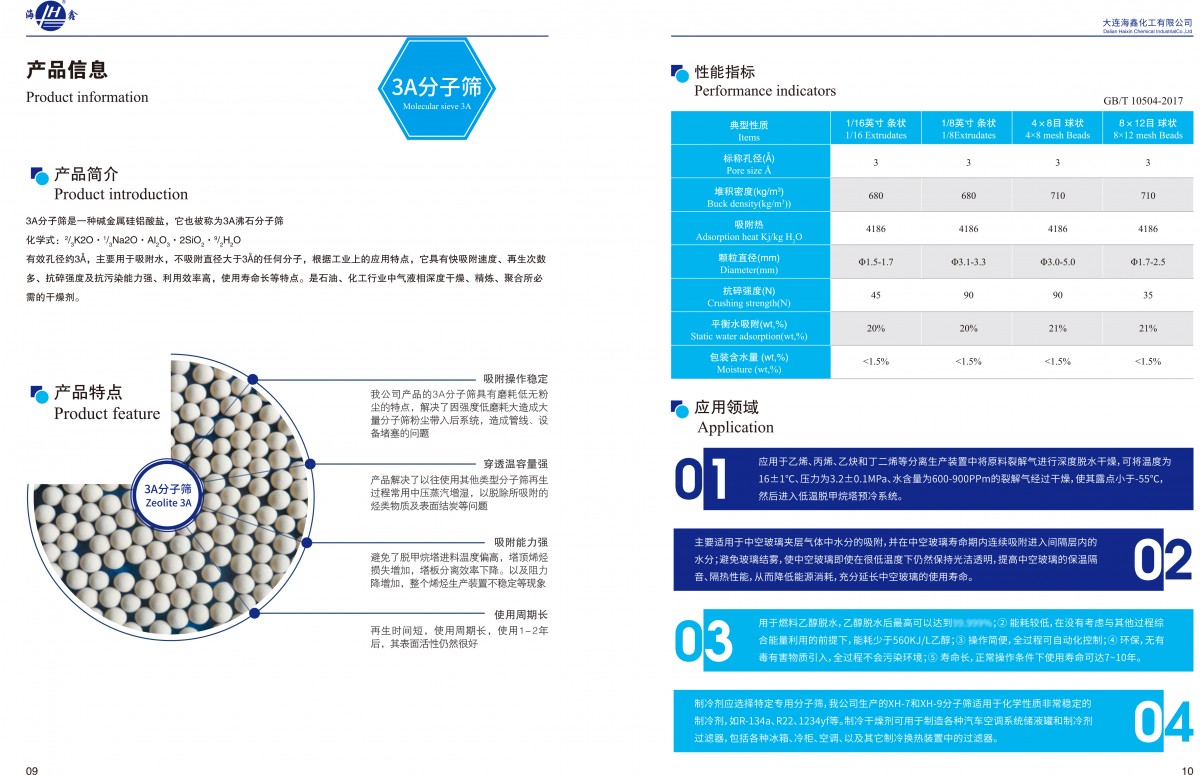
3A molecular sieve is an alkali metal silicate, also known as 3A zeolite molecular sieve.
Chemical Formula: 2/3 K₂O·1/3 Na₂O·Al₂O₃·2SiO₂9/2H2O,The effective aperture is approximately 3A, primarily used for adsorbing water, without adsorbing any molecule with a diameter greater than 3A. Based on its industrial application characteristics, it features rapid adsorption speed, multiple regeneration cycles, strong resistance to fracturing and contamination, high utilization efficiency, and a long service life. It is an essential desiccant for deep drying, refining, and polymerization in the oil and chemical industries.
Parameter
Categories | Typical characteristics | Symbol | 1/16 inch | 1/8 inch | 4x8 goal | 8x12 mesh |
3A | Bar | Spherical | ||||
Nominal Aperture (Å) | 3 | 3 | 3 | 3 | ||
Bulk Density (kg/m³) | ≥ | 680 | 680 | 710 | 710 | |
Absorption Heat | 4186 | 4186 | 4186 | 4186 | ||
Particle Diameter (mm) | Φ1.5-1.7 | Φ3.1-3.3 | Φ3.0-5.0 | Φ1.7-2.5 | ||
Impact Resistance Strength (N) | ≥ | 45 | 90 | 100 | 35 | |
Static water adsorption [75%RH, (35±1)℃] % | ≥ | 21 | 21 | 21 | 21 | |
Moisture Content in Packaging (wt,%) | ≤ | 1.5 | 1.5 | 1.5 | 1.5 | |
Dynamic Water Adsorption Capacity | ≥ | 15 | 15 | 10 | 10 | |
Static Ethylene Adsorption Quantity (mg/g) | ≤ | 3 | 3 | 3 | 3 | |
Granularity | ≥ | 98 | 98 | 98 | 98 | |
3A Molecular Sieve Features
Stable Adsorption Operation
Our 3A molecular sieve products feature low wear and no dust, effectively solving the issue of excessive molecular sieve dust entering the system due to low strength and high wear, which causes pipeline and equipment blockages.
Penetrating through temperature capacity is strong
Our product resolves the issue of using medium-pressure steam to humidify during the regeneration process of other types of molecular sieves, which is commonly used to remove adsorbed hydrocarbon substances and surface carbon buildup.
Strong adsorption capacity
Prevented high feed temperature to the CH4 tower, resulting in increased olefin losses at the tower top, decreased efficiency of plate separation, and increased resistance drop, leading to an unstable overall olefin production unit.
Long-lasting usage period
Short regeneration time, long service life; after 1-2 years of use, the surface activity remains excellent.
Application Fields
01. In separation production units for ethylene, propylene, acetylene, and butadiene, the deep dehydration and drying of raw material cracking gas can process cracking gas with a temperature of 16±1°C, pressure of 3.2±0.1MPa, and water content of 600-900PPm. After drying, the dew point is reduced to less than -55°C, and then it enters the pre-cooling system of the low-temperature CH4 tower.
02. Primarily designed for adsorbing moisture in the interlayer gas of insulating glass, it continuously absorbs moisture into the spacer layer throughout the lifespan of the insulating glass. This prevents condensation on the glass, keeping it clear and transparent even at low temperatures, enhancing the insulating and soundproofing properties of the insulating glass. Consequently, this reduces energy consumption and significantly extends the service life of the insulating glass.
03. Used for fuel ethanol dehydration, the ethanol can reach a very high degree after dehydration; low energy consumption, with less than 560KJ/L of ethanol when not considering the comprehensive energy utilization of other processes; easy to operate, with the entire process capable of automation; environmentally friendly, without introducing any toxic or harmful substances, ensuring no environmental pollution throughout the process; long lifespan, with a service life of up to 7-10 years under normal operating conditions.
04. Select specific molecular sieves for refrigerants; our XH-7 and XH-9 molecular sieves are suitable for refrigerants with highly stable chemical properties, such as R-134a, 1234yf, etc. Refrigerant drying agents can be used to manufacture various vehicle air conditioning system accumulator tanks and refrigerant filters, including filters for refrigerators, freezers, air conditioners, and other refrigerant heat exchange units.