

Distillation Tower (Column) Principle
Film evaporation and short-path distillation are essentially simple distillation, but they cannot achieve effective separation for mixtures with a boiling point difference below 30°C between the two components, and fractional distillation is required. The preheated feed liquid is added at the middle level of the fractionating column. A condenser is located at the top of the column to condense the vapor at the top into liquid. A portion of the condensate returns to the top of the column as reflux, while the remainder is continuously discharged as overhead product. In the upper part of the column (above the feed position), ascending vapor and reflux liquid undergo countercurrent contact and mass transfer. At the bottom of the column, a reboiler (film evaporator) is installed to heat the liquid and produce vapor. The vapor rises up the column, contacts the descending liquid countercurrently for mass transfer, and a portion is continuously discharged at the bottom as bottom product.
Above the tower's feeding position, the reconstituted components of the rising steam transfer to the liquid phase, while the light components in the reflux liquid transfer to the vapor phase. This mass transfer results in the concentration of light components in the rising steam gradually increasing. Only with sufficient interfacial contact surface and adequate liquid reflux flow, the steam reaching the tower top becomes a high-purity light component. The upper part of the tower completes the purification of the rising steam, i.e., removing the heavier components, hence it is called the rectifying section.
Below the tower's feeding position, light components in the descending liquid (including reflux and liquid added during feeding) transfer to the gas phase, while heavy components in the rising steam transfer to the liquid phase. With sufficient contact surface between the two phases and the amount of rising steam, the light components in the liquid reaching the bottom of the tower can be reduced to a very low level, thus achieving a high purity of the heavy components. The lower part of the tower completes the concentration of heavy components in the descending liquid, effectively removing the light components, and is therefore called the stripping section.
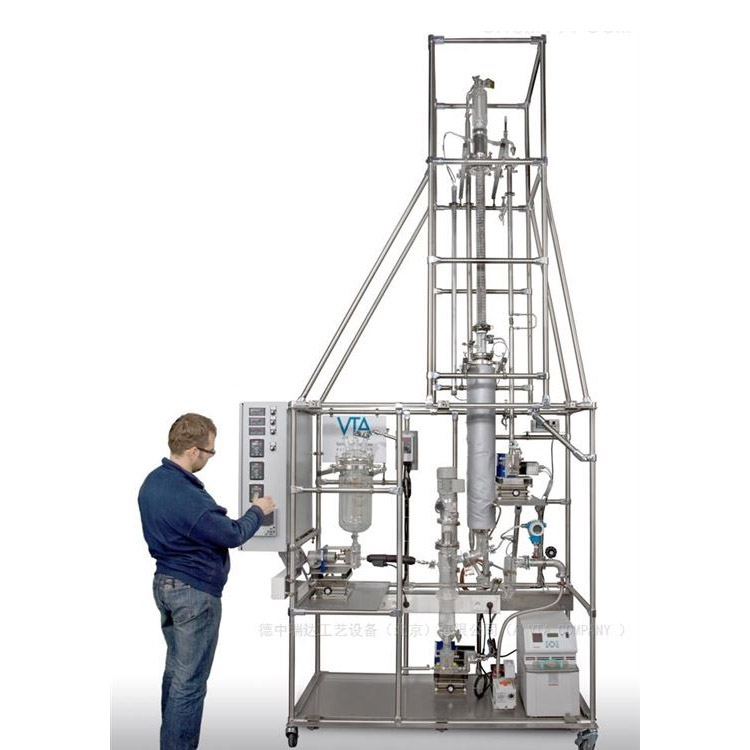
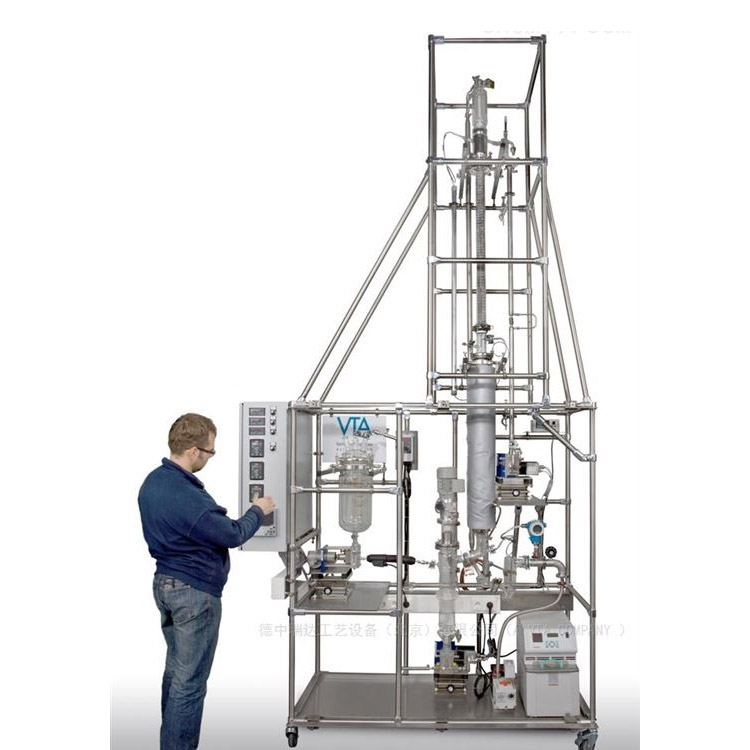
The components and basic configuration of the membrane evaporator with a rectifying column are as follows:
- Raw Material Supply System
Insulation System for Raw Material Supply
Pre-degasment section
Film Evaporator
Refined Column
External recirculation condensing system and reflux ratio controller
Cold Trap
- Discharge system for restructured fractions and light fractions
Continuous Feed System
- Heating and Condensation System
Vacuum System
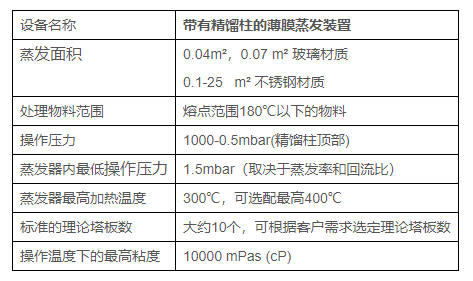
Approximately 100 kg of raw material is needed for a single experiment on the pilot-scale membrane distillation unit that yields reliable results. VTA offers membrane distillation testing services for both pilot and intermediate scales.
Other Optional Parameters:
Our systems are all customized to meet customer requirements, taking into account the characteristics of the materials and the frequency of equipment use. In addition to the basic configuration, the following options are available:
Insulation for specific parts of the system (feed, reconstituted fraction discharge, light fraction discharge) is used for handling materials with high melting points or high viscosities.
Material for contact with materials can be stainless steel, or other special materials and alloy materials.
- PLC and Visual Design
