

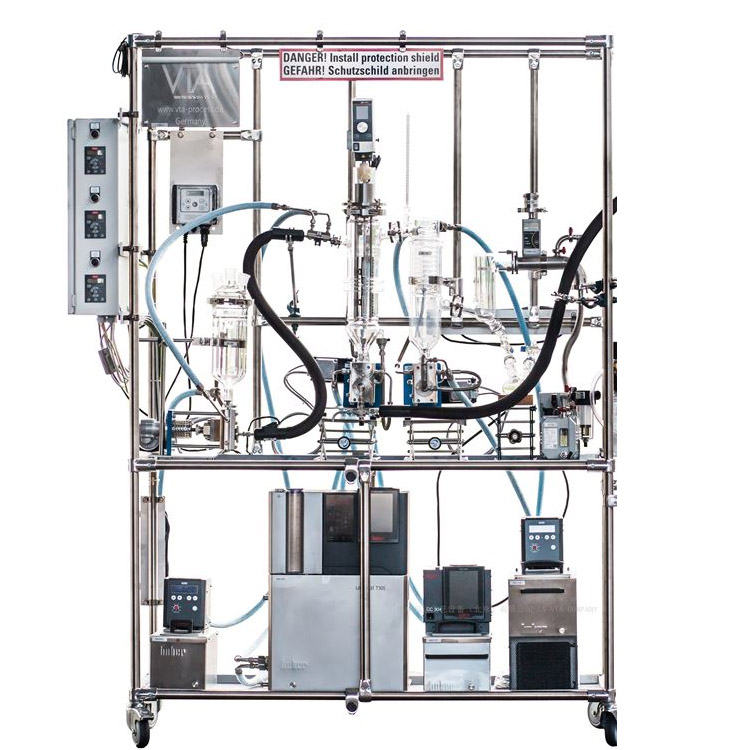
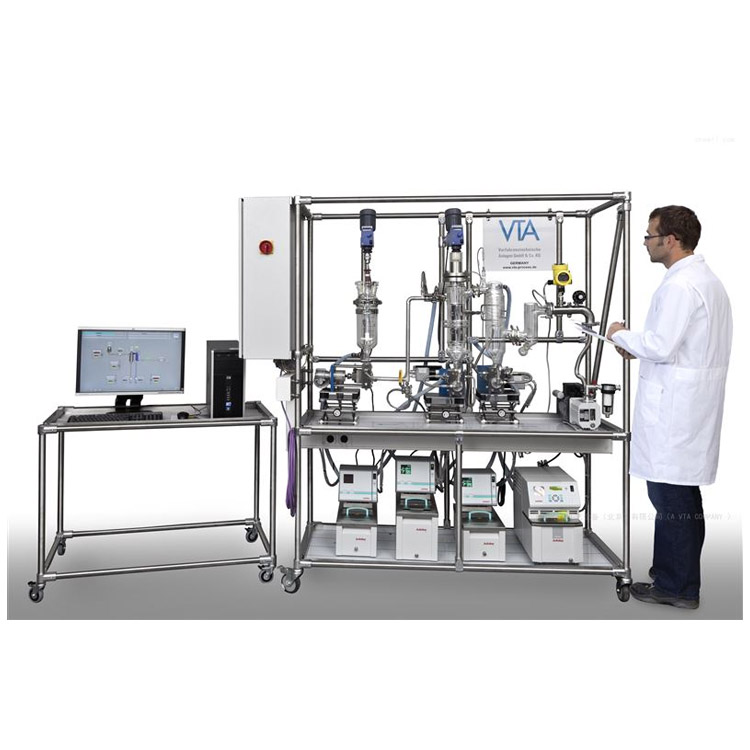
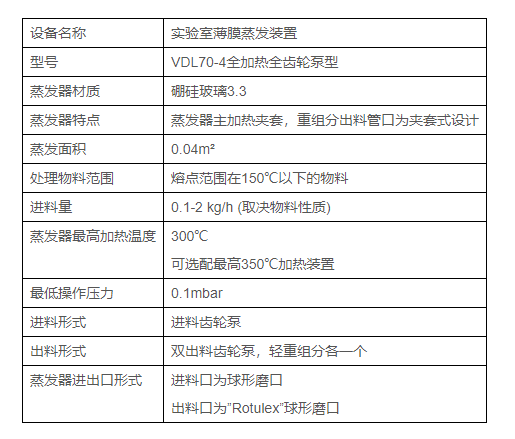
VDL70 Lab Film Evaporation Equipment Features:
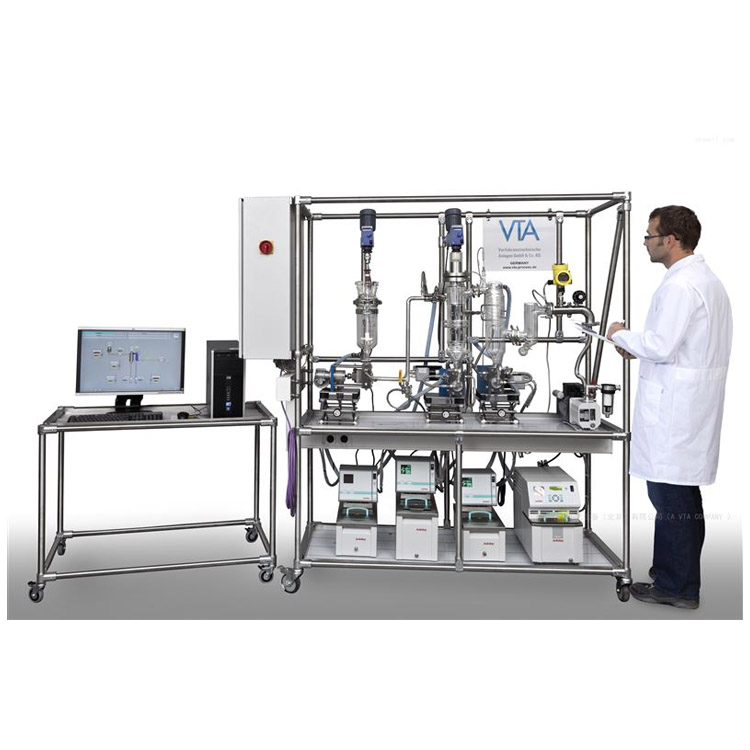
- The VDL70-4 film evaporator features an external condenser, suitable for desolventizing processes or operations with a high content of light components.
Evaporator made of glass material, allowing for a clear observation of the internal film formation.
- The condenser area can be increased according to the process to accommodate the process conditions.
- Suction gear pumps and pipelines with jacketed design for continuous and stable feeding, offering high repeatability and capable of handling high viscosity and high melting point materials.
Each configuration includes a discharge gear pump for both light and heavy fractions, continuously pumping the products into an atmospheric environment under vacuum conditions.
For laboratory setups, fewer clients typically opt for laboratory-grade thin film evaporation equipment. This is mainly because short-path/molecular distillation equipment, which is commonly used in laboratories, can largely cover the functions of thin film evaporation equipment. However, thin film evaporation equipment also has its specific application areas, such as:
The raw material contains a high proportion of light components that need to be removed, and the use of a薄膜evaporator would result in higher efficiency.
- No high vacuum level is required; typically, achieving separation at 1 mbar or below is sufficient.
- In the need for process scaling, film evaporators are more effective in preventing the splashing of light components compared to short-range evaporators, making them suitable for scaling up the film evaporation process to pilot or industrial production.
The film evaporator features a full jacket design, ensuring all parts in contact with the material can be heated after entering the evaporator. Moreover, the external condenser for light components can also be jacket-heated, allowing light components with high melting points to undergo heating treatment.
The thin-film evaporator can serve as a reboiler for a distillation column, offering excellent scalability. Modified, it can become a distillation unit with a thin-film evaporator as the reboiler, suitable for separating components with closely similar boiling points.
Featuring a feed gear pump for material intake, the pump's frequency is correlated with the feed rate, ensuring high repeatability of the feed amount.
Gear pump discharge can achieve real-time variation of distillation conditions and real-time sampling. The gear pump discharge rate can reach about one kilogram per hour. If operated continuously for 24 hours a day, ten to twenty kilograms of product can be obtained daily, which is a considerable amount for high-value-added products.
Due to the presence of gear pumps for both light and heavy fractions, sampling at the gear pump outlet can be done simultaneously. After weighing the samples separately, the feed quantity data and the distillation ratio of the light fraction can be obtained, which can guide the experiment process at any time. Since the feed is continuous, the discharge of both light and heavy fractions is also continuous. Sampling and discharge under vacuum are unrestricted, allowing for continuous distillation whether the light fraction is the product or the heavy fraction is the product.
There are two types of scraper rotors available for selection. The WRS roller-style rotor is suitable for handling materials with lower viscosity, while the SKR metal elastic scraper rotor is capable of dealing with materials of higher viscosity. This is due to the loading force exerted by the elastic metal blades on the scraper, which allows for excellent scraping and turbulent effects on the liquid film.
The heat transfer oil connection of the evaporator is designed as VTA*, featuring built-in high-temperature resistant graphite gaskets for easy disassembly. It boasts excellent sealing performance, ensuring no leakage at all under the high temperature of 300°C.
