
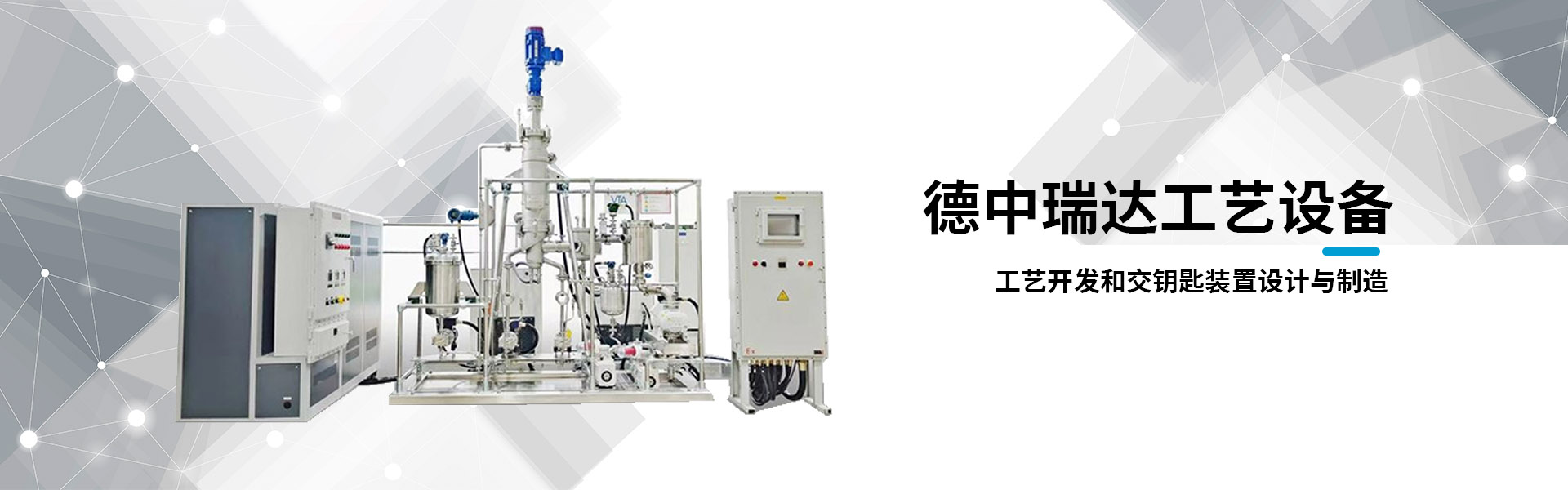
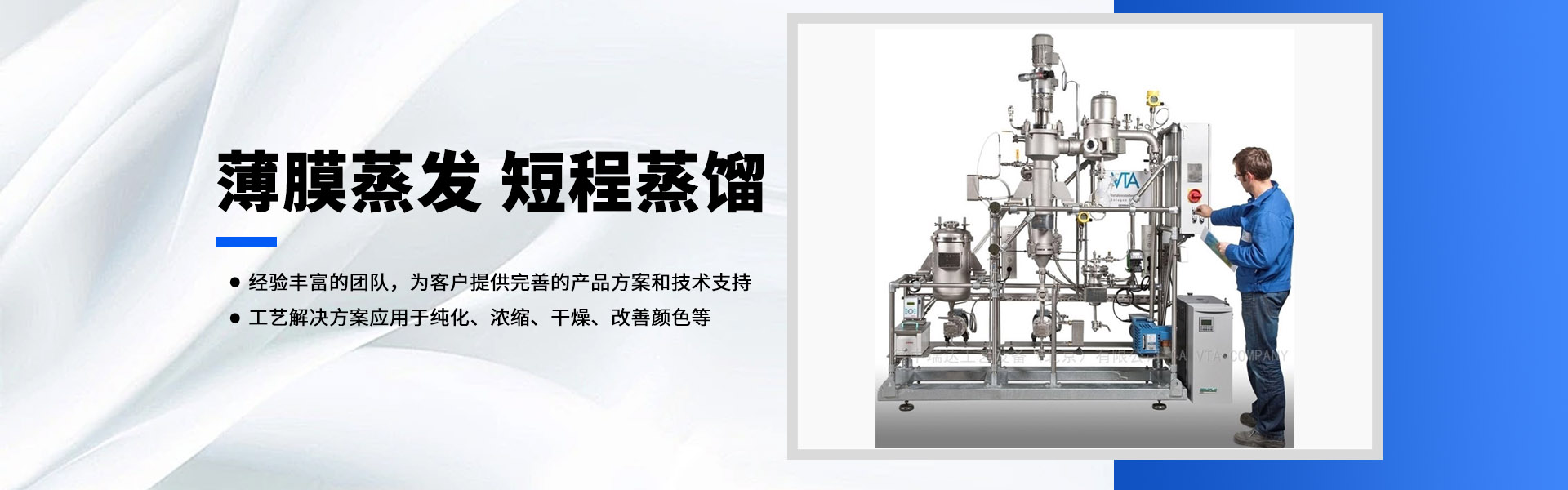
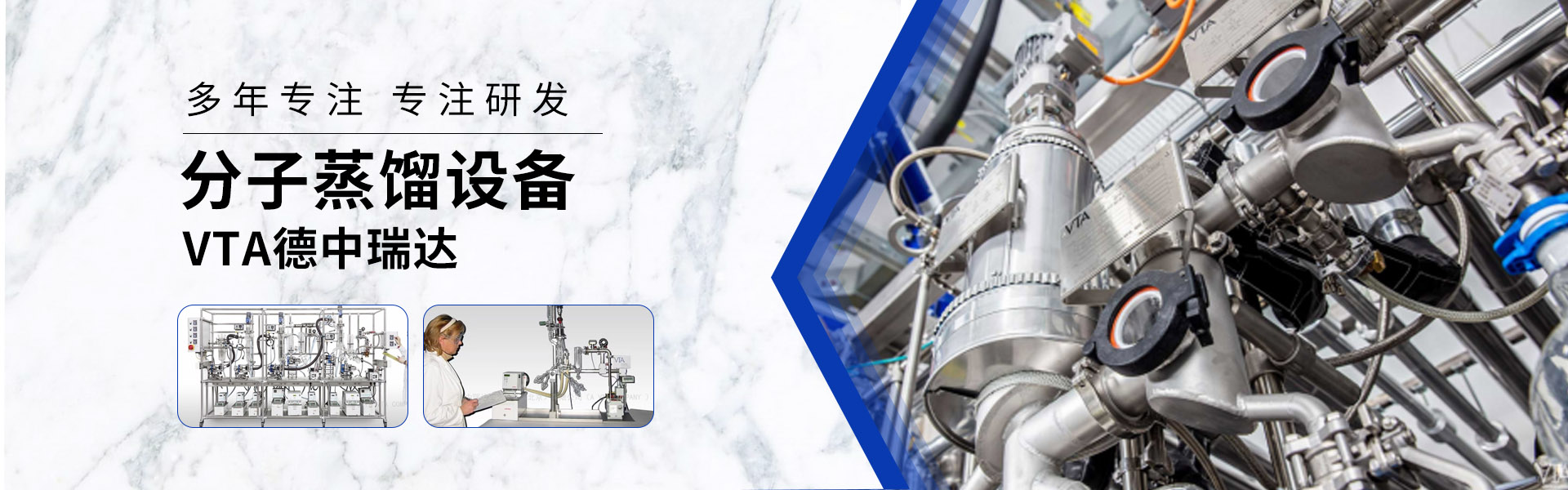

Molecular distillation technology is an efficient separation method that achieves separation by utilizing the different free paths of movement of substance molecules in a high vacuum state. This technology has widespread applications in industries such as chemical engineering and food processing. The following will introduce the process of its realization:
I. Principle
Molecular Mean Free Path:Molecular DistillationIt is based on the different average free paths of various types of molecules under high vacuum conditions. When a liquid is heated, lighter molecules, due to their shorter average free paths, can escape from the liquid surface and reach the condensing surface more quickly, while heavier molecules, with their longer free paths, find it difficult to reach the condensing surface.
2. Evaporation and Condensation: During the molecular distillation process, the material forms a thin film on the heating plate upon heating, with light molecules quickly evaporating and condensing on the condenser plate, while heavy molecules return to the raw material, thus achieving the separation of substances.
3. Vacuum Environment: To ensure the efficient operation of molecular distillation, the entire system must operate under high vacuum conditions to minimize the interference of gas molecules on the evaporation and condensation processes and to reduce the boiling point of the material.
Section II: Equipment Composition
1. The Evaporator: The evaporator is the core component of molecular distillation equipment, typically featuring a falling film or刮膜式 design to ensure that the material forms a uniform film on the heating surface, thereby enhancing the evaporation efficiency.
2. Condenser: Located opposite the evaporator, the condenser captures and condenses the light molecular vapor that escapes from the evaporator. The design of the condenser directly impacts the separation efficiency and the purity of the product.
3. Vacuum System: The vacuum system consists of a vacuum pump and related pipelines, which are used to maintain high vacuum conditions throughout the distillation system, ensuring the smooth operation of the molecular distillation process.
Step 3
1. Preheating and Feeding: Prior to the start of molecular distillation, the equipment must be preheated to reach the required operating temperature. Subsequently, the material to be separated is added to the evaporator through the feeding port.
2. Heating and Evaporation: Materials are heated in the evaporator, with light molecules quickly evaporating and condensing on the condenser, while heavy molecules remain in the evaporator or return to the feedstock.
3. Collection and Emission: After separation, light components are collected in the condenser, while heavy components are emitted through the exhaust port. The entire process requires temperature and pressure control to ensure effective separation.
Section IV: Advantages and Applications
Low-Temperature Operation: Due to the molecular distillation taking place under high vacuum, the boiling point of the material is significantly reduced, allowing for distillation at lower temperatures. This is particularly important for the separation of thermally sensitive substances.
2. Efficient Separation: Molecular distillation effectively separates substances with close boiling points, even achieving the separation of isomers, which is difficult to achieve with traditional distillation methods.
3. Application Fields: Molecular distillation technology is widely used in the petrochemical and food industries, particularly valuable in the preparation of high-purity compounds and extraction of natural products.
Molecular distillation technology achieves effective separation of substances under high vacuum conditions through its working principle and equipment design. This technique not only enhances separation efficiency but also reduces operating temperatures, making it particularly suitable for the separation of heat-sensitive and high-boiling-point substances. With the advancement of technology, molecular distillation technology is expected to demonstrate its strengths and application potential in more fields.
