

Anti-Wash Water Agitator
Sedimentation tank agitator selection
Submersible Flow Mixer for Blender

QJB Submerged Impeller Pumps, commonly referred to as underwater mixers, often encounter some issues during operation. Typical problems include unusual noises, during which the equipment emits a loud sound that can be heard over ten meters away. The current is within the normal range, and even a simple inspection is hard to pinpoint the issue. The entire equipment is divided into three parts: the mechanical assembly, the aluminum sealing component, the gearbox, and the motor. They are disassembled, inspected, analyzed, and processed separately.
1. Inspection of mechanical sealing components
The primary cause of mechanical seal failure is due to wear of the seal components and water ingress into the sealing chamber. Firstly, the mechanical seal assembly is disassembled, including the mechanical seal, oil seal, output shaft, bearings, and housing. Clean and inspect the end cover, check the relevant dimensions of the bearings and output shaft. If no issues are found, eliminate the possibility of defects in the mechanical seal components and potential malfunctions.
2. Analyze and inspect gearboxes
The gear box of this equipment features high precision machining, excellent heat treatment, thorough cleaning, and meticulous inspection of gears, gear shafts, and bearings. The gear surfaces are smooth, free of pitting and scoring, and the meshing side gaps are normal with a tooth shape of HA. There is no significant wear, and the radial and axial clearances of all bearings are normal. The inner and outer rings, as well as roller surfaces, are free of pitting. The overall quality is good, with reasonable axial clearances for all shafts. The output shaft of the sliding disk is free and without casing issues. There are no abnormal sounds. Therefore, the gear box's malfunction can be ruled out.
3. Motor Failure
Motor fault performance: Before disassembling the motor, convert it to air to identify issues. If the motor emits unusual sounds, there is excessive vibration; the motor shaft sleeve makes a hissing sound, and the motor fails to reach several tens of degrees and heat within 2 minutes. The bearing inner race has pitting areas due to pinpoint corrosion. The surface is rough, dull, and lacks luster. Pitting holes are clearly visible. The inner ring of the frame oil seal is damaged, and there are black spots on the bearing inner race, sleeve, and corresponding shaft necks formed by running circles.
Due to pitting on the inner race of the bearing, an elongated pit area is formed. When the bearing roller passes through, there is significant drag and noise. This may be the root cause of the abnormal noise in the submersible mixer motor, and thus, changing the bearing is proposed as a solution to this issue.
4. Issues to be explained
1) The motor's rotor shaft is the reference for the flow-promoting device. In addition to repairing the reference, all components must be disassembled and inspected, damaged parts replaced, and the equipment's performance restored.
2) The major overhaul time for diving equipment is typically every 5 to 6 years.
3) The common method for treating the small neck of the shaft is to increase the part, i.e., increase the diameter of the rotating section, add a shaft sleeve, utilize interference fit between the inner hole and the shaft, and the outer surface to meet the required dimensions, or replace the motor rotor shaft to completely solve the problem.
Additional Instructions for Submersible Agitator Installation
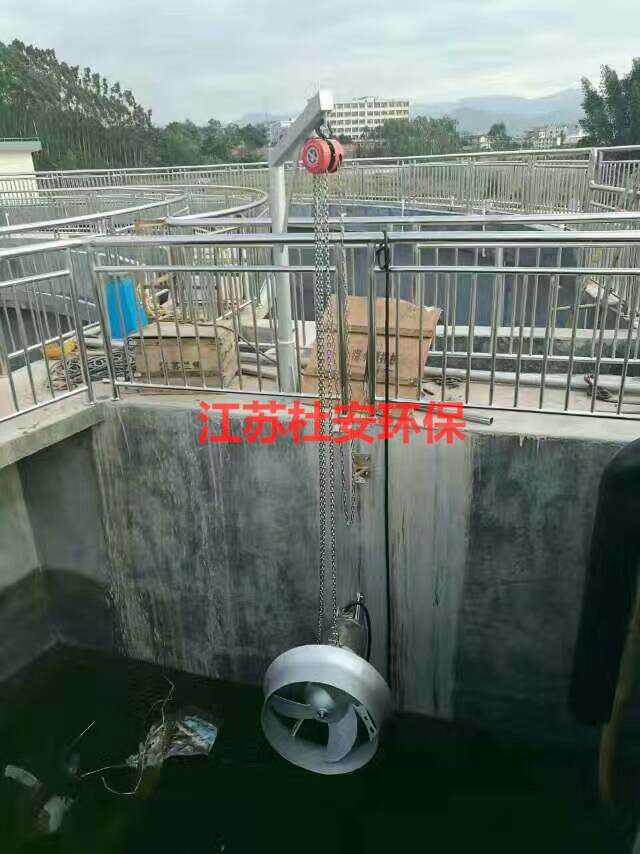
Ensure the verticality of the guide rod during installation, with the deviation between the upper and lower parts not exceeding 10MM. This allows the submersible mixer/pusher to move freely on the guide rod without jamming or excessive friction.
2. When the submersible mixer/pusher is horizontal, the lifting center of gravity is on the third hole counting from the impeller end. During installation, ensure that the lifting frame's lift aligns with the vertical line of the mixer/pusher's center of gravity. This allows the submersible mixer/pusher to move smoothly and freely during up and down lifting.
3. Prior to using the hoisting wire rope, please lubricate it with grease and refer to the national standards for lifting equipment for maintenance and operation of the hoisting equipment.
4. In the wastewater treatment industry, the junction of water and air is highly corrosive. Please apply anti-corrosion treatment to the installation system at this point, such as applying grease to the guide rod.
5. Do not rotate the submersible mixer/pusher during operation. Please adjust the angle during installation before running. Place the submersible mixer/pusher on the lower positioning plate, or directly on the bottom of the pool, to ensure the wire rope is not under stress.
6. General Submersible Mixers/Flow DriversThe immersion depth must not be less than 1.1M; otherwise, water vortices and cavitation are prone to occur.
Duwan Environmental QJB Submersible Agitator Specifications:
Model | Power (KW) | Blade Diameter (mm) | Axial Thrust (N) | Weight (kg) |
QJBO.85/8-260/3-740C/S | 0.85 | 260 | 163 | 55 |
QJB1.5/6-260/3-980C/S | 1.5 | 260 | 290 | 55 |
QJB2.2/8-320/3-740C/S | 2.2 | 320 | 582 | 110 |
QJB4/6-320/3-980C/S | 4 | 320 | 609 | 115 |
QJB1.5/8-400/3-740S | 1.5 | 400 | 600 | 70 |
QJB2.5/8-400/3-740S | 2.5 | 400 | 800 | 70 |
QJB3/8-400/3-740S | 3 | 400 | 850 | 70 |
QJB4/6-400/3-980S | 4 | 400 | 1200 | 73 |
QJB4/12-620/3-480S | 4 | 620 | 1100 | 184 |
QJB5/12-620/3-480S | 5 | 620 | 1800 | 184 |
QJB7.5/12-620/3-480S | 7.5 | 620 | 2600 | 229 |
QJB10/12-620/3-480S | 10 | 620 | 2900 | 229 |
QJB12/12-700/3-480S | 12 | 700 | 3100 | 250 |
QJB15/6-900/3-200S | 15 | 900 | 4200 | 305 |
QJB18.5/4-900/3-290S | 18.5 | 900 | 5300 | 315 |
QJB22/4-900/3-290S | 22 | 900 | 6100 | 335 |
One-year warranty
Matching site-mounted stainless steel control box installation and use