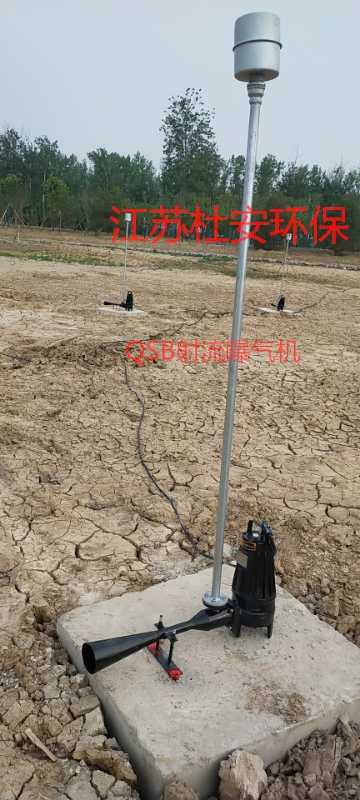
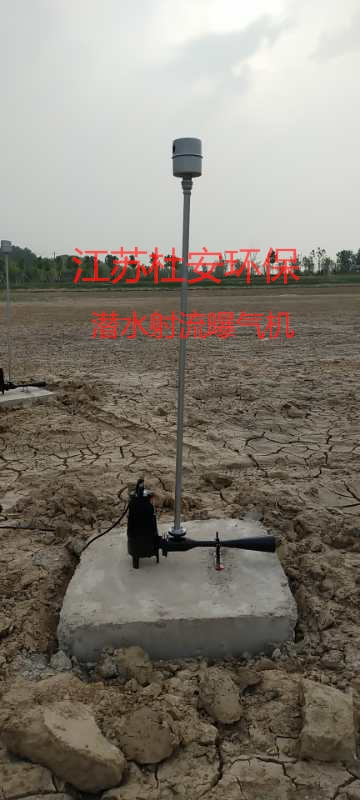
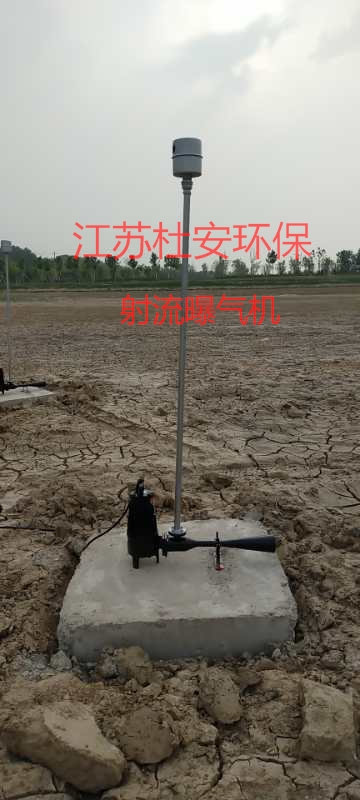
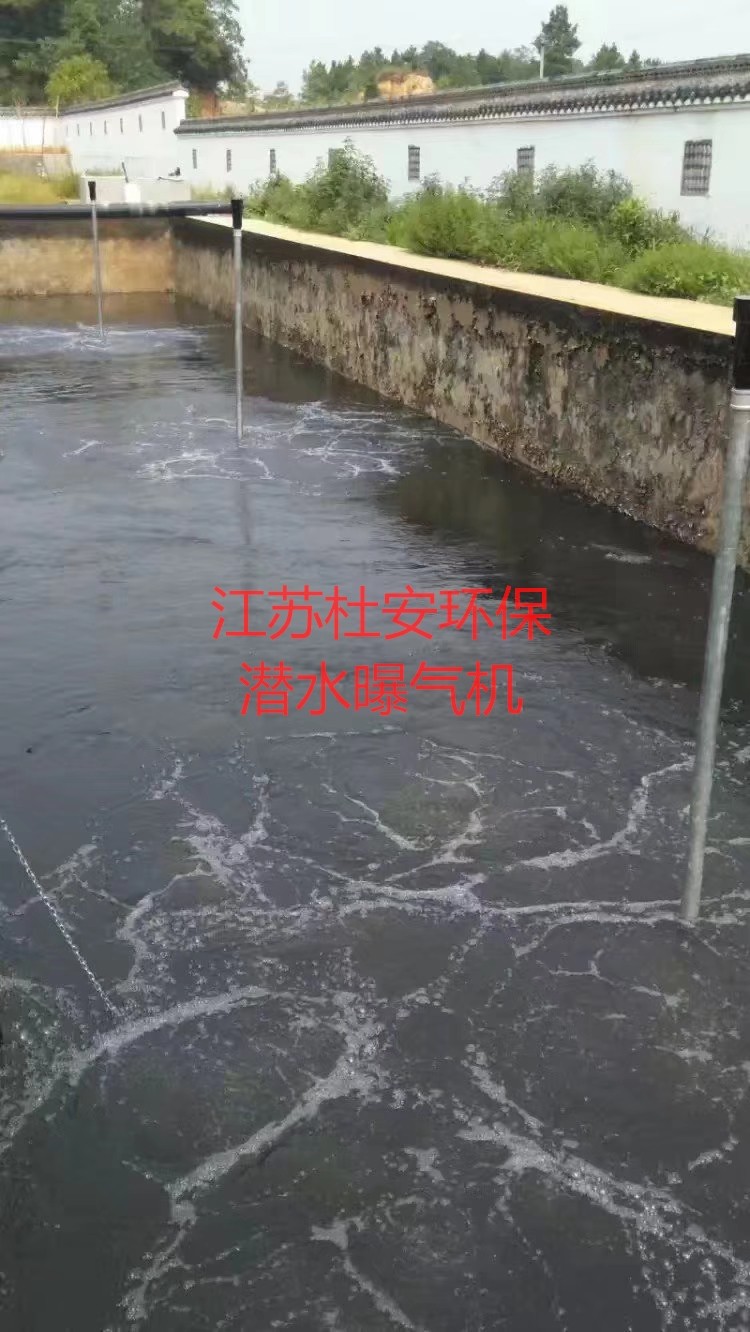
Jiangsu Du'an Environmental Protection QSB1.5 Submersible Jet Aerator
Deep Water Self-Priming Submersible Jet Aerator
2. Model: QSB1.5
3. Quantity: 1 unit
4. Key Technical Specifications
Model | QSB1.5 |
PowerkW) | 1.5 |
Rated CurrentA) | 3.7 |
Rated VoltageV) | 380 |
RPMr/min) | 2900 |
FrequencyHz) | 50 |
Insulation Grade | F |
Intake Volume(m3/h) | 22 |
Enhanced Oxygenation CapacitykgO2/h) | 1.26 |
Intake manifold diameter(mm) | 32 |
5. Features and Applications
The Deep-Sea Self-Priming Submersible Jet Aerator simultaneously stirs and oxygenates water bodies, producing fine bubbles for high oxygen transfer rates and the advantage of wheel clog-free operation. Its powerful unidirectional liquid flow creates an effective convection cycle, and the motor load varies little with water level changes, making it particularly suitable for pools with significant water level fluctuations. Without the need for compressed air, the submersible aeration depth can reach10 meters. Cost-effective, with easy installation and maintenance. Main application scopes include:
(1) Deep Water Aeration
(2) Aeration and mixing in the bio-reactor.
(3) Sludge aeration and mixing
(4) High-concentration organic wastewater treatment process.
6. Structure and Working Principle
The deep-sea self-priming submersible jet aeration unit is mainly composed ofThe WQ type submersible sewage pump, Venturi tube, diffuser, intake pipe, and silencer, etc., are composed. The working principle is: the water flow produced by the submersible pump passes through the nozzle to form a high-speed jet, creating a vacuum around the nozzle that draws air through the intake pipe. This forms a high-speed mixture of liquid and air, which is喷射出去, carrying many bubbles. The water flow, swirling and stirring in a larger area and depth of water, completes aeration.
7.Material
The pump base and pump casing are cast from HT250 cast iron, offering certain corrosion resistance and the ability to withstand impact loads.
The aeration pump motor shaft is manufactured using 2Cr13 corrosion-resistant material, and measures have been taken in the structural design to eliminate stress concentration.
The mechanical seal of the aeration pump can be made of silicon carbide/silicon carbide, tungsten carbide/tungsten carbide, or silicon carbide/tungsten carbide materials, depending on the pumped medium. The design service life of the mechanical seal exceeds 12,000 hours.
The impeller pump bearings are equipped with imported NSK bearings, which have a cumulative design lifespan exceeding 40,000 hours.
The static seal of the submersible jet aeration machine utilizes Nitrile-70 O-rings.
All fasteners on the 6 Submerged Jet Aerator are made of stainless steel.
The 7 Submerged Jet Aerator air intake pipe is made of galvanized material.
8 nozzles are made of cast iron.
The submersible aeration pump, powered by a three-phase power supply, should have its rotation direction checked upon initial startup or after each reinstallation. An incorrect rotation direction can reduce efficiency and damage the pump.
The inspection method is as follows: Before the submersible aeration pump is fully installed, look at the suction inlet from the bottom up, and the impeller rotates counterclockwise. If multiple submersible aeration pumps are connected to one controller, each pump must be checked individually. If the rotation direction is incorrect, you can change the direction by swapping the positions of any two of the three-phase wires on the controller.
Schematic Installation Diagram of Jet Submerged Aeration Machine
QSB Submersible Jet Aerator Pricing
Duwan Environmental's QSB1.5-50 Submersible Jet Aeration utilizes a unique hydraulic component design, optimizing the gap between the impeller and guide vanes (less than)The gap between the impeller and guide vanes of the new aeration pump is much smaller (1mm) compared to the older model's gap (greater than 5mm).
With the star-shaped impeller design and radial water-gas mixing channels, driven by a high-speed motor, the impeller generates centrifugal force in the water. Under the action of centrifugal force, a negative pressure area is formed around the impeller. Air is吸入 through the intake pipe, and the air and water are shredded by the high-speed rotating impeller in the mixing chamber. The gas-liquid turbulent mixing is then rapidly ejected through the diffuser channel, forming bubbles that dissolve oxygen from the air into the water. Due to the powerful jet of water and the star-shaped impeller cutting the air bubbles finer, smaller, and more densely, the contact surface between the air bubbles and the liquid to be treated is significantly increased. The air is sheared into numerous tiny bubbles, greatly enhancing the mass transfer area and creating a spiral flow cycle. A large amount of oxygen is dissolved in the water, resulting in a high oxygen utilization rate.