


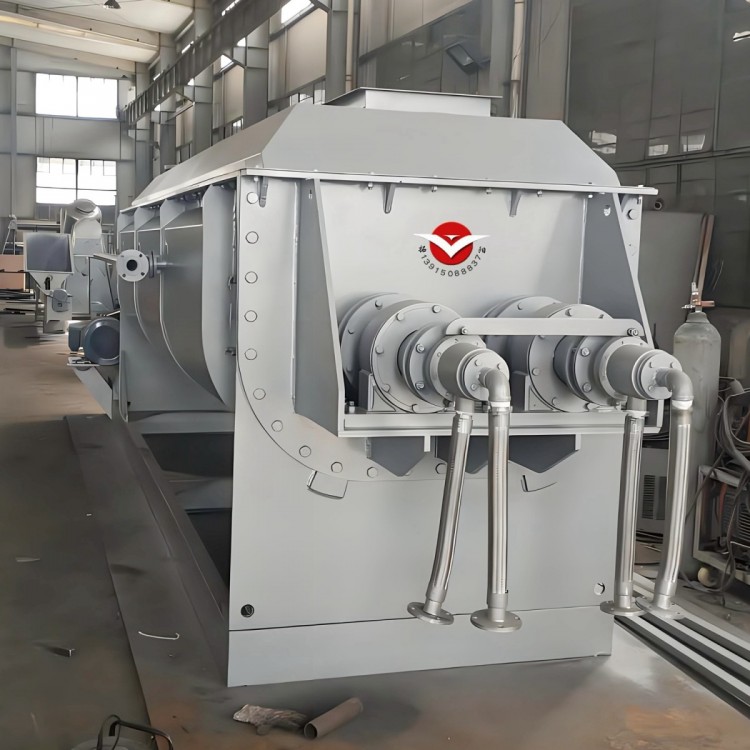
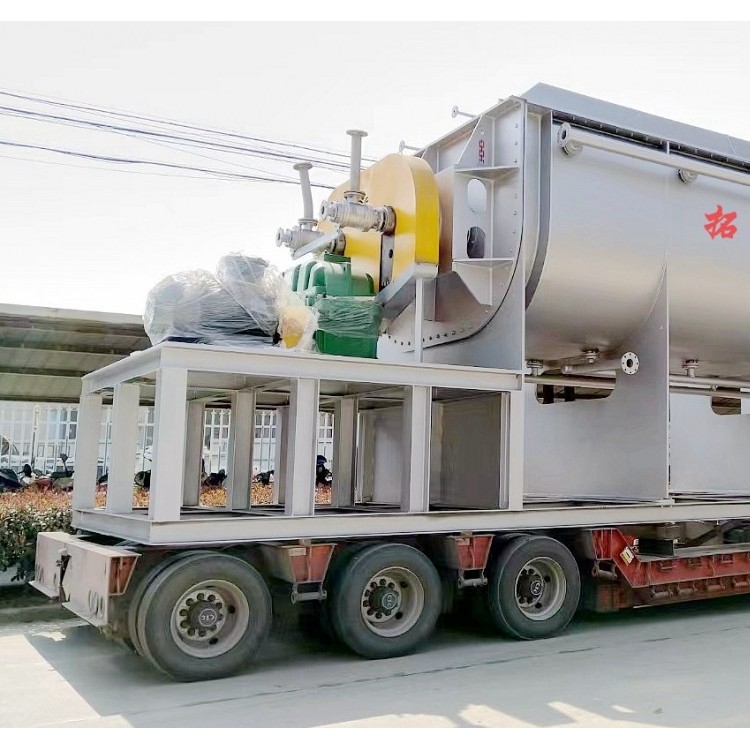
Sludge Dewatering Machine/Hollow Blade Dryer is a horizontal continuous mixing dryer primarily using heat conduction. Since the heat required for drying is indirectly heated by heat conduction, the drying process requires minimal or no gas to remove moisture. This significantly reduces heat loss carried away by air flow, improves heat utilization, and is an energy-saving drying equipment. The paddle blade dryer is widely used in the drying of powdered, granular, filter cake, and slurry materials in industries such as petrochemicals, chemicals, metallurgy, food, medicine, and pesticides.
Operating Principle
The hollow paddle dryer has a heat transfer surface consisting of blades, agitator shaft, and wall, with a significant portion of the heat transfer area being occupied by the blades, thus ensuring a compact structure and a high heat transfer area per unit volume. Additionally, the vigorous movement of the material due to stirring and mixing results in a high heat transfer coefficient. This leads to a small footprint and space requirements, thereby saving on factory construction costs. The drying process consumes minimal gas, with low flow rates and a small amount of dust carried away by the gas, making it easy to recover the dust after drying, with compact recovery equipment, thus saving on equipment investment. For drying processes requiring solvent recovery, solvent concentration can be significantly increased. Due to the unique paddle structure, the material alternates between compression and relaxation during the drying process, enhancing the drying efficiency. The filling rate of the material in the drying chamber is very high, reaching 80%-90%, and the material's residence time can be adjusted by varying parameters such as feeding speed, agitator shaft speed, and material filling degree, from a few minutes to several hours. Moreover, the movement of the material from the feeding to the discharge point within the dryer is essentially a piston-like motion, resulting in a narrow distribution of residence times and ensuring uniform moisture content in the product. The blades have a certain axial angle on the agitator shaft, allowing for continuous drying of the material.
Equipment structure
For example, let's introduce the structure of a twin-axis type (the hollow impeller dryer can be single, twin, or four shafts). It consists of a W-shaped shell with a jacketed end face, a top cover, two hollow shafts with blades, end caps at both ends, rotating joints for medium passage, metal flexible hoses, and a transmission mechanism including gears and sprockets.
The core of the equipment consists of two hollow shafts and hollow paddle blades welded to them. The blades are shaped as trapezoidal hollow semi-circles and are capable of admitting heating medium. In addition to their stirring function, they also act as heat transfer mediums. The two main heat transfer sides of the blades are sloped, allowing particles to quickly slide off as the blades rotate when in contact with the material, continually renewing the heat transfer surface and enhancing heat transfer. A scraper is located at the triangular bottom of the blades to scrape up material that has settled at the bottom of the shell, preventing the formation of dead spots.
The arrangement of the blades and the dimensions of each part are specified. In addition to the blades in the feeding, drying, and discharge zones, auxiliary mechanisms are also installed to ensure stable and even operation of the entire unit. Moreover, the dwell time can be adjusted as well.
Equipment Features
Paddle dryer main features include:
The equipment features a compact structure, large effective heat transfer area, and minimal footprint.
2. Well-mixed, high thermal efficiency, and excellent drying performance
3. Propeller shafts can intermesh and have self-cleaning capabilities, preventing material from sticking to the wall.
4. Low energy consumption, minimal operational costs
5. Low dust carryover and minimal material loss
6. Indirect heating, non-contaminating materials
7. Low blade shaft speed, without damaging product shape and properties.
10. The equipment offers high operational flexibility and runs smoothly and reliably.
Applied
Propeller dryers have been successfully applied in fields such as food, chemicals, petrochemicals, dyes, and industrial sludge. The equipment's heat transfer, cooling, and mixing capabilities enable it to perform the following unit operations: calcination (low temperature), cooling, drying (solvent recovery), heating (melting), reaction, and sterilization. The propeller blades, which are also heat transfer surfaces, increase the heat transfer area per effective volume, shortening processing time. The wedge-shaped propeller blades also feature self-cleaning properties. The compression-expansion mixing function ensures uniform mixing of materials. The materials move axially in a "piston flow," resulting in minimal gradients of temperature, humidity, and mixing degree within the axial zone.
The blade dryer, utilizing thermal oil as the heat medium, can perform low-temperature calcination. For instance, the calcination of calcium sulfate dihydrate (CaSO4·2H2O) converts it to calcium sulfate hemihydrate (CaSO4·1/2H2O). Sodium bicarbonate (NaHCO3) is calcined to produce soda ash (Na2CO3), and so on.
Cooling mediums such as water or cooling brine can be used for cooling purposes. For instance, it is used in the soda ash industry with paddle blade coolers, replacing outdated air-cooled coolers, which saves on energy and tail gas treatment equipment, reduces operating costs, and can also be used for cooling titanium dioxide powder, nickel-iron alloy powder, and various powdered or granular materials. Within a single unit, materials can be cooled from 1000℃ to less than 40℃.
Dry, the primary function of the equipment is to process solvent recovery, energy consumption, and environmental control in an ideal, easily manageable state without using hot air. Particularly suited for materials requiring solvent recovery, flammable, oxidizable, and thermosensitive. Widely used in the fine chemical, petrochemical, and dye industries.
Within the axial range, the uniformity of temperature, humidity, and mixing allows the equipment to be used for heating or melting, or for some solid material reactions. It has been successfully used in the compound fertilizer and modified starch industries. The paddle dryer can be used for sterilization of food and flour. The large heating area per unit effective volume quickly raises the material to sterilization temperature, avoiding quality changes due to prolonged heating.