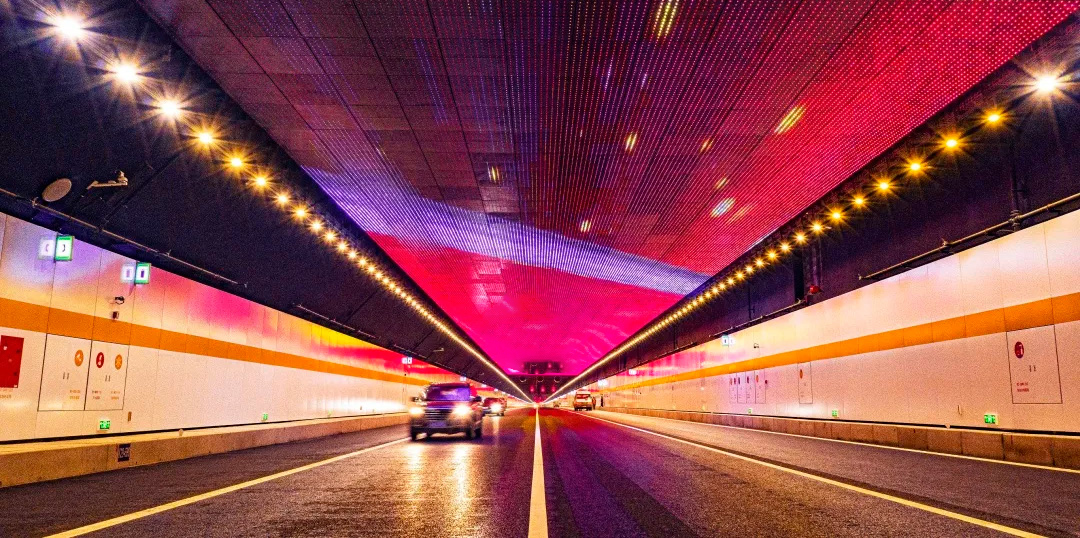

"Starry" and "Highway" are always associated with poetic romance, and such a dreamlike scene has now come to life in Taihu Tunnel. As vehicles enter the tunnel, they discover a stretch over 10 kilometers, brimming with surprises: both ends of the entrance and exit are equipped with 150-meter-long "Starry Ceiling" fatigue alert zones. At 5 kilometers into the tunnel, drivers also encounter a 150-meter-long "Dome" fatigue alert zone composed of LED strips. This interplay of light and shadow transforms the lengthy and monotonous journey through the extra-long tunnel into an engaging experience, ensuring safer driving conditions.
The Taihu Tunnel spans 10.79 kilometers and features twin tunnels with six lanes in each direction, making it one of the longest lake-bottom tunnels in China. It is also the nation's first intelligent tunnel, where advanced technologies such as full-frequency wireless communication, BeiDou navigation, and visual inspection positioning are deeply integrated into the construction of a highway.
From the initial entry to the acceptance and opening of the tunnel, the project team continuously overcame the vast scale, organizational challenges, and technical complexity of the Taihu Tunnel's electromechanical system construction, as well as the stringent environmental protection and tight schedule requirements. They consistently focused on the themes of "intelligence" and "safety," breaking through obstacles and advancing."Due to the fact that the support brackets and bridge cable installations for the mechanical and electrical construction are located in a cable tray at a height of 3.3 meters above the ground, and the cable tray is a narrow space of only 60 cm wide and 80 cm tall, we not only have to consider the challenges of working in such a confined space but also ensure that we do not obstruct the ground drainage system or the construction of fire pipelines. Therefore, we have to work suspended in the air," said Xia Changqing, the General Engineer of the Domestic Engineering Division at Zhong Zhi Group's Tek Company.
After on-site research, the project team proposes replacing traditional scaffolding with portable articulated boom platforms for elevated work. This not only addresses the issue of limited construction space but also enhances work efficiency. Additionally, to effectively tackle multiple cross-construction activities, process integration, and numerous safety concerns, the project team fully utilizes BIM technology during construction. This includes simulation for installation positioning and equipment selection, timely correction of deviations, and on-site technical exchanges with various systems and sections to resolve issues related to foundations, pipelines, and interfaces.
To ensure the orderly installation of pipelines in ultra-long tunnels, we have innovatively adopted a 300-meter template method: using the previous 300-meter pipeline installation as a template, we have integrated multiple verifications, continuously optimized, and compiled a sample section construction plan, which has been applied to subsequent pipeline installations, laying a solid foundation for the efficient progress of the electromechanical engineering for the entire project, said Zhang Tao, the Project Manager of Taihu Smart Tunnel, China Consulting Group.
To fully grasp the tunnel's operational status and ensure the safety of tunnel operations, the project team has gone "to great lengths." They have enhanced the existing Taihu Tunnel Monitoring System by integrating intelligent perception and analysis technologies based on dual-spectral, multi-target radar, and fiber-optic vibration traffic event detection systems. This enables intelligent联动 and control of lane management and information prompts, zonal broadcasting, and smart lighting control. Moreover, relying on full-frequency wireless communication and Beidou navigation, the tunnel has introduced for the first time visual inspection positioning and gas detection technologies, forming the "smart blood vessels" of an ultra-long tunnel, effectively enhancing tunnel traffic safety management.