

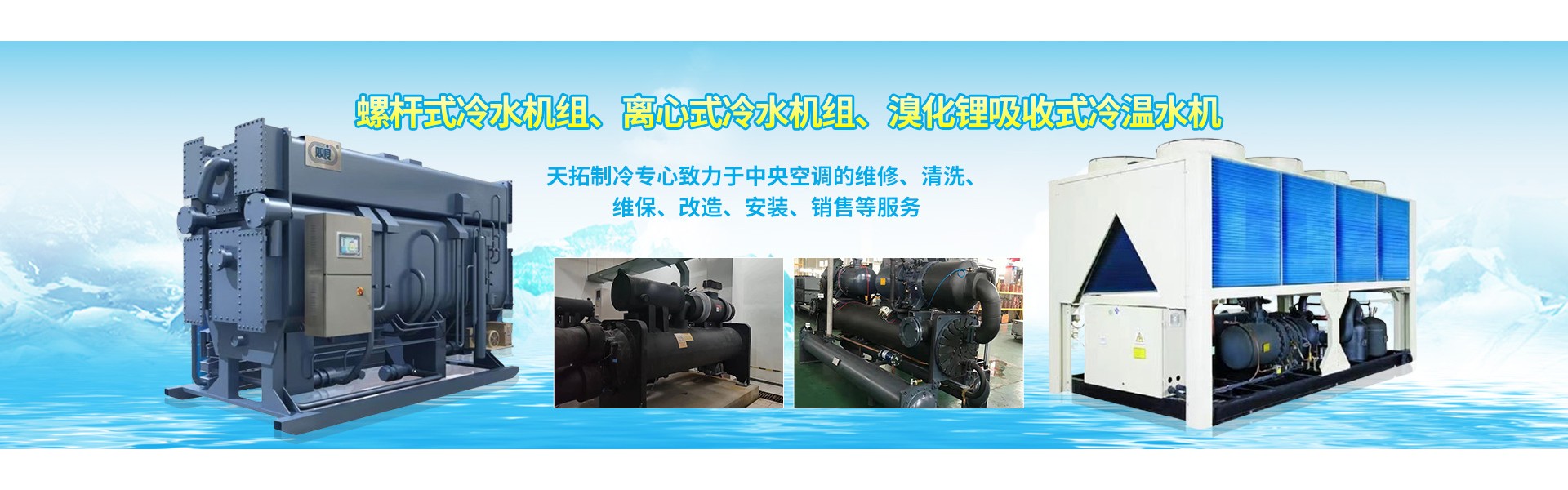


How to use a screw-type chill water unit on a daily basis?
How to Use a Screw Chiller Daily
In large-scale refrigeration or air conditioning applications, multiple machines are required to achieve the desired effect. However, screw compressors with a refrigeration capacity ranging from 30KW to 1500KW are sufficient to cover various refrigeration scales and are easy to adjust. In other words, the usage of screw compressors, in terms of market competitiveness compared to similar products in the industry, can be said to have an advantage.
Maintain clean and well-ventilated server rooms, schedule regular cleaning and descaling of the condensers to ensure the equipment operates normally and stably. For water-cooled chillers, ensure the cooling tower is kept clean and the air around it is circulated, maintaining low temperatures to prevent debris from entering the cooling tower and reducing heat dissipation efficiency. For screw chillers, consistently keep the exterior of the chiller's heat exchanger pipes clean, ensure good air circulation around them, maintain low temperatures, and regularly clean the scale buildup on the pipes.
What should be done before cleaning the refrigeration system?
What should be done before cleaning the refrigeration system?
For contamination in the refrigeration system piping, a cleaning agent can be used. Prior to cleaning, the refrigerant in the refrigeration system must be released, followed by removing the compressor and draining the refrigeration oil from the process pipe. During the cleaning process, first remove the compressor and desiccant filter, then disconnect the capillary tube (or expansion valve) from the evaporator. Connect the evaporator to the condenser using a pressure-resistant flexible hose, and then securely connect the cleaning equipment to the compressor's intake and exhaust pipes with another hose. Subsequently, clean the equipment used, such as pumps, tanks, filters, dryers, and various valves. Learn about the advantages of screw-type chillers.
The unit of the screw-type chillers mainly consists of the gaseous refrigerant leaving the evaporator. After undergoing adiabatic compression by the compressor, it becomes a high-temperature and high-pressure state. The compressed refrigerant then undergoes isobaric cooling and condensation in the condenser, transforming into a liquid refrigerant after condensation.
Further expanded to low pressure through throttling valves. The liquid refrigerant at low temperature and pressure absorbs heat from the cooled substance in the evaporator, transforming into a gaseous refrigerant. The gaseous refrigerant then enters the compressor through the pipes, initiating a new cycle. Advantages of using screw chillers.
Compared to reciprocating pumps, water source heat pumps have simpler structures, fewer moving parts, and a lower price for maintenance. They lack the inertial force of reciprocating motion, operate at high speeds with smooth movement, and are easy to handle. The units are lightweight and offer high cooling capacity per unit. Due to the absence of clearance volume in the cylinder and intake and exhaust valve plates, they have a higher volumetric power.
Screw-type chillers have fewer vulnerable parts, with components being only one-tenth of piston-type, ensuring reliable operation and easy repair; screw chillers are insensitive to wet strokes, and water source heat pump maintenance companies assure minimal liquid presence, eliminating the risk of liquid impact. Adjustment is convenient, and cooling capacity can be infinitely adjusted via a slide valve.


