


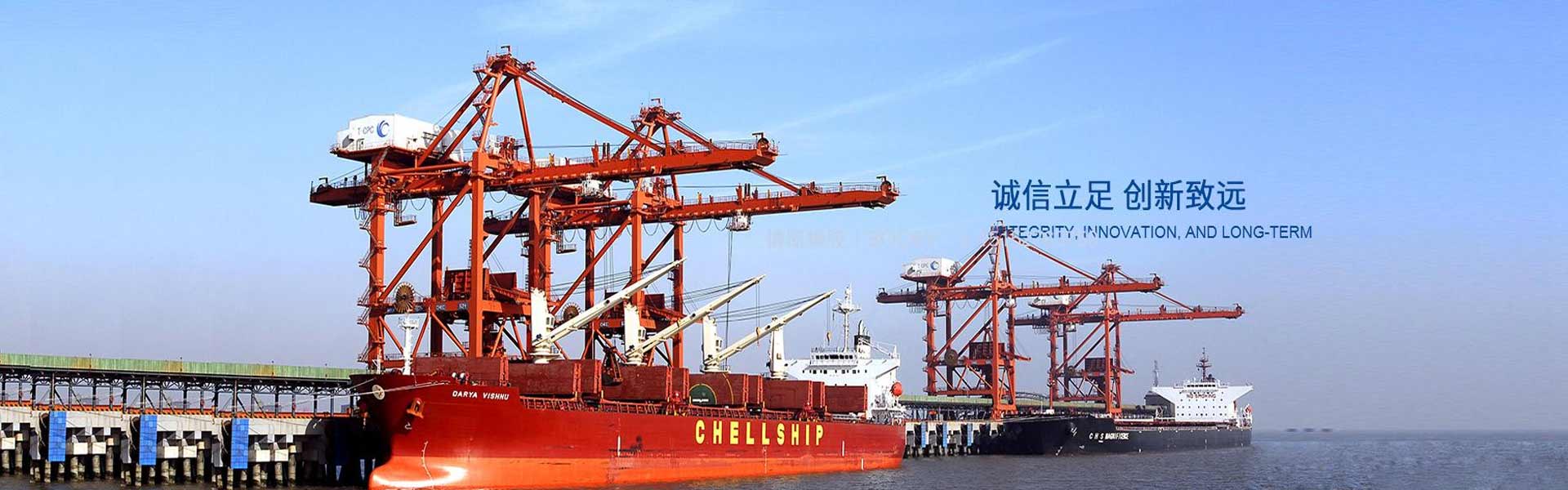

Port is locatedPlease provide the Chinese content to be translated.、Jiang、River、Lake、ReservoirThe coastal transportation hub equipped with intermodal facilities, enabling safe entry and mooring for vessels. The port serves as a gathering point and hub for land and water traffic, a distribution center for industrial, agricultural, and foreign trade import and export goods, as well as a place for vessel mooring, cargo loading and unloading, passenger embarkation and disembarkation, and supply replenishment.
In China,Coastal PortConstruction focuses primarily on coal.ContainerImported iron ore,GrainThe company has been advancing transportation systems such as land-sea roll-on/roll-off and deep-water sea channels, with a particular focus on strengthening the construction of container transportation systems. Efforts have been concentrated on...Dalian、Tianjin、Qingdao、Shanghai、Ningbo、TangshanNo Chinese content provided.ShenzhenA series of deep-water container terminals have been constructed at multiple ports, laying the foundation for the formation of China's container hub ports; the construction of the coal transportation system has been further strengthened, with a new batch of coal loading and unloading ships completed.DockIn addition, a number of import crude oil and iron ore terminals have been reconstructed and expanded. By the end of 2004, the coastal ports had over 2,500 berths of medium grade and above, including more than 650 with a capacity of 100,000 tons or more; the total container throughput reached 61.5 million TEUs, placing it at the top of the world. Some major ports have an annual total throughput exceeding one billion tons, such as Shanghai Port, Shenzhen Port, Qingdao Port,Tianjin Port、Guangzhou PortTangshanHong KongNingbo Port, etc.
In 2012, the total cargo throughput of all national ports reached 10.776 billion tons, an increase of 7.37% year-on-year. Among them, coastal ports completed 6.88 billion tons, while inland waterway ports completed 3.896 billion tons, marking growth rates of 8.2% and 5.9% respectively.
In 2012, the national ports handled a passenger throughput of 194 million, remaining relatively stable compared to 2011; of which, coastal ports handled 79 million, while inland ports handled 115 million, marking a 1.5% decrease and a 0.8% increase, respectively.
In 2012, the total foreign trade cargo throughput across all national ports reached 3.06 billion tons, an increase of 9.68% over the previous year. Among them, coastal ports handled 2.786 billion tons, while inland waterway ports handled 271 million tons, marking growth rates of 9.5% and 12.0%, respectively.
In 2012, the national ports handled 177 million TEU in container throughput, an increase of 8.43% year-on-year. Among them, coastal ports completed 158 million TEU, while inland waterway ports handled 19.5 million TEU, marking respective year-on-year growths of 8.0% and 12.3%.
Over the past decade, China's coastal port construction investments have reached nearly 1 trillion yuan, with the investment in coastal construction peaking at 1004.14 billion yuan in 2012. As of 2012, there were 29 ports with a cargo handling capacity of over 100 million tons nationwide, including both coastal and inland ports, with 19 coastal ports and 10 inland ports. These ports have a total of 31,862 berths for production use, including 1,886 berths of 100,000 tons or more.
The Shanghai International Shipping Research Center recently released the "Global Port Development Report (2012)." The report indicates that under the dual pressures of a weakening China's foreign trade and a lackluster domestic demand, the number of China's ports with a cargo handling capacity of over 100 million tons (including coastal and inland ports) increased to 29 in 2011. Port production maintained steady growth, but the growth rate significantly decelerated.
In 2012, China's large-scale ports achieved a total cargo throughput of 9.74 billion tons, marking a year-on-year increase of 7.4%. Affected by the dual pressures of softening international demand and domestic economic transformation, the cargo throughput growth rates of China's top five ports in 2011 all failed to exceed 10%. However, medium and small ports, without the burden of high base numbers, maintained a robust growth momentum with double-digit increases, as detailed in the Prospective "Market Prospects and Investment Strategy Planning Analysis Report for China's Port and Dock Industry."
Several crucial conditions and their characteristics for port development are as follows:
(1) High natural conditions and economic hinterland requirements
Port development and construction require certain natural conditions, such as advantageous geographical locations, extensive land and water areas, necessary berth depths, and favorable weather conditions, which are essential guarantees for the long-term prosperity of modern ports. The development of ports also necessitates a well-developed economic hinterland to provide stable sources of cargo.
(2) High requirements for collection and distribution conditions
Modern ports must have a well-developed and efficient transportation system to become important water and land transportation hubs in the comprehensive transportation network. Ports typically connected to hinterland transportation with large scale, diverse directions, long or relatively long distances, and complex and varied types of cargo often have more complex transportation system routes and structures, as well as distribution patterns. The opposite is also true.
(3) Significant capital investment and long construction period
Port infrastructure is characterized by large investment scale and long construction periods, demanding strong financial capabilities from entrants. Particularly as vessels become larger and coastal ports expand into deeper offshore areas, the construction environment becomes more complex, thereby requiring even greater financial strength from those seeking entry.
(4) High level of business specialization
The port industry is a highly specialized subset of the transportation sector, characterized by its specialization in areas such as port technology, management, business channels, customer relations, and product services, which increases the difficulty for new entrants.
