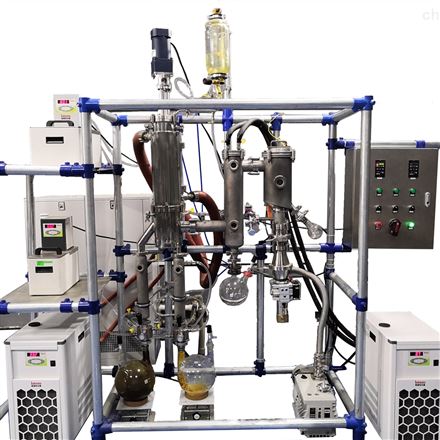
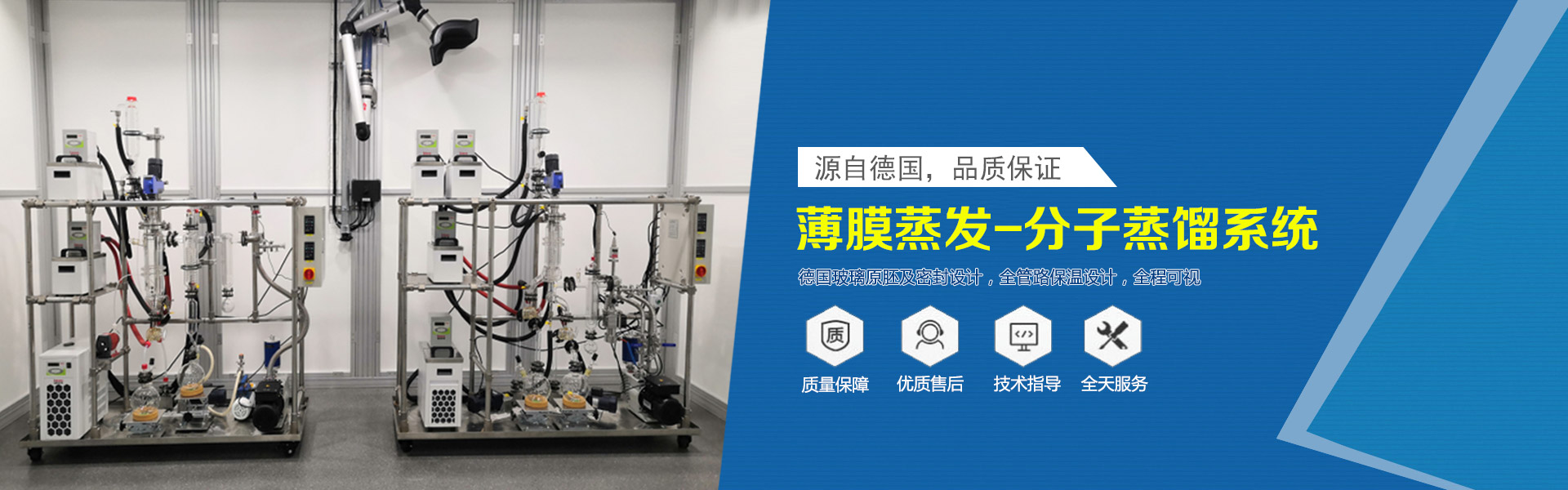
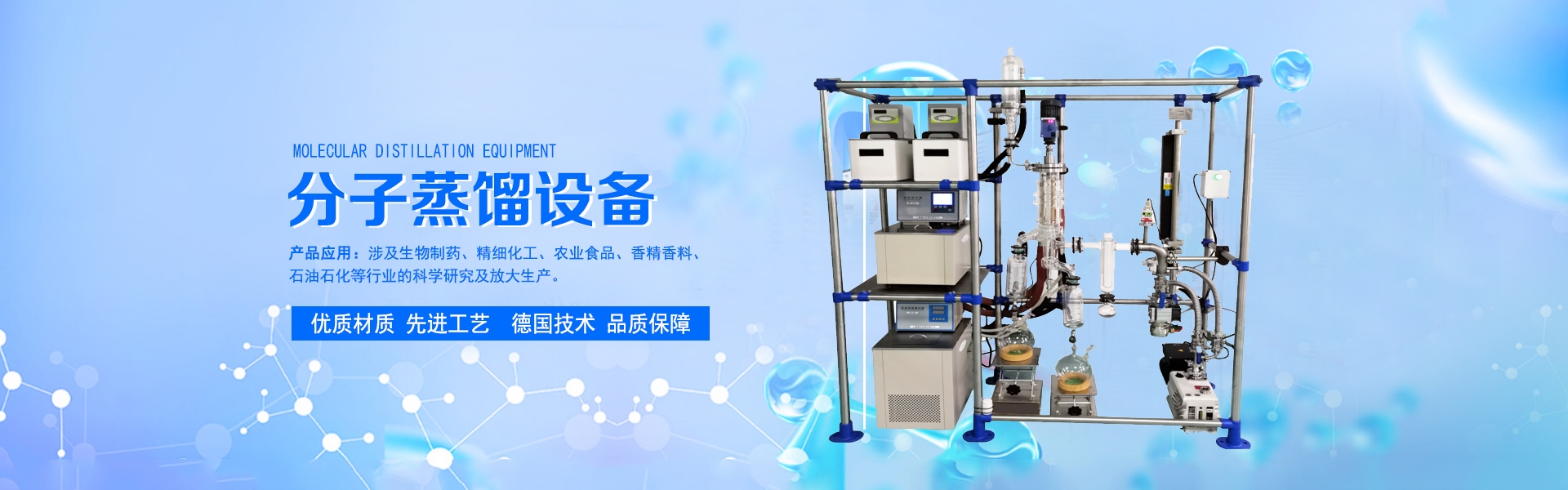
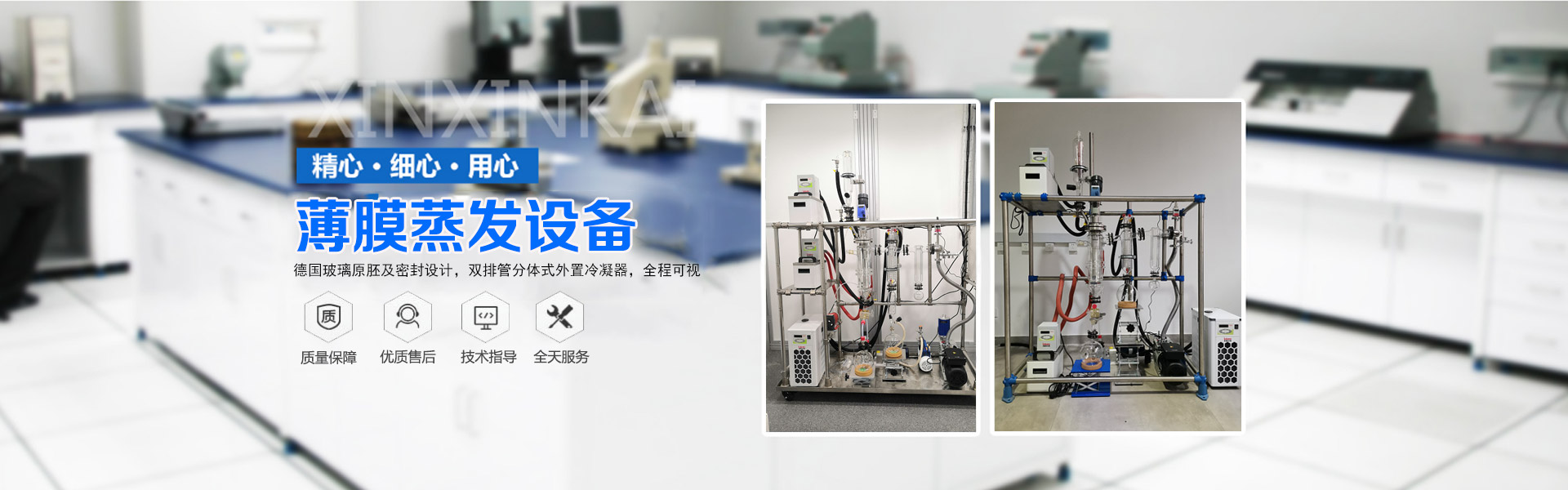
Molecular distillation is a specialized liquid separation technique that originated in the 1920s. With the advancement of vacuum distillation technology and deeper research into the theory of gas movement under vacuum conditions, molecular distillation has gradually gained prominence. Today, it has become an important branch of separation technology. The molecular distillation unit, also known as a short-path distillation unit, is an instrument that performs continuous distillation under high vacuum conditions (with residual gas pressure of 0.1 Pa). The molecular distillation process differs from the traditional distillation process. Traditional distillation separates at the boiling point temperature, where evaporation and condensation are reversible and a balance is formed between the liquid phase and vapor. In contrast, the molecular distillation process is irreversible and occurs at temperatures far from the substance's atmospheric pressure boiling point. More accurately, it is a process of molecular evaporation.
1. The average free path of molecular motion. Any molecule experiences a continuously changing free path during its movement. The average free path of a short-path molecular distillation unit is the average free path over a certain period of time. Set VM as the average speed of the molecule, f as the collision frequency, and m as the average free path. Therefore, m = VM/f, so f = VM/m.
2. Langmuir investigated the evaporation phenomenon of pure substances under high vacuum. Theoretically, compared to ordinary distillation, the molecular evaporation rate of pure substances increases by a factor of 1/2 of (MB/MA). Therefore, molecular distillation technology can be used to separate mixtures of substances with similar volatility but different molecular weights.
3. Basic Principle of Molecular Distillation. According to the formula for the average free path of molecular motion, different types of molecules have different average free paths, i.e., different types of molecules.