



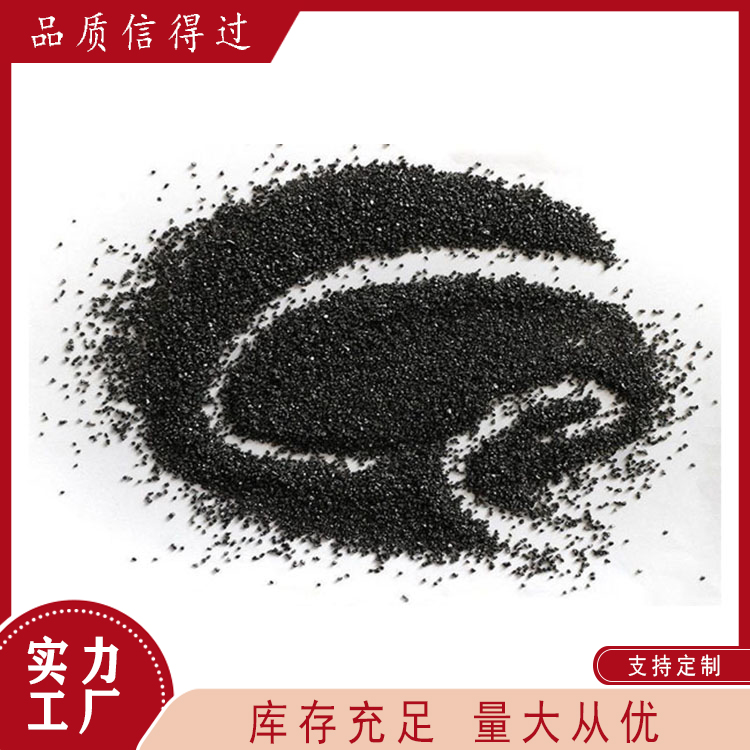


Black silicon carbide applications
Black silicon carbide, due to its stable chemical properties, high thermal conductivity, low thermal expansion coefficient, and good wear resistance, finds applications beyond abrasive use, such as: coating silicon carbide powder with special technology on the inner wall of a turbine runner or cylinder block can enhance its wear resistance and double its service life; it is used to produce refractory materials that are resistant to thermal shock, have a small volume, light weight, and high strength, with excellent energy-saving effects. Low-grade silicon carbide (containing about 85% SiC) is an excellent deoxidizer, which accelerates steelmaking and facilitates control over the chemical composition, thereby improving steel quality. Additionally, silicon carbide is extensively used in the production of electrical heating elements, such as silicon carbide rods.
Silicon carbide is extremely hard, boasts excellent thermal conductivity, and is a semiconductor that can resist oxidation at high temperatures.
Silicon carbide (SiC) is produced by high-temperature smelting in a resistance furnace, using quartz sand, petcoke (or coke), and wood shavings as raw materials. Silicon carbide also exists in nature as a rare mineral known as Moissanite.
Silicon carbide, also known as carborundum, is a widely used and cost-effective refractory material in modern high-tech applications that include carbon, nitrogen, and boron non-oxides. It can be referred to as steel shot or refractory sand.
Silicon carbide is produced by smelting quartz sand, petcoke (or coke), and wood shavings (with salt added for green silicon carbide production) in a resistance furnace at high temperatures. In China, industrially produced silicon carbide comes in two types: black and green, both of which are hexagonal crystals with a density of 3.20 to 3.25 and a microhardness of 2840 to 3320 kg/mm².
Including black silicon carbide and green silicon carbide, among which: green silicon carbide is produced mainly from petroleum coke and quartz stone, with salt added as an additive, and is smelted at high temperatures in a resistance furnace. It has a hardness between corundum and diamond and a higher mechanical strength than corundum. Common silicon carbide abrasives have two different crystals: green silicon carbide, containing over 97% SiC, mainly used for grinding hard gold-containing tools. The other is black silicon carbide, with a metallic luster, containing over 95% SiC, stronger than green silicon carbide but with lower hardness, mainly used for grinding cast iron and non-metallic materials.
Black silicon carbide is produced from quartz sand, petroleum coke, and high-quality silica stone, and is refined through high-temperature smelting in a resistance furnace. It has a hardness between that of corundum and diamond, with higher mechanical strength than corundum, and is brittle and sharp.
Silicon carbide comes in two common varieties: black silicon carbide and green silicon carbide, both belonging to α-SiC. ① Black silicon carbide contains approximately 98.5% SiC and has higher toughness than green silicon carbide. It is mostly used for processing materials with low tensile strength, such as glass, ceramics, stone, refractory materials, cast iron, and non-ferrous metals. ② It has excellent self-sharpening properties and is commonly used for processing hard alloys, titanium alloys, and optical glass, as well as for honing cylinder liners and finishing high-speed steel cutting tools. Additionally, there is cubic silicon carbide, which is a yellow-green crystal produced through special processes. The abrasive tools made from it are suitable for ultra-fine machining of bearings, capable of reducing surface roughness from Ra32 to 0.16 micrometers to Ra0.04 to 0.02 micrometers in a single pass.
