



Standard sizes include 600*1200*50mm, 600*2400*50mm, 600*1800*50mm, and 1200*1200*50mm, with thickness options of (50mm, 75mm, 80mm, 100mm). Custom sizes available upon buyer's request; waste calculation extra.
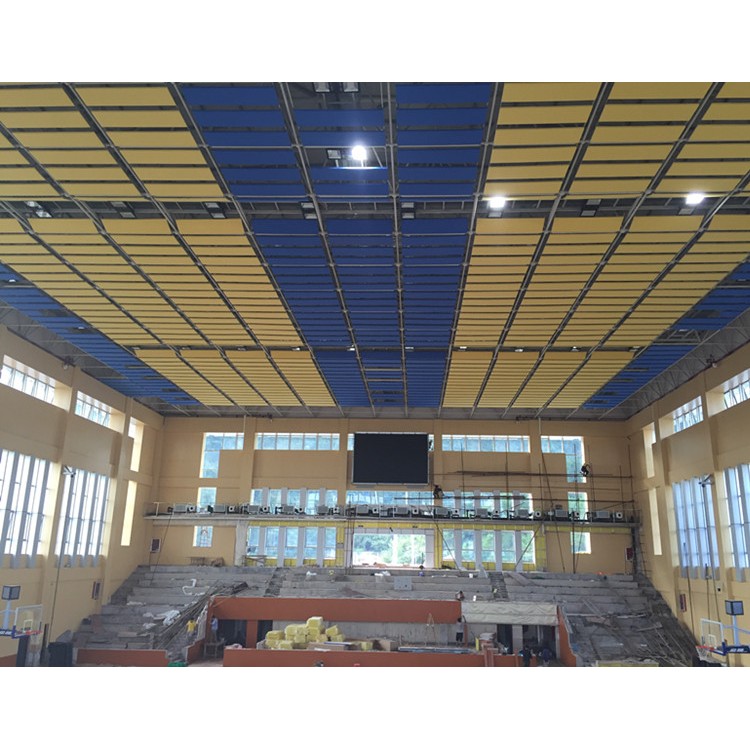
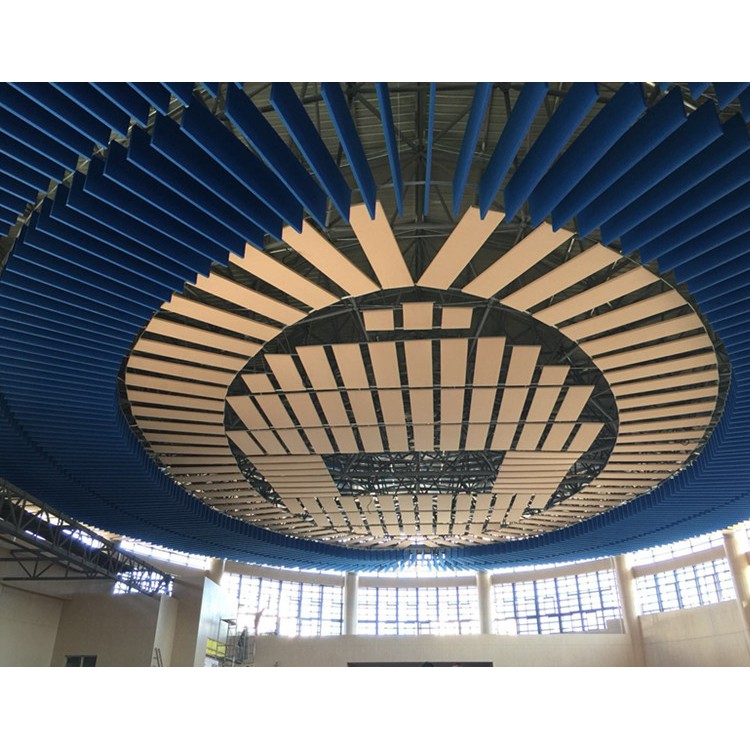
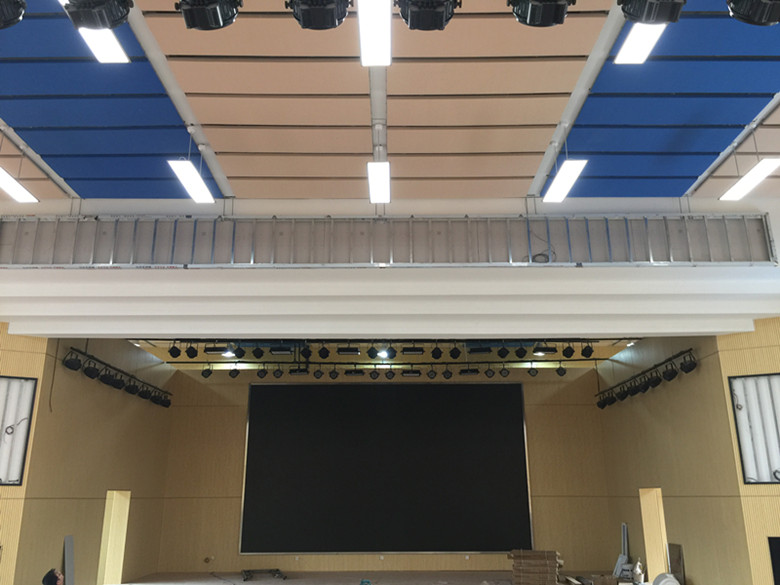
An acoustic absorber is a suspended element dispersed throughout the upper area of a building space, designed to reduce indoor noise or improve the room's acoustics. It features minimal material use, light weight, cost-effectiveness, high absorption efficiency, flexible arrangement, and ease of installation. Acoustic absorbers come in various shapes such as plate-like, cuboid, cylindrical, conical, and spherical, depending on the building's usage, area, height, structural form, decorative requirements, and sound source characteristics. The plate-like structure is the simplest and most widely used. Acoustic absorbers are commonly used in indoor sports halls, where their diverse shapes and arrangements enhance the room's decorative effect. Most importantly, their sound absorption properties prevent echo defects in large halls and effectively reduce the reverberation time.
One, Principle of sound-absorbing materials for space absorption
Space sound absorbers have a higher sound absorption efficiency compared to sound-absorbing materials on indoor surfaces, with the same projected area. This is due to the larger effective sound-absorbing area of space sound absorbers (including the top, bottom, and sides of the space sound absorber); additionally, as sound waves are reflected multiple times between the top of the sound absorber and the building's ceiling, they are absorbed multiple times, increasing the absorption amount and enhancing the efficiency. The improvement in absorption efficiency at medium to high frequencies is typically most noticeable. The sound absorption performance of space sound absorbers is commonly represented by the effective sound-absorbing volume of individual sound absorbers at different frequencies. The effectiveness of space sound absorbers in noise reduction (or reducing reverberation time) primarily depends on the number of sound absorbers, the spacing between them, the material, and the structure, as well as the sound field conditions within the building space. If the original indoor surface has little sound absorption, there is more reflected sound, and the reverberation time is long.
Section 2: Materials and Structure of Sound Absorbing Elements
Common acoustic spaces are composed of a framework, a facing layer, and an absorbent material. The choice of material should be based on the size, stiffness, and decoration requirements of the acoustic space. The framework can be made of wood, angle iron, thin-walled steel, aluminum frames, etc. The protective facing layer can be fire-resistant fabric, soundproof felt, or glass fiber cloth. The absorbent material typically consists of ultra-fine glass wool wrapped in glass fiber cloth, with a filling density of either 48KG or 64KG of sound-absorbing cotton. The thickness should be selected within a range of 5 to 10 centimeters based on the sound source frequency spectrum characteristics.
Three, the suspended quantity of acoustic absorbers in space
The number of suspended acoustic absorbers should be calculated and determined based on the acoustic absorption characteristics of the absorbers and the additional absorption required to reduce indoor noise (or control the reverberation time). When designing with plate-type acoustic absorbers, if the total area of the absorbers is equivalent to 30% to 40% of the building's roof area, the acoustic absorption efficiency of the plate-type absorbers can reach the optimal value. In actual projects, to meet the requirements of noise reduction or controlling the reverberation time, the total area of the acoustic absorbers should ideally be 50% to 60% of the building's roof area. Increasing the number of acoustic absorbers may, however, negatively impact the overall acoustic absorption performance of the space, leading to financial waste.
Four: Hanging Methods for Acoustic Absorbers
Acoustic absorbers are typically suspended from the ceiling of a building space, often hanging from the ceiling itself. Board-like acoustic absorbers can be suspended horizontally, vertically, or in a combination of both, with the same total area yielding similar noise reduction effects. The distance from the ceiling for horizontally suspended board-like absorbers is generally around 1/5 to 1/7 of the room's net height. Generally speaking, considering the ease of installation, acoustic absorbers are suspended below the steel framework at the building's ceiling, which places them at about 1/5 to 1/7 of the room's net height to meet acoustic and decorative requirements. If conditions permit, they can be hung lower, closer to the sound source. To enhance the architectural decoration effect of suspended acoustic absorbers, their form, color, and hanging method should be considered comprehensively. If a certain artistic pattern is woven into the suspension of acoustic absorbers and coordinated with lighting, ventilation, and architectural decoration, the overall effect will be even better.
Five. Application of Acoustic Absorbers
Broadly applicable in indoor gymnasiums, basketball courts, badminton halls, sports venues, swimming pools, noisy factories, as well as radio and TV studios, recording rooms, studios, schools, grand theaters, libraries, cultural centers, auditoriums, multi-functional halls, conference rooms, and concert halls, where high-quality sound is required.
